The Myth Of the Rational Market
Martin Wolf about The End Game

Finanskrisen -
The Great Recession
Home - Index - News - Krisen 1992 - EMU - Deflation.com - Economics - Cataclysm - Rebalancing - US Dollar - Houseprices - Contact
Stabiliseringspolitik
Ernst Wigforss ”Har vi råd att arbeta?”
Grundbultsfrågan: Hur blir S = I ???
Savings and investment, being different activities carried on by different people
Man återkommer ständigt till Keynes och Hayek. Har den ekonomiska "vetenskapen" inte kommit längre?
Rolf Englund blog 8 juli 2014
Varoufakis: A balanced capitalist economy requires a magic number, in the form of the prevailing real (inflation-adjusted) interest rate.
How do free marketeers convince themselves that there exists a single real interest rate (say, 2%)
that would inspire investors to funnel all existing savings into productive investments
and spur employers to hire everyone who wishes to work at the prevailing wage?
Yanis Varoufakis Project Syndicate 19 March 2019
The idea of secular stagnation is that the private economy — unless stimulated by extraordinary public actions especially monetary and fiscal policies
and, or, unsustainable private sector borrowing — will be prone to sluggish growth caused by insufficient demand.
Lawrence H. Summers, FT 6 May 2018
Själv brukar jag med en dåres envishet upprepa följande ord, första gången den 5 december 2009
Jag tycker det är skriande uppenbart att räntan världen över är för låg och att en större del av stimulanserna borde ske via finanspolitiken.
Men väljarna och därmed deras medlöpande politiker är rädda för budgetunderskott och vill hellre att villaägarna skall låna än att staten skall göra det.
Why is macroeconomics so hard to teach?
That requires an intuitive feel for the subject. It is not enough to crank through the equations.
The Economist 9 August 2018
China has avoided a recession for a quarter-century
Macroeconomists should think about credit policy as an important supplement
to the traditional fiscal and monetary tools of recession-fighting.
Noah Smith 19 July 2018
Rethinking macroeconomics
In January 2018, a group of economists convened by Oxford published
their reply to Queen Elizabeth’s question of why nobody in the profession saw the 2008 crisis coming
FT Collections
The Phillips Curve is right at the centre of the most important economic debate of the moment
John Authers FT 16 March 2018
Markets are back in fairyland again.
For many investors, the regret of missing out on what may well be a once-in-a-generation bull market
overshadows any anxiety about the next crash. Animal spirits are all too evident.
Amin Rajan FT 16 March 2018
---
What Robert Shiller, a Nobel economics laureate at Yale University, calls “narrative economics”
Neither central bankers nor Wall Street ever see these new style recessions coming because, in fact,
they can't be detected from even an astute reading of the macro-economic tea-leaves.
David Stockman 9 March 2018
Self-evidently, that's because the triggers for recession are embedded in the interstitial bubbles of the financial markets;
and while the latter may be obvious to the outsider or even a visiting Martian,
they are adamantly denied by the Wall Street stock peddling apparatus and are invisible to the Fed's financially clueless Keynesian academics and policy apparatchiks
who remain glued to their macroeconomic dashboards.
---
What Event Will Sink the Stock Market? Yields? Tariffs? Trump?
The catalyst is "sentiment" not an event.
Mike Mish Shedlock 15 March 2018
When the economy’s human and capital resources are fully utilized (meaning actual GDP is equal to potential GDP), fiscal stimulus just generates inflation and higher interest rates. Even if the extra demand might create some wage pressure, it will be met with higher inflation, so real wages – the paycheck’s actual buying power – won’t change at all.
The problem is that those making that argument are implicitly asserting that they know that the “natural rate of unemployment” – the lowest rate consistent with stable inflation – is roughly equal to the current unemployment rate. That is, they believe we’re at full employment. But the truth is they have no way of knowing that, and one key indicator – inflation – suggests they may be wrong.
Jared Bernstein, chief economist for Vice President Joe Biden, at John Mauldin 18 February 2018
NAIRU: not just bad economics, now also bad politics
Janet Yellen has long believed it’s possible for “too many” Americans to have jobs. In her view,
shared by many of her generation in the economics profession,
consumer prices will rise too fast unless millions of people remain unemployed.
Matthew C Klein, FT Alphaville 24 January 2018
What macroeconomists actually do
Problems can be traced back to two intellectual revolutions
Martin Sandbu 16 January 2018
Rethinking macroeconomics
The deepest effort to date to account for how economics failed us in the crisis
Martin Sandbu 15 January 2018
The very toxin that sparked the crisis is relied on to reboot economies in the Americas and Europe.
Pascal Blanque and Amin Rajan, FT 4 January 2017
Global debt is like the sword of Damocles — an ever-present danger. It stands at about 330 per cent of annual economic output, up from 225 per cent in 2008
Central banks need to reverse their policies, since continuing low rates and excessive leverage may well result in an explosive cocktail of multiple asset price bubbles.
Reversal, however, means that central banks will be unable to control volatility and keep a floor under asset values — something they have relied on to promote excessive risk-taking.
Olivier Blanchard and Lawrence H. Summers
Rethinking Macroeconomic Policy
“We’ve learned over the past 10 years that fiscal policy can have pretty powerful effects
in deep recessions when central banks have hit very low policy interest rates,”
Gemma Tetlow, FT 13 November 2017
There was broad agreement in 2008 and into 2009 that borrowing should be allowed to rise to cushion the impact of the financial crisis. But by 2010, with growth returning, policymakers were keen that it should be scaled back to reassure markets that government debt would not get out of hand, and so head off a sharp rise in borrowing costs.
Many economists agreed, but their views have since shifted.
“We’ve learned over the past 10 years that fiscal policy can have pretty powerful effects in deep recessions when central banks have hit very low policy interest rates,” says Alan Auerbach, professor of economics at Berkeley. “We’ve also learnt, at least from the experience in the UK and the US, that we would have benefited from... turning less immediately to measures aimed at deficit reduction.”
Under these circumstances, there is a strong case for loosening fiscal policy and borrowing more. This is especially true for policies that put money directly into the hands of people who will spend it quickly and counteract sluggish demand, and for investments that have long-term benefits.
“Economies do not self-stabilise,” said Olivier Blanchard, at a conference on macroeconomic policy, on lessons of the
financial crisis for monetary and fiscal policy.
Rethinking Macroeconomic Policy, Conference Coordinators: Olivier Blanchard and Lawrence H. Summers.
Central banking is hard. But the Federal Reserve Bank of San Francisco makes it look easy.
Matthew C Klein, FT Alphaville 30/10 2017
They have a game called “Chair the Fed” where you get to set the level of short-term interest rates once every three months.
(The European Central Bank has its own game, which we once wrote about, that was similarly limited but also more fun thanks to the colourful characters.)
Basil Fawlty’s “Don’t mention the war!” has given way to something nasty:
non-German macroeconomists over the euro and global reflation — with epithets like “ordo-liberal” and worse flying around.
Former IMF staffer Peter Doyle, FT Alphaville 17 October 2017
Central bankers have one job and they don’t know how to do it
Matthew C Klein, FT Alphaville 18 Octobr 2017
World’s top economists worry about tools to fight economic downturn
The question is whether there are enough weapons to fight the next crisis when it comes
FT 13 October 2017
With interest rate cuts unlikely to be sufficiently effective in another downturn because they will not start high enough, Mr Blanchard and Lawrence Summers, the former treasury secretary, advocated much more effective and planned use of fiscal policy.
In a joint presentation, they called for governments to put in place plans for aggressive fiscal stimulus in the event of a downturn.
Central bankers face a crisis of confidence as models fail
inflation is not behaving in the way economic models predicted
FT 11 October 2017
Fed has no reliable theory of inflation, says Former Fed governor Tarullo
FT 4 October 2017
Politicians are kept from taking full responsibility for battling recessions by the intellectual baggage of past decades.
Some cling to the notion that stimulus is unhelpful, risky and hard. Such views need updating.
The Economist, 7 September 2017
Economists of all stripes argued that the “multiplier” on stimulus—the amount by which a dollar of borrowing raises GDP—is usually low. Households save their higher incomes in expectation of offsetting future tax rises
But studies since the Great Recession tend to find that multipliers are substantially higher than once thought, particularly when monetary policy is constrained. Multipliers in such cases are often closer to two, ie, GDP increases by nearly twice the size of the stimulus.
This article appeared in the Finance and economics section of the print edition of under the headline "The borrowers"
About The Multiplier at my blog
One of the inescapable truths of the past 10 years is that
the central bank policies introduced to mitigate the crisis may be sowing the seeds of another one.
As in the run-up to 2007, ultra-low interest rates have been distorting the world’s finances.
Patrick Jenkins, FT’s financial editor, 31 August 2017
Western capitalism has few sacred cows left.
It is time to question one of them: the independence of central banks from elected governments.
Yanis Varoufakis, Project Syndicate 29 August 2017
Perhaps the macro question – is why low unemployment isn’t sparking higher inflation
as the fabled Phillips curve says it should.
John Mauldin, 2 September 2017
Real interest rates aren’t particularly low
FT Alphaville 17 August 2017
Why there was no New Deal after the Great Recession
Since the financial crisis there has been a lack of boldness in thought, as well as action
Martin Sandbu, FT 24 July 2017
Tillväxten steg och arbetslösheten föll. Men det kom även bakslag, som 1937
när Roosevelt tvingade skära i bidragen för att minska statsskulden som ökat kraftigt och
man lyckades aldrig riktigt ta sig ur depressionen.
Det var egentligen Hitler som lyckades få fart på den amerikanska ekonomin igen.
Therese Larsson Hultin, SvD 6 juli 2017
Yet today, I have come around to the idea that the debt problem is so pervasive, there is only way one forward - inflate.
We are going to end up there anyway, so let’s just inflate away the burden and restart with a system that prevents this from ever happening again.
Kevin Muir via The Macro Tourist blog, zerohedge, 7 April 2017
The US president signed an executive order on Friday 2017-03-31
calling for a 90-day country-by-country and product-by-product
study of the US’s $500bn annual trade deficit.
FT 31 March 2017
But anyway, in macro, most models use Rational Expectations,
so let's think of "behavioral" as just meaning "non-RE".
I'm seeing macro people taking behavioral ideas more seriously.
Noahpinion 15 January 2017
The orthodox view is that the US can always achieve full employment by active use of fiscal and monetary policy tools.
Experience since 2000 and especially since the financial crisis suggests this may be difficult.
As I have argued elsewhere, huge current account surpluses in some countries forced deficit countries into financial excesses
as an (ultimately unsustainable) way to maintain demand in line with potential output.
Martin Wolf, FT 31 January 2017
The new defense of DSGE
It's so silly that I almost suspect Christiano et al. of staging a false-flag operation to get more people to hate DSGE modelers.
Noah Smith 15 November 2017
The burden of proof is on the DSGE-makers, not on the critics. Christiano et al. should look around and realize that people outside their small circle of the world aren't buying it.
Dynamic stochastic general equilibrium modeling (abbreviated DSGE or sometimes SDGE or DGE) is a branch of applied general equilibrium theory that is influential in contemporary macroeconomics.
Wikipedia
The Need for Different Classes of Macroeconomic Models
This is is my third piece on dynamic stochastic general equilibrium models (DSGEs)
Olivier Blanchard (PIIE) January 12, 2017
The first, a PIIE Policy Brief, was triggered by a project, led by David Vines, to assess how DSGEs had performed during the financial crisis (namely, badly) and how they could be improved.
That brief went nearly viral (by the standards of blogs on DSGEs).
Robert Shiller presidential address to the American Economic Association
It was something out of the usual — as we should expect from as fertile, contrarian and original thinker as Shiller
— namely a plea for economists to take seriously the importance of “narrative epidemics”.
Martin Sandbbu, FT 12 January 2017
Although lots of jobs were created in the impressive recovery from the dark days of the global financial crisis,
other elements of the labor market did not respond as would be expected based on historical experience.
Mohamed A. El-Erian, Bloomberg 4 January 2017
Wage growth has remained rather anemic, even in the context of indicators of labor shortages.
In addition, the labor participation rate, at 62.7 percent in November 2016, has failed to bounce back from multidecade lows,
while the employment-to-population rate seems stuck at a rather low level of 59.7 percent.
Cyclical factors, including an unbalanced macroeconomic policy stance that has relied excessively and for too long on unconventional monetary measures and made insufficient use of fiscal policy, have played a role.
The inability of the world’s major central banks to create either inflation or stronger demand growth
has sustained a needed debate over whether the way monetary policy is conducted in most rich countries is ripe for reform.
Martin Sandbu, FT 4 January 2017
The main argument for a higher inflation target was put forward by Olivier Blanchard and his colleagues in 2010:
a higher inflation target makes it easier to cut real (inflation-adjusted) rates deeper still should the economy require it.
Since then, a higher inflation target has won steadily more adherents.
Under inflation targeting, a central bank is only committed to bring inflation back to the 2-per cent rate.
Under level targeting, it is committed to bringing the level of prices or NGDP back to the desired trend
The Case For Higher Inflation
Olivier Blanchard, currently the chief economist at the IMF,
conclusion, central banks have been setting their inflation targets too low
I’m not that surprised that Olivier should think that;
I am, however, somewhat surprised that the IMF is letting him say that under its auspices. In any case, I very much agree.
Paul Krugman, Febr 13 2010
An Extraordinary Time: The End of the Postwar Boom and the Return of the Ordinary Economy
Book by Marc Levinson, formerly finance and economics editor of The Economist
The fiscal theory of the price level (FTPL), a macroeconomic doctrine that has lately been receiving considerable attention.
In August, at the annual conference of central bankers in Jackson Hole, Wyoming, Princeton’s Christopher Sims provided a lucid explanation of the theory.
Koichi Hamada, Special Economic Adviser to Japanese Prime Minister Shinzo Abe, Project Syndicate, 28 December 2016
Sims explained, contrary to popular belief, aggregate demand and the price level (inflation) are not dictated only – or even primarily – by monetary policy.
kansascityfed.org/~/media/files/publicat/sympos/2016/econsymposium-sims-paper.pdf?la=en
The most far reaching speech at the Federal Reserve’s Jackson Hole meeting
was the contribution on the fiscal theory of the price level (FTPL) by Professor Christopher Sims
Gavyn Davies, FT 29 Auggust 2016
The low-for-long era is over.
This summer, the BoJ and then the ECB both changed their mantra
from whatever it takes to less is more targeting steeper yield curves
and the transmission mechanism of stimulus to the real economy, moving away from unlimited asset purchases.
Alberto Gallo, FT 27 December 2016
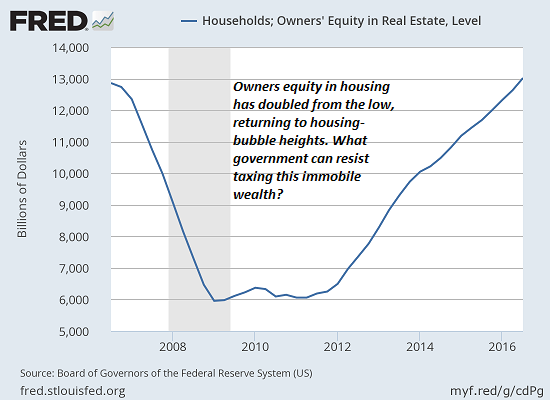
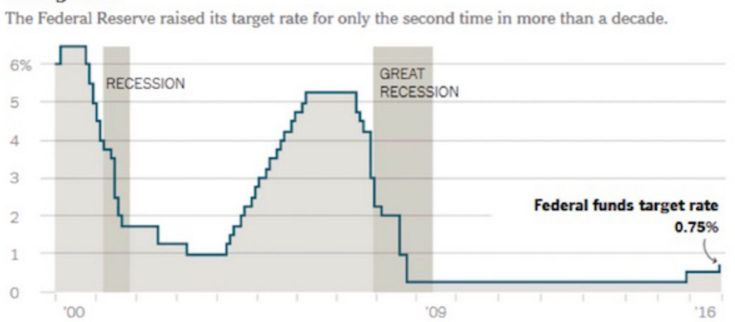
Today’s young Wall Street hotshots have never seen anything like that.
To them the jump from 0.5% to 0.75% must seem like a big deal.
It’s really not.
I would start with a fundamental reappraisal of modern macroeconomic governance
— from independent central banks and inflation targeting to deregulated financial markets and fiscal policy targets.
Put simply, if we, the liberal establishment, fail to do this, the populists will do it for us.
Wolfgang Münchau, FT 18 December 2016
Much of what we today think of as normal was established quite recently.
Central banks were not always independent. Direct inflation targeting is common today, but was unknown before the 1990s.
These observations are mild compared with those of Paul Romer, chief economist of the World Bank,
who has written a devastating critique of his profession, comparing it with string theory in physics.
The latter was once criticised by well-known physicists as “not even wrong”.
Mr Romer portrays modern macroeconomics as a racket held together by people who protect their influence
The state of Economics as a science
Era of quantitative easing is drawing to a close
arguably the greatest monetary policy experiment since John Law began dabbling with fiat paper money in France
Robin Wigglesworth, FT 8 December 2016
...
Not a credit crunch yet, but the ground is shifting
Short-term interest rates are the tectonic plates of financial markets.
They move slowly but have a nasty tendency to reveal buildings built on flimsy foundations.
Robin Wigglesworth 8 August 2018
Mr Mnuchin plans that would restore the status of the Treasury department as the vital driver of economic policy.
For those who can remember the pre-crisis era, it felt like a throwback to heavyweight predecessors such as
Robert Rubin, Lawrence Summers and James Baker III.
FT 1 December 2016
Robert Rubin, Lawrence Summers and James Baker III
Treasury Secretary Henry Paulson
John Connally, Nixon’s secretary of the Treasury, famously told the Europeans that
the dollar “is our currency, but your problem”.
On November 22, 1963, he was seriously wounded while riding in President Kennedy's car in Dallas, when the president was assassinated. Connally does not endorse the conclusions of the Warren Commission. When asked if he believed the Warren Commission's findings he said: "Absolutely not.
I do not, for one second, believe the conclusions of the Warren Commission."
Martin Sandbu/Brad DeLong four serious diagnoses of the ills of the Global North.
FT 4 November 2016
They are: A Bernanke global savings-glut.
A Krugman-Blanchard return to ‘depression economics’.
A Rogoffian-Minskyite crisis of overleverage and debt overhang.
A Summers secular-stagnation chronic crisis.
DeLong points out that each leads to different policy recommendations
Monetary policy in a low-rate world
Martin Wolf, FT 13 Sepptember 2016
Some of the greatest cheerleaders for fiscal tightening a few years back are undergoing a Damascene conversion
that is something to behold.
Martin Sandbu FT 30 November 2016
In its latest Economic Outlook, the OECD gives a thumbs-up to Donald Trump’s plans(if that is what they are)
to enact a large fiscal stimulus and increase infrastructure spending
When the dust settled, I was left with a profound sense of sadness over
our global economic leadership’s obvious lack of understanding of the real world.
John Mauldin, 4 September 2016
The rich world’s central banks need a new target
Advantages in targeting the level of nominal GDP
The Economist 27 August 2016
Quantitative easing's failure to quash the threat of deflation
is finance's equivalent of the bump in the data that alerted physicists
to the possibility of a new boson.
Mark Gilbert Bloomberg 18 August 2016
John Williams, the president of the Federal Reserve Bank of San Francisco:
Central banks need to consider aiming for a higher inflation target
FT 15 August 2016
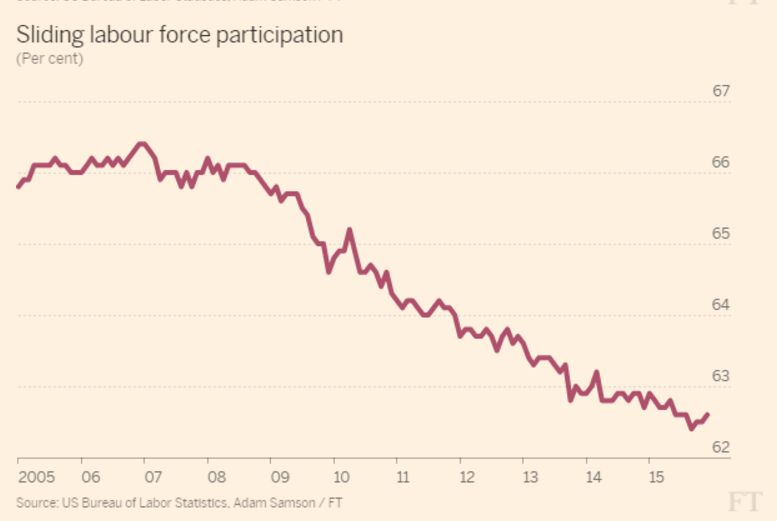
Even if unemployment — the share of workers who say they want a job but can’t find one — is low,
the share of the prime-age (25-54-year-old) population in work is only 78 per cent.
That is two percentage points below the 2007 rate, and four percentage points
— some 5m missing jobs — below the 2000 peak.
Martin Sandbu 8 August 2016
In 2013 economists at the IMF rendered their verdict on these austerity programmes:
they had done far more economic damage than had been initially predicted, including by the fund itself.
What had the IMF got wrong when it made its earlier, more sanguine forecasts?
It had dramatically underestimated the fiscal multiplier.
The Economist print 13 August 2016
Highly Recommended
We are all Keynesians now, so let's get fiscal
Monetary policy is close to the limits.
Ambrose Evans-Pritchard 4 August 2016
In his latest just released monthly letter, Bill Gross lays out the global economy as an analogy to Monopoly
where the narrative only works if everyone gets $200 in cash on every rotation around the board.
It’s the $200 of cash (which in the economic scheme of things represents new “credit”) that is responsible for the ongoing health of our finance-based economy.
Without new credit, economic growth moves in reverse and individual player “bankruptcies” become more probable.
And without banks creating new loans and injecting money into the broader economy, economic activity grinds to a halt.
The Brave New Uncertainty of Mervyn King
Paul Krugman, The New York Review of Books, Issue 14 July 2016
As a biographer and aficionado of John Maynard Keynes, I am sometimes asked:
“What would Keynes think about negative interest rates?”
Robert Skidelsky, Project Syndicate 24 May 2016
Monetary policy is not exhausted, and active use of it is essential.
But undue reliance on monetary policy is problematic.
Martin Wolf, FT 25 May 2016
Atlanta Fed's gauge of "sticky-price" inflation in the US
soared to a post-Lehman peak of 3 pc
Ambrose 2016-03-16
The subprime crisis, the euro crisis, the China slowdown, the oil bust.
But surely these events are connected.
Justin Fox, Bloomberg View 10 March 2016
I’m confident we would see improvement on all fronts
if we got GDP growth back up to 4% for a few years.
John Mauldin, March 7, 2016
Keynes’s General Theory at 80
First, Keynes invented macroeconomics – the theory of output as a whole.
Keynes’s second major legacy is the notion that governments can and should prevent depressions.
Milton Friedman reasserted the pre-Keynesian view of how market economies work.
Inflation, Friedman said, resulted from attempts by Keynesian governments to force down unemployment below its “natural” rate.
Robert Skidelsky, Project Syndicate 23 Febr 2016
The global financial crisis of 2008 bears this out.
The collapse discredited the more extreme version of the optimally self-adjusting economy;
but it did not restore the prestige of the Keynesian approach.
An even bigger shock to the pre-2008 orthodoxy than the collapse itself was the revelation of the corrupt power of the financial system
and the extent to which post-crash governments had allowed their policies to be scripted by the bankers.
To control financial markets in the interests of full employment and social justice lies squarely in the Keynesian tradition.
Students of economics eager to escape from the skeletal world of optimizing agents into one of fully-rounded humans,
set in their histories, cultures, and institutions will find Keynes’s economics inherently sympathetic.
Keynes’s magnum opus, The General Theory of Employment, Interest and Money, published in February 1936
Robert Skidelsky, Professor Emeritus of Political Economy at Warwick University and a fellow of the British Academy in history and economics, is a member of the British House of Lords
Martin Wolf: Helicopter drops might not be far away
FT 23 Febr 2016
Faced with the most severe economic downturn since the Great Depression, the U.S. Federal Reserve did the only thing it could: flood the financial system with liquidity.
The move to so-called easy money arguably saved the world from a worse fate and radically changed the economic backdrop as well as the landscape for financial markets.
Bloomberg via englundmacro.blogspot.se/2016/02/these-are-things-that-correlate
Today’s politicians and central bankers are fixated with fiscal targets and debt reduction.
As in the early 1930s, policy orthodoxy has pathological qualities.
Whenever they run out of things to say, today’s central bankers refer to “structural reforms”,
although they never say what precisely such reforms would achieve.
Wolfgang Münchau, FT 7 February 2016
- Visst beror dagens problem i ekonomin i någon mån på missgrepp i slutet av 80-talet och början av 90-talet.
Men i grunden har Sverige inte hamnat i en stabiliseringspolitisk kris.
Underskottet i statsbudgeten beror djupare sett på att vi försöker överbrygga en konjunkturnedgång
när det i själva verket handlar om en grundläggande strukturell förändring.
Mats Svegfors, Sv D 1994-09-10
Caruana and Greenspan about stocks and shocks
Rolf Englund blog 6 Febr 2016
Martin Wolf:
What might central banks do if the next recession hit while interest rates were still far below pre-2008 levels?
FT February 2016
Since we commonly understand why lowering interest rates stimulates debt and economic growth,
and less commonly understand how QE works, I’d like to explain it.
Ray Dalio, founder and head of hedge fund group Bridgewater, FT 25 January 2015
David Stockman On CNBC:
This Is A Dead Cat Bounce—-We’re At Peak Debt Headed For Recession
via Rolf Englund blog 2016-01-23
ZIRP and QE were terrible mistakes
Rolf Englund blog 4 January 2016
Solid growth is harder than blowing bubbles
The world economy has lost its last significant credit-fuelled engine of demand - China.
The result is almost certain to be a further boost to the global “savings glut” or, as Lawrence Summers calls it, “secular stagnation” — the tendency for demand to be weak relative to potential supply.
Martin Wolf, FT October 13, 2015
The Return of the Original Phillips curve?
Why Lars E O Svensson’s Critiq ue of the Riksbank’s Inflation Targeting is Misleading
Fredrik Andersson and Lars Jonung, June 2015
Some people never learn. They follow the same path that destroyed their finances in the past.
Wall Street is desperately packaging the increasing amounts of subprime slime in new derivatives of mass destruction and peddling them to clients, while shorting those same derivatives.
It’s called the Goldman Sachs method. When home prices begin to tumble, these derivatives will self-destruct again.
What is happening today is nothing more than rearranging the deck chairs on the Titanic.
zerohedge 25 September 2015
Why the Fed Buried Monetarism
Friedman’s “natural” rate was replaced with the less value-laden and more erudite-sounding “non-accelerating inflation rate of unemployment” (NAIRU).
Central bankers now seem to be implicitly (and perhaps even unconsciously) returning to pre-monetarist views:
tradeoffs between inflation and unemployment are real and can last for many years.
Anatole Kaletsky; Project Syndicate, 22 September 2015
The case for keeping US interest rates low
After nearly seven years of zero interest rates, the inflation of which critics warned is invisible
Martin Wolf, FT September 8, 2015
Arguably the most consequential question about today’s economic situation
— though one not asked with anywhere near enough urgency —
is why capital investment is not responding more forcefully to interest rates that in some places are at their lowest level in recorded history.
Martin Sandbu, FT Free Lunch, 26 August 2015
Noah Smith has picked up on the curious pattern as has Brad DeLong before him.
In short: companies can borrow at very low rates and that is also true for real (inflation-adjusted) borrowing costs.
But the return on invested capital — how much a new factory, equipment or business building boost profit relative to the amount it cost to build them — suggests business investment is as profitable as it has always been
Unpredictable does not mean unexplainable
Free Lunch is sceptical of anyone’s ability to “explain” financial market reversals.
Martin Sandbu, FT 24 August 2015
Andreas Cervenka om Stephen Williamson
Världsekonomins medicin sedan 2008 fungerar inte
Augusti 2015
Stephen Williamson, ekonom och chef på den amerikanska centralbanken Federal Reserves filial i St Louis, har gjort en genomgång av de åtgärder som Fed bedrivit sedan finanskrisen bröt ut på allvar 2008: nollränta och massiva stödköp av olika tillgångar med hjälp av nytryckta pengar.
Stephen Williamsons slutsats är att politiken misslyckats: den har inte fått upp inflationen och bevisen för att stödköpen blåst liv i ekonomin är i bästa fall svaga.
Eftersom vi talar om den strategi som dominerat hela världsekonomin sedan finanskrisen är det här lite tråkiga nyheter.
Stephen Williamson: New Monetarist Economics
http://newmonetarism.blogspot.se/
https://research.stlouisfed.org/econ/williamson/sel/
Stephen Williamson’s “New Monetarism” = F. A. Hayek’s Monetary Economics in a New Bottle with a New Label
- See more at: http://hayekcenter.org/?p=5262#sthash.8hHgMTjx.dpuf
What Hayek Can Teach Us About the Nature of Science, Argument, Economics and Knowledge -
See more at: http://hayekcenter.org/#sthash.opMeNi3F.dpuf
Debt Is Good
Paul Krugman, 21 August 2015
Rand Paul said something funny the other day. No, really — although of course it wasn’t intentional.
On his Twitter account he decried the irresponsibility of American fiscal policy, declaring, “The last time the United States was debt free was 1835.”
Wags quickly noted that the U.S. economy has, on the whole, done pretty well these past 180 years,
suggesting that having the government owe the private sector money might not be all that bad a thing.
The British government, by the way, has been in debt for more than three centuries,
an era spanning the Industrial Revolution, victory over Napoleon, and more.
I know that may sound crazy. After all, we’ve spent much of the past five or six years in a state of fiscal panic, with all the Very Serious People declaring that we must slash deficits and reduce debt now now now or we’ll turn into Greece, Greece I tell you.
Syntesen av Hayek, Friedman och Keynes,
mitt storhetsvansinniga och föga framgångsrika projekt
Rolf Englund 7 augusti 2015
Syntesen av Hayek, Friedman och Keynes,
mitt storhetsvansinniga och föga framgångsrika projekt
Rolf Englund 7 augusti 2015
IMF admits: we failed to realise the damage austerity would do to Greece
Guardian, 5 June 2015
Greece needs €60bn in new aid, says IMF
Financaial Times 2 Juky 2015
Monetary policymakers have run out of room to fight the next crisis
with interest rates unable to go lower, the BIS warns
Telegraph 28 June 2015
behavioral economics
The threat was that of a paradigm shift. This term, coined by philosopher Thomas Kuhn, refers to the dread moment
when scientists learn that up is down, black is white and everything they thought they understood about the world is wrong.
Noah Smith Bloomberg 1 June 2015
Simply put, we live in a world in which there is too much supply and too little demand.
The result is persistent disinflationary, if not deflationary, pressure, despite aggressive monetary easing.
Nouirel Roubini, MarketWatch Feb 2, 2015
Alex Stubb, the current prime minister, will be finance minister
in the three-party coalition that is seeking €6bn of additional cuts by 2021.
Finland is mired in a recession that has lasted for much of the past three years.
FT 27 May 2015
Knepet är att trycka nya centralbankspengar som sedan används för att köpa statspapper.
Räntorna pressas, och en viktig effekt är att valutan tappar i värde.
Men åtgärderna är kriminellt senkomna och beslutet tas långt efter både Storbritannien och USA.
OECD understryker att ECB:s sedelpress inte kommer att räcka för att lyfta Europas ekonomier.
DN-ledare 23 januari 2015
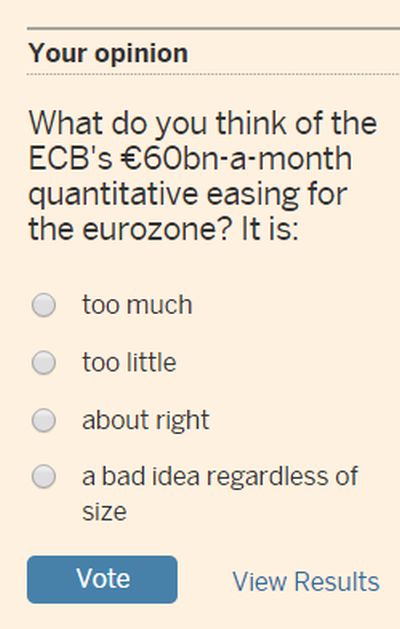
Financial Times, 22 January 2015
If investors perceived that the central bank of Italy, for example, were taking on unaffordable risks when buying Italian government bonds,
at that point the price of those bonds would fall, the implicit interest rate paid by the Italian government would rise,
and the whole point of QE would be blown up.
Robert Peston, BBC economics editor, 22 January 2015
Former Federal Reserve Chairman Ben Bernanke believes
history has already vindicated the novel efforts of the U.S. central bank to revive the economy after the financial crisis of 2008.
MarkerWatch 29 December 2014
Federal Reserve is headed down a familiar – and highly dangerous – path.
Steeped in denial of its past mistakes, the Fed is pursuing the same incremental approach
that helped set the stage for the financial crisis of 2008-2009.
The consequences could be similarly catastrophic.
Stephen S. Roach, Project Syndicate,23 December 2014
Why Paul Krugman is wrong
Central banks can always create inflation if they try hard enough
Ambrose Evans-Pritchard, 15 December 2014
Professor Paul Krugman is the world’s most influential commentator on economic issues by a wide margin.
It is a well-deserved ascendancy. He is brilliant, wide-ranging, readable, and the point of his rapier is very sharp.
He correctly predicted and described the Long Slump; though whether he did so entirely for the right reasons is an interesting question.
He demolished claims by hard-money totemists that zero rates and quantitative easing would lead to spiralling inflation in a global liquidity trap, as he calls it – or in a China-led world of excess supply and deficient demand, as others would put it.
So it is disconcerting to find myself on the wrong side of his biting critique.
----
Krugman:
Ambrose Evans-Pritchard, in an otherwise coherent description of Europe’s deflation risk, approvingly quotes Tim Congdon blithely
declaring that monetary reflation in a liquidity trap is no problem:
The interest rate is totally irrelevant. What matters is the quantity of money. Large scale money creation is a very powerful weapon and can always create inflation.
Sure. Just look, in the accompanying chart, at the rate of M1 growth in the US versus the Fed’s preferred measure of inflation
---
Ambrose:
Former Fed chair Ben Bernanke – no fool he – spelled out the powers of a central bank in his prophetic speech on deflation in 2002.
"Sufficient injections of money will ultimately always reverse a deflation.
Under a fiat money system, a government should always be able to generate increased nominal spending and inflation,
even when the short-term nominal interest rate is at zero."
Conundrum
Alan Greenspan couldn’t control long-term interest rates a decade ago,
and bond investors are betting Janet Yellen’s luck will be no better.
Bloomberg, 19 November 2014
Ultimately, economic progress depends on creativity.
That is why fear of “secular stagnation” in today’s advanced economies has many wondering how creativity can be spurred.
One prominent argument lately has been that what is needed most is Keynesian economic stimulus – for example, deficit spending.
After all, people are most creative when they are active, not when they are unemployed.
Robert J. Shiller, a 2013 Nobel laureate in economics, Professor of Economics at Yale University, Project Syndicate 18 november 2014
Germany’s policymakers deny the eurozone’s crisis-ridden countries a more active fiscal policy;
refuse to support a European investment agenda to generate demand and growth;
have declared a fiscal surplus, rather than faster potential growth, as their primary domestic goal;
and have begun turning against the European Central Bank (ECB) in the struggle against deflation and a credit crunch.
On all four counts, Germany is wrong.
Marcel Fratzscher, Project Syndicate 21 November 2014
The Germans have a name for their unique economic framework: ordoliberalism.
Wolfgang Münchau FT 16 November 2014
Finanskriskommittén
Riksgäldens garantiprogram för bankerna infördes 2008.
Sammanlagt ställdes bankgarantier för 354 miljarder kronor.
SvD Näringsliv 18 november 2014
Today’s most important economic illness: chronic demand deficiency syndrome.
David Cameron “red warning lights are once again flashing on the dashboard of the global economy”.
Martin Wolf, Financial Times 18 november 2014
The lights are again flashing red on the dashboard of the world economy, David Cameron warned yesterday.
Just to extend the metaphor, the plane is flying on empty, having pretty much exhausted its fiscal and monetary reserves,
and there is no sign of a safe landing strip in sight.
Jeremy Warner, Telegraph, 18 Nov 2014
The only things that seem to keep us going at all, raising us somewhat above the economic disaster zone of much of the rest of Europe,
are continued very high levels of deficit spending and the parallel stimulus of ultra accommodative monetary policy.
These are the things that truly mark the UK, and the much larger US economy, out from the pack – willingness to mortgage our futures in pursuit of short-term growth,
in the hope that this eventually provides the wherewithal to meet the payments on our growing debt obligations.
If everyone proceeded along these lines together, then perhaps a virtuous circle of growth – and thus declining indebtedness – might be generated.
But to do it alone while all around are engaged in a process of what might be called “competitive deflation” is in the long term completely unsustainable.
It is the economics of the Thirties we seem to be returning to
The US Federal Reserve and other western central banks have failed to anticipate this deflation environment,
persistently undershoot their inflation targets and appear powerless to reverse the trend.
At some point, we will probably wonder if it is time for the anti-deflation baton to pass to governments.
George Magnus, FT December 24, 2014
The writer is a senior independent economic adviser to UBS
Skriande uppenbart - Quantitative Easing
Ordinarily, the role of tax and spending in smoothing economic cycles is to stand back and let monetary policy do the job.
But these are not ordinary times. In the advanced world, weak growth and the threat of deflation have driven monetary policy towards its limit.
In such circumstances, fiscal policy has an important counter-cyclical role.
Financial Times editorial 7 November 2014
Within the rich world, the US recently exited QE3, its third bout of quantitative easing.
It might not have had to go so far had fiscal policy, expansionary immediately after the crisis, not encountered severe congressional dysfunction with fights over the debt ceiling and the fiscal cliff.
Normal times will not resume across the world economy for a while to come. Governments need to grasp the fact that fiscal policies matter for growth and inflation in the short as well as the long run.
Jag tycker det är skriande uppenbart att räntan världen över är för låg och att en större del av stimulanserna borde ske via finanspolitiken.
Det skrev jag på min blogg första gången
Gunnar Hökmark var en gång vänlig mot mig när jag på Timbro beklagade mig över att jag kände mig så ensam.
Är man först är man alltid ensam tröstade han mig med.
Ett annat lika klokt men kanske inte lika vänligt Hökmarskt bon mot var också träffsäkert
"Bara för att man själv förstår något är det inte säkert att andra inte förstår det".
John Maynard Keynes Is the Economist the World Needs Now
Politicians ignored Keynes in 1937. Doing so again could tank the economy
Peter Coy, Businessweek's economics editor, October 30, 2014
Quantitative easing may sown the seeds of the next great markets disaster
those who prophesied that these trillions of dollars of debt purchases would spark uncontrollable inflation have been proved wrong.
But QE could still prove toxic.
Robert Peston, BBC Economics editor, 29 October 2014
If there has been inflation, it has been in asset prices, rather than in items of everyday consumer expenditure.
The market price of the purchased bonds has been increased. And investors who received all those hundreds of billions of dollars from the Fed,
pumped that money into shares and property and even the bonds of other countries, from India to Canada.
QE probably helped prevent the Great Recession being deeper and longer.
But by inflating the price of assets beyond what could be justified by the underlying strength of the economy,
it may sown the seeds of the next great markets disaster.
Should there be another round of QE/helicopters, we must surely find a better way to inject the money.
Today’s method is enriching the uber-elites, with a painfully slow trickledown.
The better alternative is to stick the needle straight into the veins of the economy
- building roads, railways or nuclear power stations.
Ambrose 29 May 2013 with nice pic of Fed
Greenspan said that the Fed’s quantitative easing has failed in one of its goals, to spur demand.
Inflation is “dead in the water” because effective demand is “dead in the water,”
But quantitative easing has been a “terrific success” in getting the real rate of return on long-term assets down,
boosting all income-earning assets.
MarketWatch 29 October 2014
Det är oklart varför målet är just 2 procents inflation, med hur mycket Sverige har missat målet,
och hur stor skada detta eventuellt gjort för sysselsättningen.
Även om samtliga dessa frågetecken skulle rätas ut är det alltjämt tveksamt om riksbanken med sin styrränta kan göra något åt inflationen.
Andreas Bergh, kolumn SvD 3 november 2014
Riksbanken har sänkt räntan till noll.
Jag tycker det är skriande uppenbart att räntan världen över är för låg och
att en större del av stimulanserna borde ske via finanspolitiken.
Rolf Engund blog 28 oktober 2014
Carl-Johan Westholm och Jeffrey D. Sachs: alla investeringar are not equal
Rolf Englund blog 27 oktober 2014
The Greater Depression
First it was the 2007 financial crisis. Then it became the 2008 financial crisis.
Next it was the downturn of 2008-2009. Finally, in mid-2009, it was dubbed the “Great Recession.”
Late 2009, the world breathed a collective a sigh of relief. We would not, it was believed, have to move on to the next label,
which would inevitably contain the dreaded D-word. But...
J. Bradford DeLong, Project Syndicate, 28 august 2014
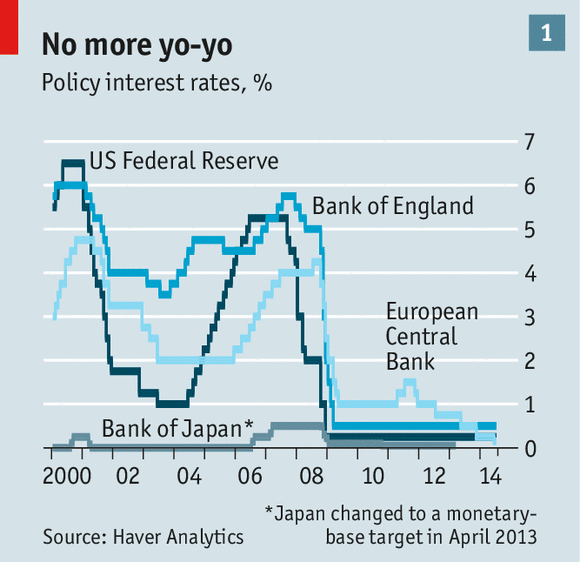
“secular stagnation”
Why inflation remains best way to avoid stagnation
Tim Harford, FT, August 21, 2014
The talk is of “secular stagnation” – a phrase which could mean two things, neither of them good.
High quality global journalism requires investment. Please share this article with others using the link below, do not cut & paste the article. See our Ts&Cs and Copyright Policy for more detail. Email ftsales.support@ft.com to buy additional rights. Normally, when an economy slips into recession, the standard response is to cut interest rates. This encourages us to spend, rather than save, giving the economy an immediate boost. Things become more difficult if nominal interest rates are already low.
Lagarde och Englund om deflation och inflation
Prof Sims, who won the Nobel Prize in 2011 for studying "cause and effect in the macroeconomy",
says monetary policy cannot do the trick either once interest rates have dropped to zero.
He dismisses the monetary effects of quantitative easing as trivial.
At best, he says, QE is a bluff intended to show resolve and change psychology.
Ambrose Evans-Pritchard, August 21st, 2014
Christopher Sims – a monetary expert, who now thinks money indicators have been rendered "essentially obsolete" by modern finance – says it may be impossible to reverse deflation in the Western economies by any normal means,
in which case we are in trouble.
Thomas Sargent and Christopher Sims win Nobel prize for economics
Centralbankerna i golfbunkern utan Keynes och ränta
Draghi is running out of legal ways to fix the euro
The ECB should starting buying equities and junk bonds. It should subsidise mortgages and consumer credit....
All these measures would be effective. Most would be illegal.
Wolfgang Münchau, FT 17 August 2014
Mr Draghi’s promise to buy eurozone government debt in the secondary markets,
known by the official name of outright monetary transactions.
This surely helped the bond market to recover, and took the heat out of the eurozone crisis.
But it was at best a partial victory because it made everybody, including the ECB itself, complacent. OMT ended all crisis resolution.
The ECB should starting buying equities and junk bonds. It should subsidise mortgages and consumer credit.
It could fund an investment programme in transport infrastructure, energy networks and scientific research, by buying debt to fund such projects at zero interest rates.
All these measures would be effective. Most would be illegal.
The one thing the central bank can do without any legal problems would be to drop the silly macroeconomic model – known as the Smets-Wouters model, after its authors – on which it has been relying for too long.
“Not without treaty change.”
It’s hard to believe, but almost six years have passed since the fall of Lehman Brothers
The crisis is by no means over. Recovery is far from complete,
and the wrong policies could still turn economic weakness into a more or less permanent depression.
In fact, that’s what seems to be happening in Europe as we speak.
Paul Krugman, New York Times 14 August 2014
European officials eagerly embraced now-discredited doctrines that allegedly justified fiscal austerity even in depressed economies (
And the European Central Bank, or E.C.B., not only failed to match the Fed’s asset purchases,
it actually raised interest rates back in 2011 to head off the imaginary risk of inflation.
Mr. Draghi & Co. need to do whatever they can to try to turn things around,
but given the political and institutional constraints they face,
Europe will arguably be lucky if all it experiences is one lost decade.
Ms Merkel does not say “no” to eurozone bonds. She says: “Not without treaty change.”
The German constitutional court in Karlsruhe would never allow Germany’s sovereign guarantee to be given to its eurozone partners
without them submitting to effective and centrally budgeted discipline.
Europe’s banking union is set to face a challenge in Germany’s constitutional court,
a development that threatens to generate renewed uncertainty over one of the main responses to the eurozone’s financial crisis.
EU’s banking union is illegal under German law because it was created without the necessary treaty changes.
Click
We academic economists knew what to do do deal with the financial crisis that started in 2007 and
to quickly restore normal levels of output relative to potential and of potential output growth.
But even though we knew what to do, we were not allowed to speak with one voice.
Brad DeLong, July 28, 2014
It was (a) not to do what Japan did in the 1990s, and
(b) take the advice of a long line of policy-oriented economists starting from the Say-Malthus debate of the 1810s and 1820s (which Malthus won) and
continuing through Mill, Bagehot, Wicksell, Keynes, Minsky, Kindleberger, Tobin, and many many others
But even though we knew what to do, we were not allowed to speak with one voice.
Other academic economists – including many whom I formerly counted as of note and reputation – elbowed their way into the debate.
They had either never bothered to learn the literature from Malthus to Tobin, had forgotten it, or were blinded by ideology.
They reached for simplistic models and methods that were clearly wrong
"Battle raging between the world’s leading macroeconomists"
The European Central Bank has found itself caught in the crossfire
The Bank for International Settlements’ call last month has reignited the debate over how to explain – and tackle –
the financial and economic turmoil that has persisted over the past six years.
The debate is so fierce, the viewpoints so distinct, that two of the world’s leading multilateral organisations,
the BIS and the International Monetary Fund, have completely different ideas on what the ECB’s next step should be
FT Money Supply blog 14 July 2014
Infrastrukturinvesteringar har blivit det fikonlöv bakom vilket åtstramningens kolportörer
gömmer det faktum att nu även de vill stimulera ekonomin genom ökad efterfrågan.
Rolf Englund blog 15 juli 2014
BIS
Investment by businesses is the key ingredient to cut our reliance on debt-fuelled current expenditure by consumers or the state
But there is a deeper issue to be tackled:
why does the economy have to be stimulated in artificial ways through the boosting of lending
Roger Bootle, Telegraph 6 July 2014
Leonid Bershinksy weeps over the cruel world that for some reason isn’t listening to Jaime Caruana of the BIS,
who warns that we must raise interest rates now now now.
Why is this prophet so lonely? And where are the bond vigilantes?
Paul Krugman, JULY 5, 2014
For decades, economic growth in America was driven by a powerful and sustainable force: increased consumption paid for by the rising incomes for middle-class and working-class Americans. But somewhere around 1980, that model broke down.
And now, with the economy only partially healed, it seems we’re going back to the lend-and-spend economy that failed us before.
Rex Nutting, MarketWatch 27 juni 2014
I admire the Bank for International Settlements.
It takes courage to accuse its owners – the world’s main central banks – of incompetence.
Yet this is what it has done, most recently in its latest annual report.
Martin Wolf, Financial Times 1 July 2014</p>
"All in all, the report is not good news"
BIS annual report suggests that “monetary policy is testing its outer limits,” and
that advanced economies, including the U.S., need “balance sheet repair and structural reform.”
Investors should take note, as the run-up in U.S. stocks has been driven by central bank accommodation using low interest rates.
MarketWatch 1 July 2014
We must end this addiction to debt as the engine of growth
There has been no serious attempt to get to grips with the financial cycle,
which requires moving away from debt as the engine of growth
Jeremy Warner Telegraph 30 June 2014
The venerable Basel-based Bank for International Settlements
“As history reminds us, there is little appetite for taking the long-term view”, the BIS thunders in its latest annual report.
“Few are ready to curb financial booms that make everyone feel illusively richer.
Or to hold back on quick fixes for output slowdowns, even if such measures threaten to add fuel to unsustainable financial booms.
Or to address balance sheet problems head-on during a bust when seemingly easier policies are on offer.
The temptation to go for shortcuts is simply too strong, even if these shortcuts lead nowhere in the end”.
In its annual report, Bank for International Settlements (BIS) spelled out
the risks of relying too heavily on monetary policy to stimulate the economy.
BIS warned that central banks including the Bank of England and US Federal Reserve could keep monetary policy loose for too long,
with potentially damaging consequences.
Szu Ping Chan, Telegraph 29 June 2014
Conventional wisdom has it natural interest rates have fallen
With debt in the developed world standing at higher levels than before the financial crisis,
one of the more disturbing threats to financial stability is an unexpectedly sharp rise in global interest rates.
John Plender, Financial Times June 24, 2014
The International Monetary Fund pointed out this month that housing can do a lot of damage.
An increase in prices provides an initial spur to the wider economy: construction activity is boosted and homeowners grow richer.
But as a boom continues, leverage grows and price rises become unsustainable.
The bursting of a bubble devastates bank balance sheets and leaves behind an economy that must painfully reallocate productive resources from a bloated construction industry to other sectors.
Mark Schieritz, economics correspondent of Die Zeit, Financial Times June 22, 2014
Jag är inte ensam
- I argued in 2003 that the housing market was becoming dangerously over-valued and that
at some point average prices would fall by about 20pc.
I made my prediction too early.
Roger Bootle, 15 June 2014
One of the more important insights about the state of the European economy
In their magnificent book House of Debt, Atif Mian and Amir Sufi find that
what is outwardly disguised as a credit crunch is in reality a fall in demand for loans.
Their analysis lends credence to the idea of a balance sheet recession
Wolfgang Münchau, FT 15 June 2014
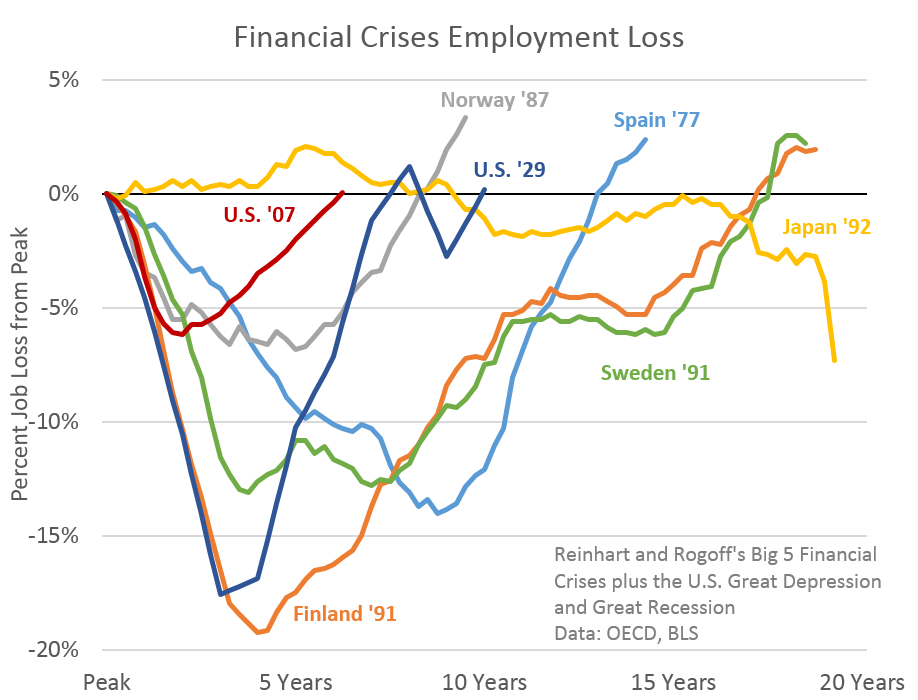
När Carl Bildt och Göran Persson styrde Sverige
Diagram på RE blog juni 2014
Claudio Borio, the BIS's chief economist,
says this refusal to let the business cycle run its course and to purge bad debts is corrosive.
leads to "time inconsistency". It steals growth and prosperity from the future,
and pulls the interest rate structure far below its (Wicksellian) natural rate.
"The risk is that the global economy may be in a deceptively stable disequilibrium," he said.
Ambrose Evans-Pritchard 4 June 2014
US vs UK median real wage growth since 1988
FT Alphavillle, 29 April 2014
Accelratorn - Varför är den bortglömd? Det var Basics, vill jag minnas.
To have more or less full employment, we need sufficient spending to make use of the economy’s potential.
But one important component of spending, investment, is subject to the accelerator effect:
the demand for new capital depends on the economy’s rate of growth, rather than the current level of output.
Paul Krugman via Rolf Englund blog 21 maj 2014
“The Great Recession: Causes and Consequences.”
We were suffering from inadequate demand.
Why, at the moment it was most needed and could have done the most good, did economics fail?
Paul Krugman, NYT 1 May 2014

Only the ignorant live in fear of hyperinflation
Failure to understand the monetary system has made it more difficult for central banks to act
Martin Wolf, FT April 10, 2014
Fortunately the Bank of England is providing much needed education.
In its most recent Quarterly Bulletin, its staff explain the monetary system.
So here are seven fundamental points about how it really works as opposed to how people think it does.
The act of saving does not increase deposits in banks. If your employer pays you, the deposit merely shifts from its account to yours.
This does not affect the quantity of money; additional money is instead a byproduct of lending.
What makes banks special is that their liabilities are money – a universally acceptable IOU. In the UK, 97 per cent of broad money consists of bank deposits mostly created by such bank lending.
Banks really do “print” money. But when customers repay, it is torn up.
Understanding the monetary system is essential. One reason is that it would eliminate unjustified fears of hyperinflation. That might occur if the central bank created too much money.
But in recent years the growth of money held by the public has been too slow not too fast.
Asset price bubbles and Central Bank Policy
“secular stagnation”
What the world must do to kickstart growth
The IMF in its current World Economic Outlook essentially endorses the “secular stagnation” hypothesis
Lawrence Summers, FT April 6, 2014
The IMF in its current World Economic Outlook essentially endorses the “secular stagnation” hypothesis, noting that the real interest rate necessary to bring about enough demand for full employment is likely to remain depressed for a substantial period. This is made manifest by the fact that inflation is well below target throughout the developed world and is likely to decline further this year
I’m pretty annoyed with Larry Summers right now.
His presentation at the IMF Research Conference is, justifiably, getting a lot of attention. And here’s the thing: I’ve been thinking along the same lines, and have, I think, hinted at this analysis in various writings.
But Larry’s formulation is much clearer and more forceful, and altogether better, than anything I’ve done
Paul Krugman, November 16, 2013
Yellen said recovery still feels like a recession to many Americans,
which is why the central bank will keep its “extraordinary” support for the economy for “some time to come.”
MarketWatch, 31 March 2014
I’ll eat my hat. The St Louis Federal Reserve – the last bastion of monetary orthodoxy in the Fed family –
has just published a paper that basically deems quantitative easing to be useless.
John Maynard Keynes was right all along.
The working paper by Yi Wen and Jing Wu cites China as the world’s resounding success story post-Lehman
Ambrose Evans-Pritchard, March 28th, 2014
A depressingly familiar reality lies behind the UK’s economic miracle
Growth is predicted to depend entirely on rising household spending, a recovering housing market,
and the questionable assumption of a bounce in business investment
Jeremy Warner, 24 March 2014
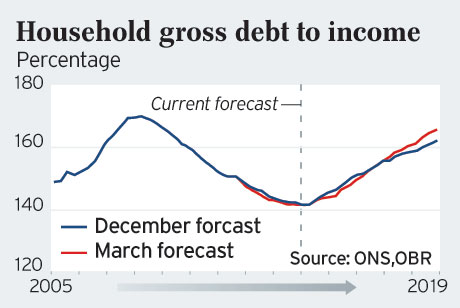
One of the abiding truisms of economics is that growth doesn’t happen without credit expansion.
This is well explained in a recent paper by the Bank of England,
which points out that money in the modern economy is largely created by commercial banks making loans.
It is a common misconception to think that banks only lend what they can borrow from depositors.
Jeremy Warner, 24 March 2014
Money creation in the modern economy
Bank of England pdf, QB 2014 Q1
Consumer credit and falling savings are indeed driving Britain’s unhealthy boomlet
Ambrose Evans-Pritchard, March 21st, 2014
The Bank of England will never unwind QE, nor should it
Governor Mark Carney more or less acknowledged this morning that the Bank of England will never reverse its £375bn of Gilts purchases.
Quite right too.
Ambrose Evans-Pritchard, 11 March 2014
Britain has just carried out one of the greatest victimless crimes in modern financial history. It is in effect wiping out public debt worth 20pc to 25pc of GDP – on the sly – without inflicting serious macroeconomic damage or frightening global bond markets.
How to make a graceful exit
Central banks’ forward guidance is a forgivable sin
Financial Times editorial, March 10, 2014
Why does everyone
— or, to be more accurate, everyone except those who have seriously studied the issue —
believe that the stimulus was a failure?
Because the U.S. economy continued to perform poorly — not disastrously, but poorly — after the stimulus went into effect.
There’s no mystery about why
Paul Krugman, NYT 20 February 2014
America was coping with the legacy of a giant housing bubble.
Even now, housing has only partly recovered, while consumers are still held back by the huge debts they ran up during the bubble years.
And the stimulus was both too small and too short-lived to overcome that dire legacy.
Even more importan, is the huge natural experiment Europe has provided on the effects of sharp changes in government spending.
Recession - The R-word - Transcripts
Policy makers at the Federal Reserve tell us not to worry,
that it’s mostly just bad weather and the normal ups and downs of the economic data.
But what if they’re wrong? Would they tell us if they thought we were heading for a new recession?
Rex Nutting, MarketWatch, Feb. 27, 2014
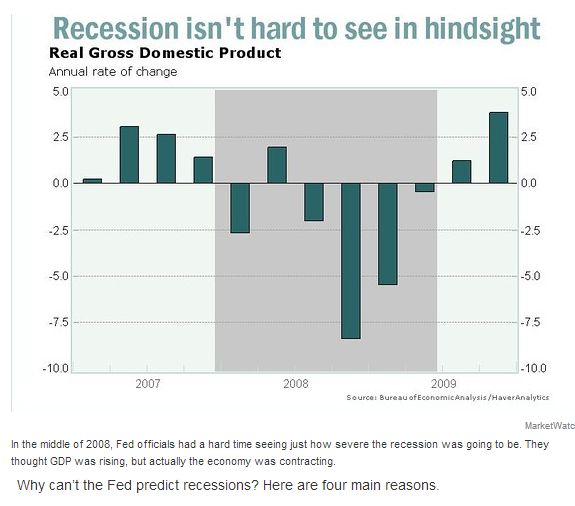
The experience of the last recession, which started at the beginning of 2008, is telling.
Although the Fed began cutting interest rates months before the recession began and continued to cut rates aggressively throughout 2008,
policy makers were reluctant to use the “R” word, even in private, according to
the recently released
transcripts of the meetings of the Federal Open Market Committee.
While most policy makers had recognized by March that the economy was in a recession, they didn’t grasp the magnitude of the disaster until it was too late. Most of them thought the recession would be shallow and brief. Most of them thought the Fed would begin raising interest rates very quickly once the storm passed. They were wrong.
Laughing all the way to an economic crash
How the central bank coped with a crisis
DAVID WEIDNER'S WRITING ON THE WALL, MarketWatch, Feb. 25, 2014
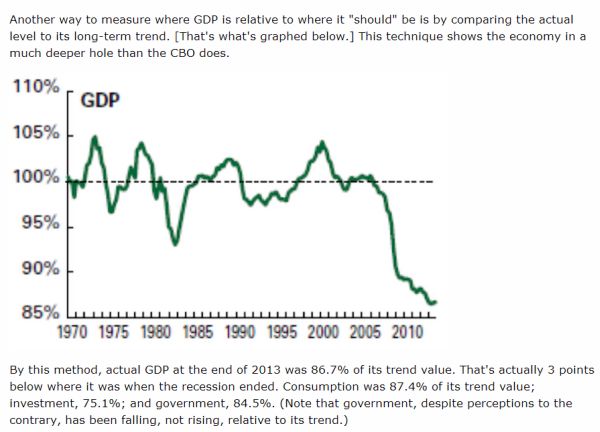
US GDP at the end of 2013 was 86.7% of its trend value.
That's actually 3 points below where it was when the recession ended.
John Mauldin, 10 February 2014
What was radical, if you like, was my style, not my content
On macroeconomics, there’s not a lot of air between my views and those of, say,
staff economists at the Fed Board of Governors, the New York Fed, the IMF, and even (say it quietly) the ECB.
Paul Krugman, New York Times 4 February 2014
They’re very much at odds both with freshwater macro and with austerian views; but no more so than those of many other economists — and austerian notions, like that of expansionary austerity, are far more radical than holding to old-fashioned concepts like the multiplier.
The impression that I’m some kind of far-out thinker largely comes from my willingness to go with what mainstream macroeconomics actually says, rather than shading my views and language to appease the Very Serious People.
Mainstream macro said that once you’re in a liquidity trap, deficits don’t drive up interest rates; money-printing doesn’t cause inflation; contractionary fiscal policy is very contractionary.
I said that, without hedging, and ridiculed the fashionable case for austerity.
But what was radical, if you like, was my style, not my content.
Consider what happened in 1936. F.D.R. had just won a smashing re-election victory
It’s very hard to communicate even the most basic truths of macroeconomics,
like the need to run deficits to support employment in bad times.
You can argue that Mr. Obama should have tried harder to get these ideas across;
many economists cringed when he began echoing Republican rhetoric about the need for the federal government to tighten its belt along with America’s families.
Paul Krugman, New York Times 23 January 2014
Cash
Global companies sitting on $7 trillion cash, double 2003
When the corporate cash dam bursts, everything will be ok, right? Well, maybe.
Investors have long assumed that a corporate spending revival will nurture a building economic recovery.
CNBC, 22 January 2014
Davos
One of the big stories here is that despite returning growth, business investment of the type that drives innovation, productivity gain and income growth is still as dead as a dodo.
They’ve got trillions of dollars in cash lying around on their balance sheets, but business leaders are still too cautious to loosen the purse strings.
So there is definitely something of a problem.
Jeremy Warner, Telegraph, 23 Jan 2014
The issue really comes down to whether you think it a supply-side issue, or simply one of absent demand.
“secular stagnation”
In a fascinating discussion with other leading international economists, Professor Summers argued that the only compelling solution to low growth was public investment.
Unconventional monetary policy, he argued, was no match for the problem, and in any case ran the risk of creating asset bubbles and renewed financial instability.
He also expressed grave concerns about the distributional consequences of sustained periods of negative real interest rates.
Jeremy Warner, Telegraph, 23 Jan 2014
For at least a decade and a half, cash has progressively increased its share of the American corporate balance sheet
According to research by the Federal Reserve Bank of St Louis,
their cash hoard had reached almost $5tn by the end of 2011.
John Plender, FT December 29, 2013
Rolf Englund blog 5 december 2009:
- Jag tycker det är skriande uppenbart att räntan världen över är för låg och att en större del av stimulanserna borde ske via finanspolitiken. Men väljarna och därmed deras medlöpande politiker är rädda för budgetunderskott och vill hellre att villaägarna skall låna än att staten skall göra det.
Strategin synes vara att det gäller att stabilisera, helst höja, villapriserna så att konsumenterna främst i USA skall återgå till att konsumera med lånta pengar, dvs just det som ledde fram till katastrofen.
Detta kan inte vara klokt.
Many are convinced that the US is a victim of secular economic stagnation and that its power and influence are waning inexorably as a result.
It is politically dysfunctional, its political class has been bought by Wall Street bankers with an efficiency and cynicism not seen since Cosimo de Medici bought up the 15th century papacy.
But... One of the important consequences of the financial crisis has been that it reinforced the role of the dollar as the world’s most sought after store of value in a storm.
John Plender, Financial Times 7 January 2014
Can Policy Boost Growth?
Some economic experts have suggested that US may be in a period of secular stagnation,
or protracted slow growth, similar to what followe Depression.
They propose further monetary and fiscal stimulus, but those have proven to provide only a temporary boost for short-term growth.
John H. Makin, American Enterprise Institute, 6 January 2014
Traditional macro policy also will not boost long-term growht.
While improving long-term growth is difficult, the best places to begin are with advances in a tax reform, deregulation, and freer trade. These structural measures, along with efforts to re high levels of policy uncertainty, might help boost sustainable, long-term economic growth.
Vi tackar P för länken
Secular stagnation
Since the start of this century, annual US gross domestic product growth has averaged less than 1.8 per cent.
The economy is now operating nearly 10 per cent – or more than $1.6tn – below what was judged to be its potential as recently as 2007.
And all this is in the face of negative real interest rates for terms of more than five years and extraordinarily easy monetary policy.
Lawrence Summers, Financial Times, January 5, 2014
A long time ago, the debate between monetarists and Keynesians was the debate in macro.
But it was a rather limited debate: both sides generally used the same model (IS-LM), and so it was all about parameter values.
More recently, but before the recession, that debate had largely gone away, but since then it seems to have come back.
This post asks why that is.
Simon Wren-Lewis, an economics professor at Oxford University, and a fellow of Merton College, 6 January 2014
Om bostadspriserna i Sverige börjar falla leder det till att konsumtionen går ner. Det slår också mot sysselsättningen.
Detta mardrömscenario har inträffat i andra länder och då fört med sig en långvarig recession med hög arbetslöshet.
Sverige tillhör de relativt fåtaliga som hittills har klarat sig, trots att skuldsättningen är högt uppdriven även här.
Enligt riksbankschefen ger detta dock inget skydd mot kommande bakslag, som i värsta fall också kan leda till en ny finanskris.
Stefan Ingves, DN 3 januari 2014
De svenska bankerna har tillgångar som motsvarar fyra gånger Sveriges hela BNP.
– Schweiz, Cypern och Nederländerna ligger högre. De har haft sina problem. Och under oss har vi Storbritannien, Danmark och Spanien och de har haft sina problem
– Samtidigt vet vi att mer än hälften av bankernas finansiering sker utomlands och det betyder att man där kan ha synpunkter på vår bolånemarknad.
I slutändan är det de utländska placerarnas syn på oss som är avgörande.
Den svenska bolånemarknaden har därmed blivit systemviktig
Stefan Ingves, DN 3 januari 2014
In 2010, most of the world’s wealthy nations, although still deeply depressed in the wake of the financial crisis,
turned to fiscal austerity: slashing spending and, in some cases, raising taxes in an effort to reduce
budget deficits that had surged as their economies collapsed.
Basic economics said that austerity in an already depressed economy would deepen the depression. But the “austerians,” as many of us began calling them, insisted that spending cuts would lead to economic expansion, because they would improve business confidence.
The result came as close to a controlled experiment as one ever gets in macroeconomics
Paul Krugman, New York Times 19 December 2013
I’m well aware that the austerians may win political points all the same. Political scientists tell us that voters are myopic (närsynta), that they judge leaders based on economic growth in the year or so before an election, not on overall performance in office.
So a government can preside over years of depression, yet win re-election if it can engineer an uptick late in the game.
Paul Krugman's Blind Spot
Sorry, but the New York Times' star columnist just doesn’t understand Europe.
Anders Åslund, Foreign Policy 8 November 2013
Interndevalvering (Ådals-metoden)
If the /UK/ economy was not massively overheated in 2007 and fiscal policy had not been hugely irresponsible,
what caused the post-crisis losses of output and consequent fiscal deterioration?
The answer to the first question is the global financial crisis.
Martin Wolf, Financial Times 19 December 2013
The panic led to sharp declines in financial sector profits, financial intermediation and economic activity.
The fiscal deterioration was then the result of these declines.
The present value of lost output would be close to five times annual GDP.
The Hubble bubble theory of the continuous expansion of the financial universe
All of which is a whimsical way of suggesting that perhaps Larry Summers has a point.
Perhaps inflating asset bubbles one after the other isn’t such a bad idea. Perhaps it’s even necessary?
Izabella Kaminska, FT Alphaville 6 December 2013
Conservatives and the cult of home-ownership
Promoting house-buying is a form of stimulus that does not overtly add to the fiscal deficit
Samuel Brittan, FT, November 28, 2013
The U.S. Treasury yield curve has lost its forecasting power
An ideal leading indicator would exclude components such as the yield curve that behave perversely during times of financial stress, said Morgan Stanley economist Ellen Zentner.
She suggested investors look at the Duncan Leading Indicator,
devised in 1977 by Wallace Duncan, then of the Federal Reserve Bank of Dallas.
Bloomberg, Simon Kennedy, Nov 27, 2013
Secular stagnation
Since the start of this century, annual US gross domestic product growth has averaged less than 1.8 per cent.
The economy is now operating nearly 10 per cent – or more than $1.6tn – below what was judged to be its potential as recently as 2007.
And all this is in the face of negative real interest rates for terms of more than five years and extraordinarily easy monetary policy.
Lawrence Summers, Financial Times, January 5, 2014
We may, as I argued last month in the Financial Times, be in a period of “secular stagnation” in which sluggish growth and output, and employment levels well below potential, might coincide for some time to come with problematically low real interest rates.
Larry Summers has argued that the short-term real interest rate consistent with full employment
fell to minus 2 or 3 per cent sometime in the middle of the last decade. This was due to an ex-ante global saving glut,
possibly reinforced by a weakening in ex-ante investment demand.
Because currency has a riskless zero nominal interest rate, nominal interest rates on other financial instruments cannot fall much below zero.
Willem Buiter, Financial Times 23 December 2013
With output significantly below potential since the start of 2008, the expected inflation required to achieve a significantly negative real interest rate with the nominal rate at zero has not been forthcoming, despite aggressive policy easing by the world’s leading central banks. The resulting unemployment is self-perpetuating. Human capital formation suffers: today’s high actual unemployment rate becomes tomorrow’s high natural unemployment rate.
Why stagnation might prove to be the new normal
In the past decade, before the crisis, bubbles and loose credit were only sufficient to drive moderate growth
Lawrence Summers, December 15, 2013
Is it possible that the US and other major global economies might not return to full employment and strong growth without the help of unconventional policy support? I raised that notion – the old idea of “secular stagnation” – recently in a talk hosted by the International Monetary Fund.
The implication of these thoughts is that the presumption that normal economic and policy conditions will return at some point cannot be maintained.
Even if the economy accelerates next year, this provides no assurance that it is capable of sustained growth at normal real interest rates.
"We should not dismiss the possibility, raised by Larry Summers
that we may need negative real rates for a long time"
I interpret this as IMF chief economist Olivier Blanchard saying,
as clearly and straightforwardly as his office allows him to,
that in his judgment the 2% per year inflation target is past its sell-by date and rotted,
and that the North Atlantic economies need to move to a 4% per year inflation target
in order to reduce the risk of another 1932, or another 2010.
Brad DeLong, November 20, 2013
Harvard economist Larry Summers created a stir earlier this month when he suggested that
the world economy may be entering a period of “secular stagnation,”
where aggregate demand fails to recover and sustain growth on anything like the pre-crisis trajectory.
Darrell Delamaide, MarketWatch, 20 November 2013
The hallmarks of this situation are deflation and underinvestment, which means monetary authorities will be forced to keep interest rates at zero.
“Imagine a situation where natural and equilibrium interest rates have fallen significantly below zero,” Summers said at an International Monetary Fund forum in Washington. “Then conventional macroeconomic thinking leaves us in a very serious problem because we all seem to agree that, whereas you can keep the federal funds rate at a low level forever, it’s much harder to do extraordinary measures beyond that forever, but the underlying problem may be there forever.”
Summers on bubbles and secular stagnation forever
Larry Summers’ speech to the IMF Research Conference on November 8, the video of which started circulating at old fashioned money multiplier rates this Sunday.
Izabella Kaminska, FT Alphaville 18 November 2013
Developed world cannot thrive at ‘stall speed’
Bill Gross, FT July 20, 2011
What is the “stall speed” of an economy?
Unemployment tends to rise when GDP growth falls below about 2.5-3 per cent
Gavyn Davies blog June 15, 2011
Det erinrar om dagens situation där i USA centralbankschefen Greenspan försöker uppnå en "soft landing" på ekonomins hangarfartyg.
Han känner att han inte kommer fram, drar gasen - räntan - i botten, men motorn, penningmängden, svarar inte. Farten sjunker ändå.
Grant drar också en mycket tänkvärd parallell mellan England och USA på 1920-talet och Japan och USA på 1980- och 90-talen.
England hade 1925 under finansminister Churchill återgått till guldmyntfonten på en då orealistisk växelkurs (den som rådde före första världskriget).
Bank of England förmådde USA att sänka räntan mot slutet av 1920-talet. Detta ledde till att aktiespekulanterna fick ny kraft inför 1929.
I mitten på 1980-talet var det USA som på hotellet Plaza (ägt av Donald Trump) fick japanerna att sänka sin ränta, vilket ledde till den japanska bubbla som nu spricker och hotar hela världsekonomin.
"Stålbadet i skuldfällan", Rolf Englund på DN Debatt 26/8 1992
No, Larry Summers, We Don’t Need More Bubbles
Would-be Fed chairmen aren’t supposed to ask unsettling questions about bubbles.
Clive Crook, Bloomberg, Nov 20, 2013
His ideas on the longer term were more arresting; so was hearing them from the man who was President Barack Obama’s first choice for chairman of the Federal Reserve.
Maybe we face an age of secular stagnation, in which the zero lower bound is normal. If so, short-term fiscal easing can’t be the answer. Permanent fiscal stimulus may be necessary to maintain demand. And if that can’t be done because politics makes it impossible, what’s left? Bubbles. Summers doesn’t advocate them, mind you, he just poses the question.
Suppose, as Summers asks us to imagine, that the U.S. does face a chronic shortfall of demand, that fiscal stimulus isn’t available and that you therefore need bubbles to get the economy back to full employment.
What’s the point, if periodic crashes such as the one the economy has just endured are part of the outcome? Bubbles eventually burst: That’s what they do. Wouldn’t slow growth and less-than-full employment be better -- if that’s the alternative -- than crash-bubble-crash?
Secular stagnation isn’t impossible. It’s a disturbing possibility, worth thinking about. But there’s no strong evidence it’s upon us, and even if it were, bubbles wouldn’t be the answer.
--
Raka puckar
Clive Crook’s pathological centrism
— his intense desire to see that the truth is in the middle, never mind actual facts —
requires that he invent a history in which Keynesians were just as guilty of politicization as the other side.
Paul Krugman, May 7, 2013
"A bravura performance"
Lawrence Summers has poured gallons of icy water on any remaining optimists.
Speaking on a panel at the International Monetary Fund’s annual research conference,
the former US Treasury secretary suggested that there could be no easy return to pre-crisis normality in high-income economies.
Instead, he sketched out a disturbing future of chronically weak demand and slow economic growth.
Martin Wolf, November 19, 2013
Mr Summers is not the first to identify the possibility of so-called “secular stagnation”: the fear of emulating Japan’s lost decade has been in the minds of thoughtful analysts since the crisis. But his was a bravura performance.
I anledning av Summers
Det kanske är så att utan bubblor och snabb kreditexpansion skulle vi inte haft de tillväxttal vi kommit att vänja oss vid.
Det tycks finnas en underliggande och långsiktig stagnation som dolts av excesserna de senaste två decennierna.
Peter Wolodarski, DN, 1 december 2013
Larry Summers, Paul Krugman, Gavyn Davies
Utan bubblor kollapsar ekonomin
Andreas Cervenka, SvD Näringsliv 19 november 2013
Enda sättet att få någon som helst fart på ekonomin verkar alltså vara att blåsa upp nya bubblor, vilket ser ut att vara vad Federal Reserve och andra kanske gör just nu, i alla fall att döma av utvecklingen på världens börser och kreditmarknader.
Ett sätt att sammanfatta Larry Summers tal är just detta: utan bubblor kollapsar ekonomin.
Han konstaterar till och med allt som görs i syfte att förhindra en ny kris, som tillexempel bankregleringar för att hindra ansvarslös utlåning, blir kontraproduktivt. Slutsats: enda sättet att hålla igång hjulen är att låta Wall Street löpa amok!
--
Jag tycker det är skriande uppenbart att räntan världen över är för låg och att en större del av stimulanserna borde ske via finanspolitiken. Men väljarna och därmed deras medlöpande politiker är rädda för budgetunderskott och vill hellre att villaägarna skall låna än att staten skall göra det.
Strategin synes vara att det gäller att stabilisera, helst höja, villapriserna så att konsumenterna främst i USA skall återgå till att konsumera med lånta pengar, dvs just det som ledde fram till katastrofen.
Detta kan inte vara klokt.
And here’s the worrisome thing:
what if it turns out that we need ever-growing debt to stay out of a liquidity trap?
Paul Krugman, New York Times blog, September 25, 2013
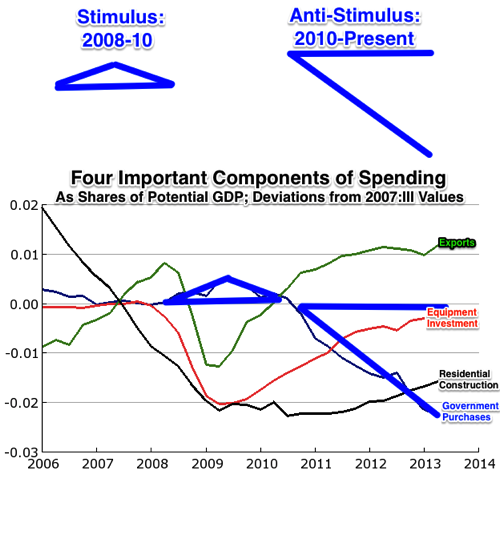
[Sarcasm]Yes, I know: "small businesses and families are tightening their belts. Their government should, too".
Growth rates have remained stubbornly low and unemployment rates unacceptably high,
partly because the increase in money supply following QE has not led to credit creation to finance private consumption or investment.
Nouriel Roubini, Project Syndicate, 31 October 2013
Not that long ago, macroeconomists were congratulating central bankers
(and central bankers were, of course, congratulating themselves)
over doing a pretty good job of getting this right.
Inflation, occasional commodity shocks aside, was indeed low and stable, and from 1985 to 2007 the real economy was fairly stable too.
Then came catastrophe – and as so often happens, when the house collapses you find the skeletons that were lurking in the closet all along.
The stability of prices and output masked an underlying unsustainable growth in leverage
Paul Krugman, New York Times blog, September 25, 2013
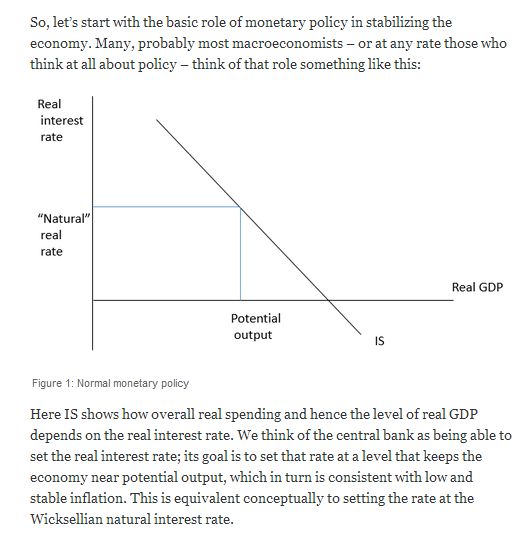
Since the US economy shows no signs of having been overheated on average from 1985 to 2007, the argument that the Fed should nonetheless have set higher rates
is an argument that the Fed should have kept the real economy persistently depressed, and unemployment persistently high...
in order to keep borrowers and lenders from making bad decisions.
Many of us would therefore argue that the right answer isn’t tighter money but tighter regulation:
higher capital ratios for banks, limits on risky lending, but also perhaps limits for borrowers too, such as maximum loan-to-value ratios on housing
and restrictions on second mortgages.
This would guard against bubbles and excessive leverage, while leaving monetary policy free to pursue conventional goals.
And here’s the worrisome thing:
what if it turns out that we need ever-growing debt to stay out of a liquidity trap?
Broadly speaking, for possibly longer and for at least 115 years - since the publication of Swedish economist Knut Wicksell's Geldzins and Guterpreis
- economists have divided into two camps with respect to what a central bank like the Federal Reserve system really is.
One camp, call it the Banking Camp, sees a central bank as a bank for bankers
Brad DeLong, August 31, 2013
Hushållens bolån kan sluta i katastrof
”Det vore en katastrof för Sverige om vi kommer tillbaka till mer normala räntenivåer utan att ha fått ned skuldsättningen."
Göran Persson, Dagens Industri 27 juni 2013
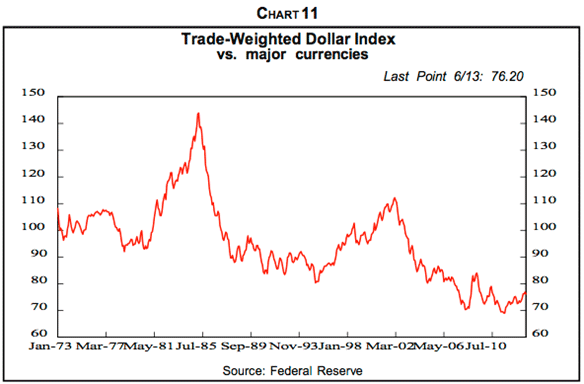
Trade Weighted US dollar Index och
myterna om de svenska devalveringarna och pratet om att Göran Persson räddade Sverige
Rolf Englund blog 17 september 2013
Can fiscal austerity be expansionary in present Europe?
The lessons from Sweden
Lennart Erixon, Department of Economics, Stockholm University, September 4, 2013
The main conclusion in this article is that the fiscal austerity measures in the mid-1990s delayed the Swedish economic recovery
and that neither these measures nor the fiscal rules were responsible for the impressive Swedish macroeconomic performance in the following period.
The positive economic development in Sweden was driven by export, profit and technology, reflecting an international upswing
and the country’s flexible exchange rates and industrial composition.
Click
A small open economy like Sweden in the 1990s may well be able to tighten its way back to vitality in a the middle of a global boom,
but if half Europe does so in unison in a slump, it will inflict carnage.
Ambrose Evans-Pritchard, Telegraph, September 17th, 2013
Broadly speaking, for possibly longer and for at least 115 years - since the publication of Swedish economist Knut Wicksell's Geldzins and Guterpreis
- economists have divided into two camps with respect to what a central bank like the Federal Reserve system really is.
One camp, call it the Banking Camp, sees a central bank as a bank for bankers
Brad DeLong, August 31, 2013
Because people make exceptionally large mistakes, orthodox neoclassical economics does not work very well.
A more helpful guide is the Swedish-Austrian theory of the business cycle,
developed by Knut Wicksell, the Swedish economist, and Friedrich Hayek, the Austrian, in the 1920s and 1930s.
During such periods, they argued, the real interest rate is too low and monetary policy too loose, given the over-optimistic view of prospective returns on capital.
Martin Wolf Financial Times 28/5 2003
Are zero interest rates a subsidy to banks?
Back and forth between Leijonhufvud and Krugman
Axel Leijonhufvud: The two pioneers of modern monetary economics – Irving Fisher and Knut Wicksell ...
Eurointelligence 26/1 2011
It’s easy to understand why economics might be mistaken for science.
It uses quantitative expression in mathematics and the succinct statement of its theories in axioms and derived “theorems,” so economics looks a lot like the models of science we are familiar with from physics.
Economics employs partial differential equations like those in a Black-Scholes account of derivatives markets, equations that look remarkably like ones familiar from physics.
The trouble with economics is that it lacks the most important of science’s characteristics — a record of improvement in predictive range and accuracy.
Alex Rosenberg and Tyler Curtain, New York Times, August 24, 2013
Alex Rosenberg is the R. Taylor Cole Professor of Philosophy and chair of the philosophy department at Duke University. He is the author of “Economics — Mathematical Politics or Science of Diminishing Returns,” most recently, “The Atheist’s Guide to Reality.”
Tyler Curtain is a philosopher of science and an associate professor of English and comparative literature the University of North Carolina at Chapel Hill. He was recently named the 2013 recipient of the Robert Frost Distinguished Chair of Literature at the Bread Loaf School of English, Middlebury College, Vt.
Economics may be dismal, but it is not a science
The failures of economics in the recent crisis are most evident in two areas:
the inadequacies of the efficient market hypothesis, the bedrock of modern financial economics,
and the irrelevance of recent macroeconomic theory.
John Kay, FT, April 13, 2010 and more links
That 1999 Time magazine cover is finally catching up with Lawrence Summers.
That was the year Summers was celebrated along with Alan Greenspan and Robert Rubin as
“The Committee to Save the World”
for their free-market solutions to Asia’s financial crisis.
The timing always struck Asians as odd, given that they were still picking up the pieces
from a meltdown made worse by the trio’s ill-conceived and overbearing remedies.
William Pesek, a Bloomberg View columnist, Aug 5, 2013
Need to avoid what he called “artificial bubbles”
President Barack Obama, who took office amid the collapse of the last financial bubble,
wants to make sure his economic recovery doesn’t generate the next one.
Bloomberg, Aug 19, 2013
Obama this month spoke four times in five days of the need to avoid what he called “artificial bubbles,” even in an economy that’s growing at just a 1.7 percent rate and where employment and factory usage remain below pre-recession highs.
Obama’s cautionary notes call attention to the risk that the lessons of the financial crisis, which was spawned by a speculator-driven surge in asset values, will be forgotten, widening the income gap and undermining a broad-based recovery.
“Clearly, this is a growing concern both in the administration and at the Fed,” said Adam Posen, a former member of the Bank of England’s monetary policy committee.
The cult of home ownership is dangerous and damaging
You would think that the residential property bubble and subsequent crisis of the past decade
would make people leery of widespread home ownership, and governments reluctant to pump it up.
Yet, here we are again
Adam Posen, Financial Times, July 26, 2013
Three more years of zero interest rates
Whether it's in the long term interests of the economy is another matter.
Savers are again punished, and the profligate rewarded.
Jeremy Warner, August 7th, 2013
Raghuram Rajan, who predicted the 2008 global financial crisis,
was named the next governor of India’s central bank
Bloomberg, 6 August 2013
Quantitative easing has truly been a step in the dark.
Given all the uncertainty – why it works, how to make it most effective, and how to exit –
why have central bankers, for whom “innovative” is usually an epithet, departed from their usual conservatism in adopting it?
Raghuram Rajan, Project Syndicate, June. 27, 2013
As Raghuram Rajan of the University of Chicago Booth School of Business and former chief economist of the International Monetary Fund
notes in a thought-provoking new book, the underlying “fault lines” are still with us.
Martin Wolf July 13 2010
A new way of thinking has recently taken hold in the German capital
Wolfgang Schäuble sounded almost like a new convert extolling the wonders of heaven as he raved about his latest conclusions on the subject of saving the euro.
"We need more investment, and we need more programs," the German finance minister announced
The man who had persistently maintained his image as an austerity commissioner is suddenly a champion of growth.
Der Spiegel, 27 May 2013
On Monday 13th May, I participated in a debate on austerity
organised by the New York Review of Books, held in the Sheldonian Theatre, Oxford.
The motion was: “Austerity in the Eurozone and the UK: Kill or Cure?”.
Those arguing in defence of austerity were Meghnad (Lord) Desai and Sir John Redwood MP.
On my side was Lord (Robert) Skidelsky.
Here is the speech I presented: Austerity has failed.
It has failed in the UK and it has failed in the eurozone.
Its failure was predictable and, by some at least, predicted.
Martin Wolf, May 23, 2013
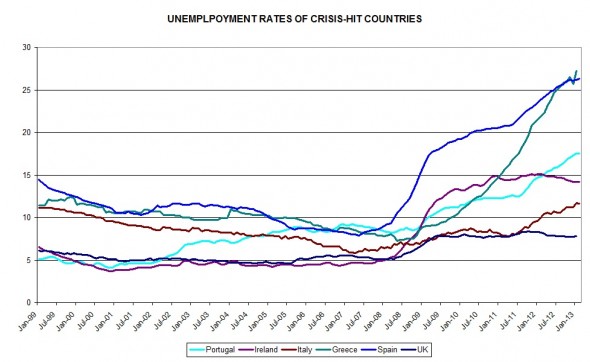
Fed History Shows Punch Bowl Goes as Jobs Rise
An improving labor market rather than accelerating inflation
made the Federal Reserve decide to end its last three episodes of easy monetary policy.
Simon Kennedy Bloomberg May 24, 2013
How the Case for Austerity Has Crumbled
Paul Krugman, New York Times Review of Books, June 6, 2013
Volcker helped cut the unemployment rate to an eight-year low of 5.7 percent in 1987,
his last year as Fed chairman,
after reversing interest-rate increases that brought inflation down from as high as 15 percent.
Bloomberg, 15 May 2013
Från arkivet
Kaletsky i Kapitalism 4.0
Centralbankerna har i smyg, med bibehållen retorik om inflationsbekämning,
återgått till att inte bara kontrollera inflationen utan anser nu även att stabilisera sysselsättningen på en hög nivå.
USA:s tidigare centralbankschef Paul Volcker är mest känd för att ha blivit tillsatt av Ronald Reagan för att få ner inflationen,
vilket lyckades genom en hård åtramning med recession som följd.
Det ryktet kvarlever med märklig kraft.
Men Kaletsky menar att det var Paul Volcker som ledde återgången till "demand management".
- In the United States, the return to demand management began as early as the summer of 1982,
when a three-year recession and the bankruptcy of the Mexican government
persuaded the Fed that its experiment with monetarism had gone too far.
www.internetional.se/volckeregokaletsky.pdf
Rolf Englund 1987-10-26 För Svensk Tidskrift nr 9/1987:
Kanske är det på sidan 20 i den amerikanska affärstidskriften Fortune av den 28 september 1987 man skall börja leta
efter den gemensamma förklaringen till skuldkrisen, börsuppgången och börsrasen
samt vad man brukar kalla stagflationen (kombinationen av inflation och arbetslöshet).
Där återfinns längst nere i hörnet, alldeles i början på det diagram som stiger mot höjderna över hela nästa sidan, ett datum.
Det datum som där angavs som utgångspunkt för uppgången på börsen var den 12 augusti 1982.
Vad var det då, frågar man sig, som hände fredagen den 13 augusti, som satte fart på världens aktiebörser.
Jo, det som hände den dagen var att Mexiko förklarade att man inte längre kunde betala sin utlandsskulder.
Det var /den dåtida, det är lite för orta/ skuldkrisens födelsedag.
Paniken stod på lur, sammanbrott hotade västvärldens banksystem.
Den amerikanske centralbankschefen Paul Volcker agerade snabbt,
fixade fram några kortfristiga miljarder dollar från kontot för stratgisk lagring av olja och
betalade Mexiko i förskott för framtida oljeleveranser. Men han gjorde inte bara det.
Han satte också högsta fart på de amerikanska sedelpressarna.
internetional.se/analkstorm.htm
The decline in yields on Spanish debt, shown so clearly in the chart, dates almost precisely to 26th July 2012, the date on which Mario Draghi, president of the ECB, told an audience in London that “Within our mandate, the ECB is ready to do whatever it takes to preserve the euro. And believe me, it will be enough.”
This statement, in turn, led to the announcement by the ECB on August 2nd 2012 of “outright monetary transactions” which would be aimed “at safeguarding an appropriate monetary policy transmission and the singleness of the monetary policy”.
Rightly or wrongly, markets concluded that the risk of an outright default on Spanish bonds had largely disappeared.
Martin Wolf, Financial Times, 10 May 2013
At this point the economic case for austerity — for slashing government spending even in the face of a weak economy — has collapsed.
Ending stimulus has never been a problem — in fact, the historical record shows that it almost always ends too soon.
Paul Krugman, NYT May 5, 2013
Raka puckar
Clive Crook’s pathological centrism
— his intense desire to see that the truth is in the middle, never mind actual facts —
requires that he invent a history in which Keynesians were just as guilty of politicization as the other side.
Paul Krugman, May 7, 2013
Brad DeLong finds Clive Crook making some easily refuted claims about the nature of the stimulus debate in the winter of 2008-2009, and my role in particular.
Clive Crook dammade också på:
In a column last week I criticized Paul Krugman’s apparent belief that people who disagree with him
- let’s say about half the country - are knaves, fools or sociopaths.
/Definition of knave: You don't hear about knaves much these days: it's an older word for a rascal, a scoundrel, or a rogue.
It isn't a compliment./
ECB sänker räntan med 0,25 procent
"Central bankers say they are flying blind", "Uncharted territory", "No one fully understands"...
IntCom 2 Maj 2013
Fed’s policymakers want prices to go up because they believe that a little bit of inflation is good for growth.
The Fed wants interest rates to be below the rate of inflation to give homeowners
and businesses a strong incentive to borrow and spend, generating jobs.
The Fed can’t do that if there’s no inflation because interest rates can’t be lower than zero.
Bloomberg, 1 May 2013
The new governor of the Bank of Japan, Haruhiko Kuroda,
not wedded to central bankers’ obsolete doctrines,
he has made a commitment to reverse Japan’s chronic deflation,
setting an inflation target of 2%
There is every reason to believe that Japan’s strategy for rejuvenating its economy will succeed
Joseph E. Stiglitz, Project Syndicate 25 April 2013
Joseph E. Stiglitz, a Nobel laureate in economics and University Professor at Columbia University, was Chairman of President Bill Clinton’s Council of Economic Advisers and served as Senior Vice President and Chief Economist of the World Bank. His most recent book is The Price of Inequality: How Today’s Divided Society Endangers our Future.
Deflation increases the real (inflation-adjusted) debt burden, as well as the real interest rate.
Though there is little evidence of the importance of small changes in real interest rates, the effect of even mild deflation on real debt, year after year, can be significant.
Japan
While experimental monetary policy is now widely accepted as standard operating procedure in today’s post-crisis era,
its efficacy is dubious
Stephen S. Roach, Project Syndicate 25 April 2013
Stephen S. Roach was Chairman of Morgan Stanley Asia and the firm's Chief Economist, and currently is a senior fellow at Yale University’s Jackson Institute of Global Affairs
Nearly four years after the world hit bottom in the aftermath of the global financial crisis, QE’s impact has been strikingly asymmetric. While massive liquidity injections were effective in unfreezing credit markets and arrested the worst of the crisis – witness the role of the Fed’s first round of QE in 2009-2010 – subsequent efforts have not sparked anything close to a normal cyclical recovery.
The reason is not hard to fathom. Hobbled by severe damage to private and public-sector balance sheets, and with policy interest rates at or near zero, post-bubble economies have been mired in a classic “liquidity trap.”
They are more focused on paying down massive debt overhangs built up before the crisis than on assuming new debt and boosting aggregate demand.
Massive liquidity injections carried out by the world’s major central banks – the Fed, the ECB, and the BOJ – are neither achieving traction in their respective real economies, nor facilitating balance-sheet repair and structural change.
That leaves a huge sum of excess liquidity sloshing around in global asset markets.
Where it goes, the next crisis is inevitably doomed to follow.
Reinhart, Rogoff... and Thomas Herndon
This week, economists have been astonished to find that a famous academic contains major errors.
Another surprise is that the mistakes, by two eminent Harvard professors, were spotted by a student doing his homework.
His professors at the University of Massachusetts Amherst had set his graduate class an assignment
- pick an economics paper and see if you can replicate the results. It's a good exercise for aspiring researchers.
No matter how he tried, he just couldn't replicate Reinhart and Rogoff's results.
BBC 19 April 2013
Harvard economists, Carmen Reinhart and Kenneth Rogoff
Did an Excel coding error destroy the economies of the Western world?
First, they omitted some data; second, they used unusual and highly questionable statistical procedures
Paul Krugman, New York Times, April 18, 2013
German Foreign Minister Guido Westerwelle maintained Germany's position, warning against a move away from austerity.
"We are convinced that if we give up on the policies of budgetary consolidation,
if we fall back into the old policies of racking up debts, then we will cement mass unemployment for many years in Europe,"
Growth cannot be purchased with new debts, he added, saying that
"growth and consolidation policies are two sides of the same coin."
Der Spiegel, 23 April 2013
"Growth-friendly budget consolidation"
European Commission President José Manuel Barroso said the strict austerity measures thus far
imposed on the EU's beleaguered economies may have reached their political limits.
Although this policy is "fundamentally right," it has nevertheless "reached its limits," he told a conference in Brussels.
"A policy, to be successful, not only has to be properly designed,
it has to have the minimum of political and social support," he added
Der Spiegel, 23 April 2013
Debunking austerity claims makes no difference to Europe's monks and zealots
Fresh research has refuted the famous Reinhart-Rogoff paper showing a cliff-edge fall in growth to minus 0.1pc once public debt reaches 90pc of GDP.
The greater conceptual error was to conflate correlation and cause
This was the paper seized upon by Tea Party Republicans, scorched-earth Schaublerians and Rehnites in Europe, our own dear Chancellor George Osborne, and
Austro-liquidationists the world over, to back calls for draconian, pro-cyclical, fiscal tightening.
Ambrose, April 18th, 2013
Central bankers say they are flying blind
Growing concern at IMF over the long-term side-effects of interest rates close to zero
Some of the leading figures in central banking conceded they were flying blind when steering their economies.
Lorenzo Bini Smaghi, the former member of the ECB’s executive board:
“We don’t fully understand what is happening in advanced economies.”
Financial Times, April 17, 2013
Sir Mervyn King, the outgoing governor of the Bank of England, said that “there is the risk of appearing to promise too much or allowing too much to be expected of us”.
It is troubling for monetary policy experts that their crisis-fighting tools – rates stuck at zero, money printing operations to bring down longer-term interest rates and encourage private sector spending, and efforts to calm financial market fears – might have nasty side-effects.
The central bankers were clear that they had got it wrong before the crisis, allowing themselves to be lulled, by stable inflation, into thinking they had eliminated financial vulnerabilities.
Lorenzo Bini Smaghi satt i högsta ledningen för ECB mellan juni 2005 och november 2011
Centralbankerna har en tendens att hela tiden fortsätta stimulera ekonomin med billiga pengar lite för länge.
Andreas Cervenka, SvD Näringsliv 15 september 2013
*
Jag tycker det är skriande uppenbart att räntan världen över är för låg och
att en större del av stimulanserna borde ske via finanspolitiken.
Rolf Englund blog, 2009-12-05
Om fastighetsbubblor, Anders Borg, Irving Fisher och Cornucopia
Nice charts
Rolf Englund 17 mars 2013
It is weird that inflation has remained so stable,
despite huge shortfalls in output, relative to pre-crisis trends, and prolonged high unemployment.
Understanding why this is the case is important because the answer determines the correct policy action.
Martin Wolf, Financail Times 16 April 2013
Rosy Scenario
Note the graph below. CBO forecasters assume that GDP will recover back to its former trend line, instead of simply growing from a lower base;
and that is where they get their obscenely rosy 4 % increases.
John Mauldin, 13 April 2013
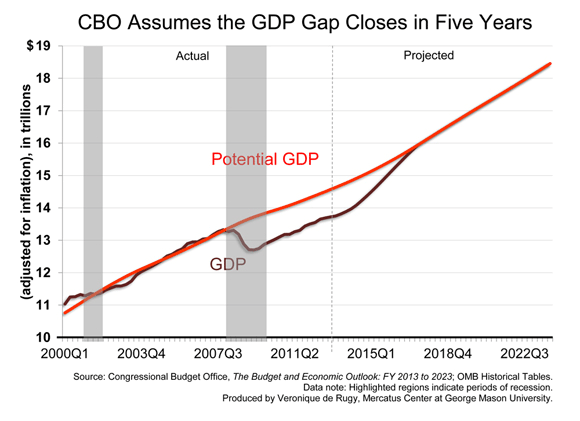
What happens if we land in a recession instead?
Not only do we not get back to that trend, we drift farther from it!
Will the CBO then project 5% GDP growth for three years running to get us back to the original trend?
That would be no more absurd than what they are doing now.
The reality is that no politician or government agency can forecast a recession.
None of us really know when the next recession will happen.
Theoretically, we could go another 10 years without one.
It is also possible that the government will reveal that there really are aliens in Area 51.
"The only sound policy was to let the depression run its course, bring down money costs, and eliminate weak and unsound firms."
Friedman viewed this as evident nonsense, and commended instead the then Chicago view that banks should be rescued,
government should act to reflate the economy, and that there was a strong case
“for the use of large and continuous deficit budgets to combat the mass unemployment and deflation of the times.”
Paul Krungman, tips from Brad DeLong, link Tim Lee, 14 April 2013
"Growth-friendly process of consolidation"
Schäuble: “We need to stop this debate which says you have to choose between austerity and growth,”
The two-day effort by the United States Treasury secretary, Jacob J. Lew,
to persuade Europe to consider shifting its focus from budget balance to growth highlighted a deep trans-Atlantic policy gulf
New York Times, 9 April 2013
"RECONSTRUCTING MACROECONOMICS"
LSE: What should economists and policymakers learn from the financial crisis?
EXCHANGE: MERVYN KING, BEN BERNANKE, OLIVIER BLANCHARD, AXEL WEBER, LARRY SUMMERS
Brad deLong, April 03, 2013
Psychological Roots of Austerity
Simon Wren-Lewis has a thoughtful post on the reasons for austerity mania
Thinking about President Obama’s first inaugural
Paul Krungman, March 23, 2013
His analysis had me thinking about President Obama’s first inaugural, and my (lonely) upset reaction:
In response to an unprecedented economic crisis — or, more accurately, a crisis whose only real precedent is the Great Depression — Mr. Obama did what people in Washington do when they want to sound serious: he spoke, more or less in the abstract, of the need to make hard choices and stand up to special interests.
That’s not enough. In fact, it’s not even right.
Interndevalvering (Ådals-metoden)
The Fiscal Multiplier
Just as lawmakers force as much as $85 billion of budget cuts on the federal government
Bradford DeLong and Lawrence Summers: Now is the perfect time to spend more, not less
Bloomberg, 13 March 2013
Their advice is based on new research suggesting that, because of today’s rare economic circumstances,
increased spending could be unusually potent in reviving growth.
A study by former Treasury Secretary Summers and DeLong, a University of California at Berkeley economist, concluded stimulus now could generate so much growth that
it would pay for itself.
Key to the debate is rethinking a number called the fiscal multiplier, a gauge of how much growth can be generated for each dollar spent by the government. DeLong and Summers argue that, with short-term interest rates near zero, the multiplier right now is at its most powerful.
DeLong has used his economics blog as well as his daily 100 tweets and retweets to deride those he calls “austerians.”
Britain’s perilous austerity bunker
Cameron’s arguments against fiscal policy flexibility are wrong
Martin Wolf, Financial Times, March 12, 2013
Highly recomended
Central bank money printing and the mystery of soaring shares
'Why did nobody see it coming?", the Queen asked four years ago on a visit to the London School of Economics,
a brilliantly faux naïve question that cruelly exposed the failings of modern economics.
Well, here's another in a similar vein she might like to ask when she next returns to matters financial.
"How come the stock market is going up, when the economy keeps tanking?"
Jeremy Warner, Telegraph 7 March 2013
The post-election deadlock in Italy is an uncomfortable reminder that
the developed world’s sovereign debt problem ultimately boils down
not just to bad economics but to a failure of democracy.
John Plender, Finncial Times 26 February 2013
En snabb minskning av hushållens skulder skulle slå hårt mot konsumtionen och är inte önskvärd.
Det säger finansminister Anders Borg och
spår att bostadsmarknaden kommer att befinna sig i stagnation de kommande 10-20 åren.
Anders Borg säger att hushållens skuldsättning är bekymmersam och att en eventuell lånebubbla skulle bli kostsam
och leda till en långvarig lågkonjunktur som skulle riskera att slå ut de vanliga ekonomisk-politiska instrumenten.
Dagens Industri 26 februari 2013
Kommentar av Rolf Englund:
En tolkning av Anders Borgs uttalande om att bostadsmarknaden kommer att befinna sig i stagnation de kommande 10-20 åren
är att han anser att bopriserna nu har nått en platå.
Dessvärre brukar bubblor se ut som den amerikanska bostadsbubblan
En annan stor ekonom, Irving Fisher har också talat om en plateau:
In October 1929, Professor Irving Fisher of Yale University, a great guru of the markets, earned immortality with the pronouncement:
"stock prices have reached what looks like a permanently high plateau."
Läs mer här
The Austerians, Olli Rehn, Olivier Blanchard and fiscal multipliers
No debate please, we're Europeans
Paul Krugman, New York Times blog, 16 February 2013
Jonathan Portes blog 15 February 2013
The case for helicopter money
I fail to see any moral force to the idea that fiat money should only promote private spending
Martin Wolf, Financial Times 12 February 2013
During the housing boom of the last decade Americans withdrew over $1 trillion in home equity.
They spent the money on cars, televisions, vacations and fancy home upgrades.
It was seemingly endless equity, until suddenly that equity was gone.
Diana Olick, CNBC 8 February 2013
A breakthrough speech on monetary policy
Wednesday night may have marked the “emperor’s new clothes” moment of the Great Recession,
That delusion today is economic fatalism: the idea that nothing can be done to break the paralysis in the global economy
and therefore that a “new normal” of mass unemployment and declining living standards is inevitable for years or decades to come.
John Maynard Keynes proposed burying money in disused coal mines to be dug up by unemployed workers,
while Milton Friedman suggested dropping money out of helicopters for citizens to pick up.
Anatole Kaletsky, Reuters Opinion 7 February 2013
Should Bank /of England/ start the helicopter?
Stephanie Flanders, BBC Economics editor, 12 October 2012
Let the helicopters start to drop money. Go, go, go.
Rolf Englund 16 september 2012
Jag tycker det är skriande uppenbart att räntan världen över är för låg och
att en större del av stimulanserna borde ske via finanspolitiken.
Rolf Englund blog, 2009-12-05
BIS effective exchange rate indices
Today we live in a world of fiat money and mostly floating rates.
The last vestige of the gold standard was swept away in August 1971, when Richard Nixon suspended the convertibility of the dollar into gold.
For one country to accuse another of waging a currency war in 2013 is therefore absurd.
The war has been going on for more than 40 years and it is a war of all against all
Niall Ferguson, Financial Times January 25, 2013
The European Commission’s 400-page report last week on the jobless crisis
quietly demolishes the claim that labour rigidities are the elemental cause of the social tornado sweeping across Club Med and parts of Eastern Europe.
It dutifully lists the sorts of things that can be done to help:
But then goes on to finger a "demand shock" as the real culprit. All else is "less relevant".
Ambrose Evans-Pritchard, 13 Jan 2013
The macroeconomics of deleveraging or what Richard Koo of Nomura Research calls “balance sheet recessions”
The essential idea is that since income has to equal expenditure for the economy, as a whole,
(which is the same things as saying that saving equals investment)
so the sums of the difference between income and expenditures of each of the sectors of the economy must also be zero.
These differences can also be described as “financial balances”.
Martin Wolf, Financial Times, 19 July 2012
Today, the US private sector is saving a staggering 8 per cent of gross domestic product – at zero interest rates, when households and businesses would ordinarily be borrowing and spending money.
But the US is not alone: in Ireland and Japan, the private sector is saving 9 per cent of GDP; in Spain it is saving 7 per cent of GDP; and in the UK, 5 per cent.
Interest rates are at record lows in all these countries.
Richard Koo, Financial Times, November 4, 2012
Vi lever med våra etablerade sanningar
Det är antaganden som sällan eller aldrig ifrågasätts, därför att vi intalar oss att de måste vara korrekta
En sådan så kallad sanning är att Japan fullständigt misslyckats med hanteringen av sin finanskris som bröt ut kring 1990
Peter Wolodarski Signerat DN 13 januari 2013
Japan
For three years economic policy throughout the advanced world has been paralyzed, despite high unemployment, by a dismal orthodoxy.
Every suggestion of action to create jobs has been shot down with warnings of dire consequences. If we spend more, the Very Serious People say, the bond markets will punish us. If we print more money, inflation will soar. Nothing should be done because nothing can be done, except ever harsher austerity, which will someday, somehow, be rewarded.
Paul Krugman, New York Times, 13 January 2013
Japan never had the kind of employment and human disaster we’ve experienced since 2008. Indeed, our policy response has been so inadequate that I’ve suggested that American economists who used to be very harsh in their condemnations of Japanese policy, a group that includes Ben Bernanke and, well, me, visit Tokyo to apologize to the emperor. We have, after all, done even worse.
And there’s another lesson in Japan’s experience: While getting out of a prolonged slump turns out to be very difficult, that’s mainly because it’s hard getting policy makers to accept the need for bold action. That is, the problem is mainly political and intellectual, rather than strictly economic. For the risks of action are much smaller than the Very Serious People want you to believe.
Consider, in particular, the alleged dangers of debt and deficits. Here in America, we are constantly warned that we must slash spending now now now or we’ll turn into Greece, Greece I tell you. But Greece, a country without a currency, doesn’t look much like the United States; surely Japan offers a more relevant model. And while doomsayers keep predicting a fiscal crisis in Japan, hyping each uptick in interest rates as a sign of the imminent apocalypse, it keeps not happening: Japan’s government can still borrow long term at a rate of less than 1 percent.
Suddenly it is game on in Tokyo – and the world is watching.
For the past 15 years Japan has been trying to shrink its way out of its problems. That did not work.
Now it is about to try the opposite approach.
Financial Times January 11, 2013
Japan’s “lost decades” have long been an awful warning to the world of the damage that a spectacular boom and bust can inflict on an economy’s long-term prospects.
Now Japan could become another kind of example. If the pedal-to-the-metal reflationary policies of Shinzo Abe, the recently elected prime minister, succeed, there will be a profound impact on post-crisis policy making everywhere.
De uppdrivna priserna kollapsade – i Japan föll värdet på kommersiella fastigheter med 87 procent
– samtidigt som den privata sektorn gick från att låna pengar till att börja spara och amortera i stor skala.
En liknande typ av kris har de senaste åren inträffat i länder som USA, Storbritannien, Spanien och Irland.
Peter Wolodarski Signerat DN 13 januari 2013
I dag jublas det bland många högbelånade innerstadsbor när räntan sänktes ytterligare ett steg till 1 procent.
I glädjeyran kan det vara värt att påminna om att vi har en ränta och räntebana som indikerar att vi går mot en djup lågkonjunktur.
privat skuldsättning över 2.000 miljarder kronor - hushållens skulder 170 procent av disponibel inkomst
Carolina Neurath, SvD Näringsliv 18 december 2012
2012 kommer vi att minnas som året då även optimisterna fick riva upp sina prognoser.
Sverige har enligt officiell statistik både högre arbetslöshet och styrränta än USA.
Hur ska man då se på hushållens höga skulder? Är det inte legitimt att oroa sig för dem?
DN-ledare 19 december 2012
Det är något fel med den ekonomiska debatten i Sverige just nu.
För ett par år sedan trodde Riksbanken och regeringen att det värsta var över. Finanskrisen hade ebbat ut och svensk ekonomi återhämtat sig så till den grad att utländska bedömare talade om Pippi Långstrump-tillväxt.
Den svenska ekonomin är sammanvävd med den europeiska. När eurokrisen fördjupas slår det hårt mot Sverige, eftersom merparten av exporten går till andra EU-länder.
Hur ska man då se på hushållens höga skulder? Är det inte legitimt att oroa sig för dem?
Att värna om finansiell stabilitet är en av Riksbankens uppgifter. Men det kräver en mer sammanhängande analys än vad som hittills presenterats och det är långtifrån säkert att just räntepolitiken är det mest effektiva medlet för att minska riskerna.
Dessutom var argumentet mer giltigt de år bostadspriserna och krediterna ökade. Nu är det verkliga orosmolnet i svensk ekonomi den stigande arbetslösheten.
Stigande huspriser och skulder är Sveriges största bekymmer just nu
Anders Borg, DI 21 november 2012
Targeting the level of nominal gross domestic product - NGDP
A quiet revolution is sweeping over central banks.
The past five years have led central banks to a revolutionary situation.
Fed said it would keep interest rates close to zero until the US unemployment rate falls below 6.5 per cent (it is 7.7 per cent today).
For a central bank, let alone the Fed, to tie rates to the economy in this way was without precedent.
Robin Harding, Financial Times 14 december 2012
The Teuto-Calvinists believe that the fiscal multiplier is around 0.5
The entire EU austerity plan is based on a false premise.
This disastrous error is now clear beyond any reasonable doubt.
Ambrose Evans-Pritchard, 3 October 2012
The Teuto-Calvinists believe – or profess to believe, since much of their dogma is national self-interest dressed up as theory – that the fiscal multiplier is around 0.5.
That is to say, fiscal retrenchment worth 1pc of GDP will cut output by half as much, or around 0.5pc over two years. There is pain, but at least there is gain.
This is based on the IMF's analysis of fiscal crises over the decades.
Well, it has not worked out like that. Ireland has contracted at nearly seven times the speed, Spain four times, and Greece three times.
Here is a table put together by Jean-Michel Six from S&P using IMF data.
The multiplier is nearer 2.0 for part of the Club Med bloc.
So what went wrong? It is blindingly obvious.
The IMF data – and indeed the more extreme theory of `expansionary fiscal contractions' (which the IMF does not endorse) – is based on past cases where individual countries were able to claw their way out of trouble by exporting to a healthy global economy, usually by devaluing first and often by slashing interest rates as well.
Greece, Spain and Italy cannot devalue. Most of Europe is tightening fiscal policy in lockstep.
They are all dragging each other down. It is synchronised policy suicide.
Budgetbalans är inte det yttersta tecknet på ett lands välmående.
Socialdemokraterna borde välkomna Anders Borgs omsvängning i stället för att låta som finansministern gjorde förr.
Peter Wolodarski, signerat DN 23 september 2012
Finansministern kan tänka taktiskt och låta statens utgifter växa därför att valet 2014 närmar sig.
Inte heller kan man utesluta att finansministern faktiskt ändrat uppfattning. Kritiken mot regeringens sparnit har varit hård, särskilt från ekonomer men också från de egna alliansleden.
Vilken förklaring som är giltig vet jag inte; Borgs överoptimistiska prognoser i finansplanen visar att hans uppsåt kan ifrågasättas.
It's hard to think of a British man born in the 1880s whose name you hear more often, in current debates, than John Maynard Keynes.
I've made a TV series, with help from the Open University, about three economic thinkers from the past who have something interesting to tell us about the financial crisis and how to get past it:
Friedrich Hayek, Karl Marx and, tonight, Keynes.
Stephanie Flanders, BBC Economics editor, 17 September 2012

Detta är första svaret hos Google när man söker Rolf Engund
Martin Wolf och Rolf Englund om att den som har en sedelpress går inte i konkurs.
Det inlägget har tydligen väckt intresse på nätet.
Men jag kan väl inte ha varit den förste att påpeka detta uppenbara faktum, och därigenom visa de på ett grundläggande och ofrånkomligt konstruktionsfel i den gemensamma valutan, euron?
Rolf Englund 27 July 2012
BBC har en motsvarande beskrivning på engelska, daterad den 7 november, lustigt nog samma dag som jag lagt ut en engelsk version av mitt inlägg, efter att inte ha fått in det i Financial Times.
Jag letar vidare på nätet och finner
Is the United States in danger of bankruptcy? Contrary to what you may read in the media or hear from many politicians, no, it isn’t. The US Treasury will never run out of dollars. It’s impossible.
The reason is relatively simple. The US government owns a printing press.
16 July 2012
Men förmodligen ingår det i varje elementär lärobok i nationalekonomi, väl?
After almost four years of $1tn-plus fiscal deficits, near-zero policy rates, and a Fed balance sheet that is pregnant with triplets, how can we not have some growth, any growth?
The government spigots have been turned on to such an extent that if this were a normal plain-vanilla cycle, the economy would have ballooned at an 8 per cent average annual rate since the “great recession” ended three years ago.
The fact that it has expanded at barely more than a 2 per cent pace – the weakest recovery ever – speaks to the secular headwinds from debt-burdened households, structural unemployment and retrenchment at state and local government level.
David Rosenberg, Financial Times, 1 August 2012
Unfortunately, people are regularly fooled by rising asset prices, particularly rising house prices, into borrowing more than they should.
In making such mistakes, they will always be encouraged by the foolish, the ill-informed and, above all, the self-interested.
Maybe, people think, “this time is different”, to quote the title of the seminal book by Carmen Reinhart and Kenneth Rogoff.
Now consider what happens when the asset prices start to fall.
Martin Wolf, 25 July 2012
"The Great Recession: Market Failure or Policy Failure?" by Robert Hetzel
A fresh US slump is not just a risk any longer. It has already begun.
Bernanke was not paying full attention because he disdains the quantity of money theory of Milton Friedman and countless others before him - including Keynes - as hocus pocus.
Yet the moneratists were right. They saw the steam engine coming straight down the tracks.
Ambrose 15 July 2012
I have no doubt that this would bring about a full recovery very fast if conducted with enough panache, but is it possible to marshal political consent for such revolutionary action?
The Tea Party Congress, like Europe's bourgeousie, would rather wallow in liquidation, Puritan cleansing, and mass default than tolerate the possibility of a solution.
Ambrose 15 July 2012
On the other hand, there is people who argue that
As every effort to re-inflate and perpetuate the credit bubble is made,
the words of Austrian economist Ludwig Von Mises lurk ominously nearby:
Peak Prosperity, 10 July 2012
There is no means of avoiding the final collapse of a boom brought about by credit expansion.
The alternative is only whether the crisis should come sooner, as the result of a voluntary abandonment of further credit expansion,
or later, as a final and total catastrophe of the currency system
Ludwig Von Mises Institute, full text, direct
10y TIPS
David Glasner is unhappy with Allan Meltzer, who wrote an absurd op-ed in the WSJ in which Meltzer,
among other things, just makes stuff up — claiming that markets are signaling fear of inflation when they are in fact doing no such thing.
Paul Krugman, July 14, 2012
Failed Keynesianism caused the economic crisis
Tim Worstall, Telegraph June 29th, 2012
Professors Paul Krugman and Richard Layard have launched a manifesto
- they are trying to get economists to sign up to their version of what went wrong with the world economy and what we should do about it. I can't sign it as I'm not an economist. But even if I were, I wouldn't – because they've made a very bad error in the analysis of the basic cause of the crisis.
Leave entirely aside their advice on what should be done now; I'd argue that what went wrong is the perfect proof of why Keynesian demand management of the economy will never work
Det finns vissa likheter mellan Europas eurokris idag och den process som ledde fram till den stora depressionen i början av 1930-talet i USA.
Både eurozonen och USA hade bundit sin valuta på ett sätt som initialt gjorde det omöjligt att vidta kraftfulla motåtgärder mot den begynnande krisen.
Danne Nordling 11 juni 2012
Chefredaktören för Dagens Nyheter, Peter Wolodarski, skrev igår 10/6-12 en kolumn där han jämförde vissa drag i USA i början av 30-talet med dagens kris i Europa.
Den osunda konsumtionen under 20-talet skulle bestraffas med fattigdom som skulle lära folk att leva ett mera moraliskt liv (bloggart mars -09). Krisen var helt enkelt ett nödvändigt "reningsbad" som andra senare kallat svåra konjunkturnedgångar. Därför var det fel, mest av moralistiska skäl, att vidta motåtgärder.
Genom att tredubbla olika inkomstskatter 1934-38 lyckades Roosevelt också uppnå budgetbalans. Detta skedde dock till priset av en ny, kraftig konjunkturnedgång 1938
Det är senare keynesiansk mytbildning som skapat bilden av Roosevelt som en företrädare för Keynes' politik.
Någon egentlig krislösning framkom inte i USA utan rustningsutgifterna inför andra världskriget löste problemet med arbetslösheten och produktionsminskningen
Mellon lät tusentals banker gå i konkurs efter ett flertal förödande bankrusningar.
Återigen väcks frågan hur man ska möta en kraftig nedgång i den ekonomiska aktiviteten efter en finansiell krasch.
Sker det bäst med åtstramning eller med motverkande åtgärder som håller uppe efterfrågan?
Betraktar man de senaste årens utveckling i Europa inser man att 30-talskollapsen inte alls är obegriplig eller omöjlig att upprepa.
Den dystra sanningen är ju att eurokrisen bär på många av de frön som en gång framkallade den stora depressionen.
Peter Wolodarski, Dagens Nyheter 10 juni 2012
Highly recommended
Det fungerar inte att få fart på Europas ekonomier genom att spä på redan ohållbart stora skulder, eftersom effekterna då uteblir.
Istället för att låna mer bör Europa satsa mer på frihandelsavtal och underlätta handeln med tjänster inom Europa.
Statsminister Fredrik Reinfeldt, SvD Näringsliv 29 maj 2012
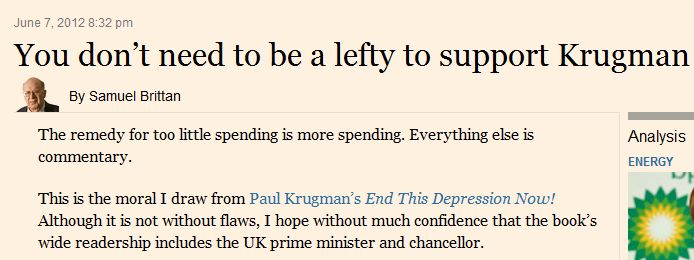
You don’t need to be a lefty to support Krugman
Samuel Brittan, Financial Times 7 June 2012
The remedy for too little spending is more spending. Everything else is commentary.
This is the moral I draw from Paul Krugman’s End This Depression Now! Although it is not without flaws, I hope without much confidence that the book’s wide readership includes the UK prime minister and chancellor.
I wish there were a way of getting finance ministers to learn by heart the chapter on the folly of their deficit obsession. As Mr Krugman says:
“The government is simply finding a use for the excess of what the public wants to save over what it is willing to invest.”
There is nothing new about the hostility of conventional opinion to the Krugman message. Keynes faced similar hostility when he tried to rescue capitalism from the Depression.
Irving Fisher “debt deflation”
”The boom, not the slump, is the right time for austerity.”
So declared John Maynard Keynes 75 years ago, and he was right.
An economy is not like an indebted family. Your spending is my income, and my spending is your income.
So what happens if everyone simultaneously slashes spending in an attempt to pay down debt? The answer is that everyone’s income falls
Paul Krugman 31 May 2012
Rolf Englund blog 7 mars 2012
The German Chancellor
“It’s just about not spending more than you collect.
It’s astonishing that this simple fact leads to such debates,”
Speaking yesterday the British Chancellor, George Osborne, said:
“Eurozone countries needs to stand behind their currency
or face up to prospect of a Greece exit with all the risks that that could involve.”
Telegraph 22 May 2012
Michael Meister, a member of Ms Merkel’s Christian Democratic Union party, said there was nothing to stop France and Italy from going it alone on common bonds.
“No one is preventing Hollande going ahead with joint bonds for France and Monti for Italy,” he wrote on Twitter, referring to the French and Italian leaders.
A learned article making the case that high unemployment is the result of our failure to adapt to rapid technological change, and that there are no easy answers.
In particular, welfare programs designed to protect workers from the costs of change are making things much worse.
Clearly, the problem requires structural reform, and it’s foolish to think that it could be solved just by increasing demand.
Paul Krugman, New York Times 9 May 2012
In the two years after the article was published, as the US began its military buildup and demand increased as a result, employment rose by 20 percent — the equivalent of adding 26 million jobs today.
Source: The American Economic Review, Vol. 29, No. 2 (Jun., 1939), pp. 246-259, URL: http://www.jstor.org/stable/1803623
Europa leds av ett tankefel
Merkantilismen har ersatt kapitalismen och orsakat dagens kris
Om alla länder ska ha exportöverskott finns det inga som kan importera detta överskott.
Den merkantila principen och analogin med ett vanligt hushåll är fel
Danne Nordlling 20 maj 2012
De länder som lyckats forcera fram ett exportöverskott borde förstå att det förutsätter att andra har förmåtts acceptera ett underskott.
Men istället gör man merkantilismen till moralisk norm och fördömer de länder som har underskott. De ska förpakta sig att driva svångremspolitik för att få bort underskottet i statsfinanserna inom några år.
Sannolikt tror man att det automatiskt också kommer att eliminera exportunderskottet.
En återbetalning förutsätter att Grekland mfl skaffar sig ett handelsöverskott. Då måste Tyskland skaffa sig ett underskott. Känns det rätt för Angela Merkel och hennes arga väljare?
Merkantilismen och analogin med vanliga hushåll är tydligen fel. Europas politik verkar styras av ett ekonomiskt tankefel.
Några fasta växelkurser och konstlade valutaunioner, som medger uppbyggnaden av gigantiska obalanser, ska man inte ha.
In a fusillade of debates and speeches President Barack Obama and his Republican challengers have firmly established
the economic policy combat lines for next year.
Steven Rattner, FT 12 September 2011
Many economists agree that the drastic measures taken probably prevented a repeat of the Great Depression. But...
Howard Gold, MarketWatch 1 July 2011
As he saw it, the propensity to save has exceeded the propensity to invest throughout most of recorded history.
The unpopularity of very low interest rates leads to what is known in financial circles as “the search for yield”.
Samuel Brittan, FT March 31 2011
Paul Krugman 10 June 2011
J. Bradford DeLong, 2011
Unemployment tends to rise when GDP growth falls below about 2.5-3 per cent
Gavyn Davies blog June 15, 2011
Click here
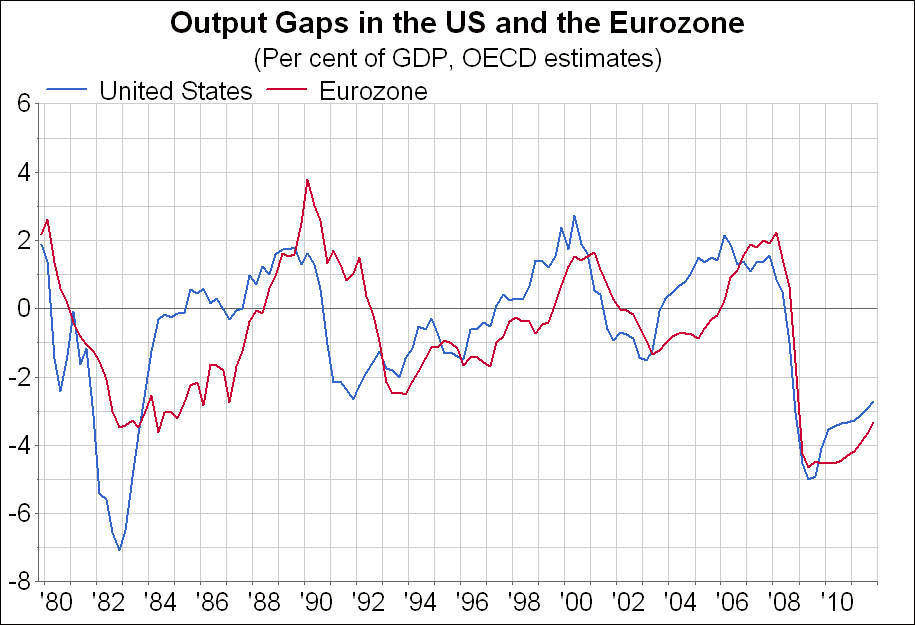
One Sunday in October 2008, Alistair Darling flew back from Washington to find Britain on the brink of banking meltdown. The chancellor was told by his Treasury officials that unless a rescue plan was announced by the time the City opened for business the following morning, there was no guarantee that cashpoints would work and that cheques would be honoured.
The possibility of global financial implosion concentrated minds wonderfully; bailout plans were announced that ensured disaster was averted. Co-ordinated and collective action meant there was no return to the 1930s, and within six months most countries were recovering.
Larry Elliott, Guardian, 31 May 2011
China's economy is now almost a third bigger than it was at the start of 2008, while India's has grown by almost a quarter.
The US and Germany have recouped all the ground lost in the Great Recession.
För ekonomer
DeLong and Summers:
Fiscal Policy in a Depressed Economy: Conference Draft
Brookings 22 March 2012
zc
Spotting a banking crisis is not like predicting the weather
Short-term weather forecasts are better than medium-term economic forecasts
John Kay, Financial Times, August 13, 2013
In contrast, severe recessions, property bubbles and bank failures are relatively infrequent,
and calibration by economists has come to mean tweaking models to better explain the past rather than revising them to better predict the future
– a particularly dangerous methodology when there are many reasons to think that the underlying structure of the economy is in a state of constant flux.
The objective of monetisation has not been to put money in the hands of consumers and businesses
but to put money in the vaults of banks.
To be fair, the central bankers who disbursed it hoped some might work through to the real economy.
But their primary objectives were to underwrite the past losses of the banking system and allow the strengthening of bank balance sheets.
That is why these mechanisms for printing money have won plaudits rather than excoriation from the traditional defenders of sound currency.
John Kay, Financial Times 12 February 2013
The reputation of economists, never high, has been a casualty of the global crisis.
Ever since the world’s financial system teetered on the abyss following the collapse of Lehman Brothers three years ago next month, critics from Queen Elizabeth II downwards have posed one uncomfortable yet highly pertinent question:
are economists of any use at all?
John Kay, FT 25 August 2011
Once, not so long ago, Americans thought their central bank near omnipotent. As economist Paul Krugman put it in 1997, the U.S. unemployment rate would be what then Fed Chairman Alan Greenspan wanted it to be, “plus or minus a random error reflecting that he is not quite God.”
With the Fed’s short-term interest-rate target at 5.5 percent, the central bank had plenty of room to cut rates if it wanted to boost markets and stimulate the economy.
It did just that when financial troubles struck in 1998, keeping the boom roaring for two more years.
Today, no such intervention is possible.
The Fed quickly slashed its interest-rate target to near zero during the crisis of late 2008.
Since then, it has been pinned against what economists ominously call the “zero lower bound,”
forced to confront the most challenging economic period since the Depression without its monetary tool of choice.
Ryan Avent, Bloomberg 22 February 2013
I USA var så kallade National Banks länge förbjudna att lämna lån mot säkerhet i fastigheter. Banker skulle inte vara pantlånare.
Grant beskriver spekulationsvågorna gällande mark, fastigheter och aktier och främst 1920-talets utveckling fram mot kulmen 1929. Han uppehåller sig mycket vid den av andra föga uppmärksammade frågan om hur det kom sig att det tog så lång tid, ända fram till 1950-talet, innan lusten att låna kom tillbaka.
Det erinrar om dagens situation där I USA centralbankschefen Greenspan försöker uppnå en "soft landing" på ekonomins hangarfartyg.
Han känner att han inte kommer fram, drar gasen - räntan - i botten, men motorn, penningmängden, svarar inte. Farten sjunker.
Rolf Englund, Smedjan nr 4/1992
Republicans are dead wrong
The latest devastating demonstration of that wrongness comes from IMF, which has just released its World Economic Outlook,
a grim and disturbing document, telling us that the world economy is doing significantly worse than expected,
with rising risks of global recession.
Paul Krugman, New York Times, 11 October 2012
Bank of England raised interest rates to 7 per cent in 1920.
The aim of this was to support the return to the prewar /USD-GBP/ parity.
Coupled with the consequent deflation, the result was extraordinarily high real interest rates.
This, then, was how the self-righteous fools in the British establishment greeted the hapless survivors of the hellish war.
Martin Wolf, Financial Times, 9 October 2012
What happens if a large, high-income economy, burdened with high levels of debt and an overvalued, fixed exchange rate, attempts to lower the debt and regain competitiveness?
This question is of current relevance, since this is the challenge confronting Italy and Spain.
Yet, as a chapter in the International Monetary Fund’s latest World Economic Outlook demonstrates,
a relevant historical experience exists: that of the UK between the two world wars.
Martin Wolf, Financial Times, 9 October 2012
Andrew Huszar vittnar om intern kritik bland Fed-chefer som varnade för att QE inte fungerade som det var tänkt.
Hans egna köp av bostadsobligationer hjälpte inte vanliga amerikaner.
Bankerna lånade inte ut, och de lån som gavs blev inte billigare. Däremot gjorde bankerna själva enorma vinster.
Andreas Cervenka, SvD Näringsliv 12 november 2013
Några år senare, efter insatser på svindlande 4 000 miljarder dollar, konstaterar han att Federal Reserve inte lyckats få USA:s ekonomi att växa mer än marginellt. Istället har stimulanserna bara minskat trycket på Washington att ta itu med USA:s strukturellt osunda ekonomi och blivit ett skyddsnät för Wall Streets megabanker som blivit de stora vinnarna.
As a former Federal Reserve official, I was responsible for executing the centerpiece program of the Fed's first plunge into the bond-buying experiment known as quantitative easing.
The central bank continues to spin QE as a tool for helping Main Street.
But I've come to recognize the program for what it really is: the greatest backdoor Wall Street bailout of all time.
Mr. Huszar, a senior fellow at Rutgers Business School, is a former Morgan Stanley managing director,
Wall Street Journal via zerohedge, 12 November 2013
Having been at the Fed for seven years, until early 2008, I was working on Wall Street in spring 2009 when I got an unexpected phone call. Would I come back to work on the Fed's trading floor? The job: managing what was at the heart of QE's bond-buying spree—a wild attempt to buy $1.25 trillion in mortgage bonds in 12 months.
Incredibly, the Fed was calling to ask if I wanted to quarterback the largest economic stimulus in U.S. history.
Cui bono? /("To whose benefit?", literally "[being] good for whom?") is a Latin adage that is used either to suggest a hidden motive or to indicate that the party responsible for a thing may not be who it appears at first to be. /
The banks, of course.
The first, second and third beneficiaries of the Federal Reserve’s pending helicopter drop of cash will be banks, not ordinary people or companies.
How to solve the financial crisis?
Let me tell you a little secret, folks.
Play for time. A few years of nice profits will help offset the big losses from past blunders
Allan Sloan, senior editor CNN, August 18, 2008
Jag tycker det är skriande uppenbart att räntan världen över är för låg och
att en större del av stimulanserna borde ske via finanspolitiken.
Rolf Englund blog, 2009-12-05
QE - What If the Fed Has It All Wrong?
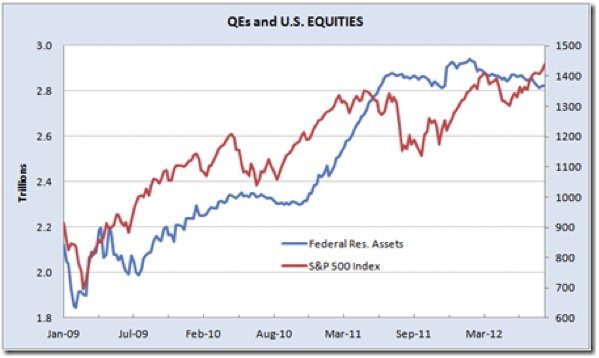
Inflating asset prices without having a definitive impact on the economy other than,
most importantly, preventing a lethal debt-deflation spiral.
By Denis Ouellet, via John Mauldin, 25 September 2012
This is the 4th major intervention from the Fed since 2009, each one apparently inflating asset prices without having a definitive impact on the economy other than, most importantly, preventing a lethal debt-deflation spiral.
The Siren Song of 'Beautiful Deleveraging'
Charles Hugh Smith, via Peak Prosperity, September 2012
Basel
Bank of England’s latest financial stability report call for the banks to bolster their capital base in order to boost their capacity for lending to industry and commerce.
Yet there is a chicken-and-egg problem here that relates to investors’ readiness to stump up.
For as the Financial Policy Committee itself points out, the banks sell at a discount of around a third to net asset value because of
uncertainty about the value of assets that are difficult to price and a well justified conviction that the assets are overvalued.
John Plender, Financial Times 4 December 2012
Treasuries have turned anything but risk-free
The global financial system is hostage to a big rise in borrowing costs
when the retreat from QE puts an end to the current era of extraordinarily low interest rates.
John Plender, FT 22 October 2013
The rise in bond yields will thus inflict big capital losses on bond holders.
Neither the Fed nor anybody else can know how those losses will be distributed around an increasingly complex system. How far bonds have been hedged or leveraged is likewise unclear.
Jag tycker det är skriande uppenbart att räntan världen över är för låg och
att en större del av stimulanserna borde ske via finanspolitiken.
Rolf Englund blog, 2009-12-05
Next Bubble Is Forming: U.S. Government Bonds
The greatest ever monetary experiment
Throughout history monetary experiments have shown a nasty tendency to blow up.
I repeat: this experiment is vast.
John Plender, Financial Times 25 September 2012
September 2012 will surely go down in history as the month in which the world’s top central bankers set the seal on the greatest monetary experiment of all time.
Mario Draghi of the European Central Bank committed to buying eurozone sovereign debt without limit.
Federal Reserve chairman Ben Bernanke announced an open-ended asset purchase programme aimed specifically at a weak US labour market.
Then at the Bank of Japan Masaaki Shirakawa announced an aggressive expansion of monetary easing, increasing the size of asset purchases and extending the deadline for the purchasing programme.
Stephen Cecchetti and colleagues at the Bank for International Settlements have calculated that the primary fiscal surplus as a percentage of gross domestic product must swing over 10 years by 15 percentage points in the UK, 14 per cent in Japan, 11 per cent in the US and 9 per cent in France just to stabilise public debt at the pre-crisis level. How likely are their governments to pull off this awesome trick?
The Trouble with Printing Money
QE3 reflects a colossal failure to address our predicament
Chris Martenson, September 18, 2012
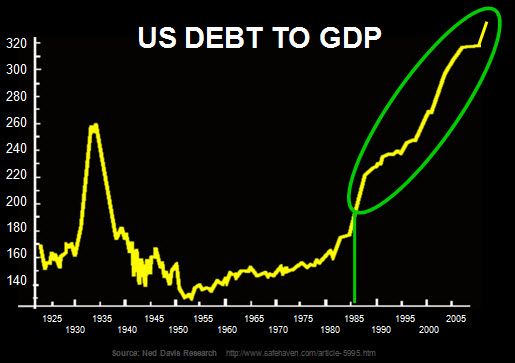
Now we have two of the most important central banks, that of the U.S. (the Federal Reserve) and in Europe (the ECB) having committed to open-ended, limitless QE.
Not just because of fears that the timing of QE3 looked “political”.
The bigger worry is that the benefits of QE3 are so unclear,
because the transmission mechanism is so muddled, while the potential costs are so high.
Gillian Tett, Financial Times, September 20, 2012
Fed announced last week that 11 of the 12 voting members of the Fed committee backed Bernanke’s move. But what the Fed did not reveal was that while almost all of the voting committee members supported QE3, several non-voting members did not (under the Federal system, the regional presidents vote on a rotating basis.) Indeed, if you include those non-voting members, around a third of the committee was wary, if not unhappy, with QE3.
Richard Fisher, head of the Dallas Fed, observed in a powerful speech on Wednesday (which cited the Duke survey): “Nobody on the [Fed] committee...really knows what is holding back the economy. Nobody really knows what will work to get the economy back on course.
Anyone who feels tempted to start celebrating the recent share price rally, in other words, would do well to read Fisher’s bold speech – and then take a long, deep breath.
Richard W. Fisher, Remarks before the Harvard Club of New York City September 19, 2012
“It is the demand, stupid.”
Men jag förstår inte det här med “quantitative easing”
Rolf Englund blog 19 september 2012
Jag är tydligen inte ensam om att inte förstå quantitative easing
Rolf Englund blog 21 september 2012
Mer än 95 procent av alla pengar skapas i och av privata banker.
Pengaskapandet sker när banker beviljar lån.
Andreas Cervenka, SvD Näringsliv 2 september 2012
En vanlig uppfattning är att banker tar kunders sparpengar och lånar ut dessa till andra kunder. Det är ett synsätt som härstammar från äldre skolboksmodeller. Så fungerar det inte i den moderna finansvärlden. En bank behöver inte vänta på att någon sätter in pengar för att kunna låna ut.
Allt mer av utlåningen har gått till spekulation i stigande priser på tillgångar, som hus och aktier. Prisuppgången föder mer krediter, som i sin tur driver upp priserna, vilket gör att bankerna lånar ut ännu mer och så vidare i en självförstärkande virvelvind. På pappret ser det bra ut, bankerna tjänar pengar och ekonomin går för högtryck.
I själva verket kan allt vara ett luftslott. Detta blir uppenbart först på vägen ned. Banker har nämligen inte bara förmågan att skapa pengar utan också att destruera dem, vilket sker när krediter dras in och dåliga lån skrivs ned. Det gör att börsen och fastighetspriser rasar, utlåningen sjunker ännu mer och så vidare.
Come on Bernanke, fire up the helicopter engines
Samuel Brittan, Financial Times, August 30, 2012
Brent crude jumped to $115 a barrel last week.
Petrol costs in Germany and across much of Europe are now at record levels in local currencies.
This is a remarkable state of affairs given the world economy is close to a double-dip slump right now, the latest relapse in our contained global depression.
Ambrose Evans-Pritchard, 26 Aug 2012
Har Borg knäckt den keynesianska koden?
Man håller igen när det går trögt och gasar på när hjulen rullar.
Det är inte ortodox konjunkturpolitik, om man så säger.
SvD-ledare 25 augusti 2012
I suspect that we’re seeing the old Schumpeter “work of depressions” mentality,
the notion that all the suffering going on somehow serves a necessary purpose
and that it would be wrong to mitigate that suffering even slightly.
This doctrine has an undeniable emotional appeal to people who are themselves comfortable.
Paul Krugman with link to Brad DeLong 6 June 2012
It’s also completely crazy given everything we’ve learned about economics these past 80 years. But these are times of madness, dressed in good suits.
The Economic History of the Twentieth Century
The Great Crash and the Great Slump
J. Bradford DeLong
Paul Krugman och jag om finanspolitiken som stimulans i stället för räntan
Rolf Englund 26 maj 2012
Sannolikt lämnar Grekland euron
Resten av Europa har nu bättre chanser än för två år sedan att hantera förlusterna på de grekiska fordringarna.
SEB förordar en mer expansiv politik både för Sverige och Euroland.
Danne Nordling, 8 maj 2012
Man behöver inte tro på Keynes teorier från 1930-talet för att se både
den politiska och ekonomiska faran i en finanspolitik som spär på nedgången.
Det långsiktigt nödvändiga – att sanera skuldsatta ekonomier – är inte en klok strategi i ett akut läge.
Peter Wolodarski, DN 13 maj 2012
The /Spain/ government’s calculations are based on a simple extrapolation of the necessary fiscal adjustment from nominal GDP.
In an economy of roughly €1 trillion, the 3.2 percentage point targeted reduction in the deficit would,
on the government’s thinking, therefore require a €32bn consolidation.
You hardly need to be an economist as accomplished as Prof Garicano to figure out that ripping 3.2pc of demand out of the economy will cause it to be smaller at the end than it was at the beginning.
Jeremy Warner, Telegraph 18 April 2012
Fiscal and monetary policy in a liquidity trap
What is the correct approach to fiscal and monetary policy when an economy is depressed and the central bank’s rate of interest is close to zero?
These are two enormously important questions raised by current circumstances in the US, the eurozone, Japan and the UK.
Martin Wolf, Financial Times April 17, 2012
Broadly speaking, I can identify three macroeconomic viewpoints on these questions:
The first is the pre-1930 belief in balanced budgets and the gold standard (or some other form of a-political money).
The second is the religion of balanced budgets and managed money, with Milton Friedman’s monetarism at the rules-governed end of the spectrum and independent inflation-targeting central banks at the discretionary end.
The third demands a return to Keynesian ways of thinking, with “modern monetary theory” (in which monetary policy and central banks are permanently subservient to fiscal policy) at one end of the policy spectrum, and temporary resort to active fiscal policy at the other.
Liquidity trap
Two new papers bring light from the second of these perspectives.
Martin Wolf, Financial Times April 17, 2012
One is co-authored by Paul McCulley, former managing director of Pimco and inventor of the terms “Minsky moment” and “shadow banking”,
and Zoltan Pozsar, formerly at the Federal Reserve Bank of New York and now a visiting scholar at the International Monetary Fund.
Does Central Bank Independence Frustrate the Optimal Fiscal-Monetary Policy Mix in a Liquidity Trap?
The other is co-authored by J. Bradford DeLong of the university of California at Berkeley,
and Lawrence Summers, former US treasury secretary and currently at Harvard university.
Fiscal Policy in a Depressed Economy
There is no central bank shortcut to the goal of full employment
If one is really determined to boost demand, production and employment by pumping money into the economy,
the clear preference should be for the fiscal pumps.
Dan Kervick, neweconomicperspectives, April 6, 2012
Vad som sker just nu i Europa är något helt annat än vad Sverige genomförde på 1990-talet.
Att skära ner i en liten ekonomi när resten av världen går bra (och dessutom bli belönad med lägre och lägre ränta) är en sak.
I Sverige vågar dock nästan ingen säga det av rädsla för att stöta sig med våra modiga män och kvinnor på finansdepartementet.
Vi är helt irrationella i den här frågan.
Katrine Kielos i en ledarkrönika Aftonbladet den 8 april 2012
Jag kan i själva verket tycka att Tyskland leder saneringen av Europas ekonomi just genom att agera bromskloss.
Merkels lite buttra motsträvighet fyller en viktig funktion som motvikt mot röster och stater
som bara vill brassa på med stödåtgärder utan att bekymra sig över myntets baksida.
SvD-ledare Claes Arvidsson 24 mars 2012
Istället för att satsa oss ur kristider innebär arbetslinjen att vi arbetar oss ur de besvärliga perioderna.
Medicinen är något beskare men sockerpiller hjälper bara mot inbillade problem.
SvD-ledare, signerad Maria Ludvigsson, 19 mars 2012
Viritanen säger i God morgon världen att det i Finland ”råder en mer naiv Keynesiansk inställning” varpå han ifrågasätter den traditionella stimulanspolitiken. Att blåsa på under lågkonjunktur för att spara i högkonjunktur har traditionellt lett till att spenderbyxorna behållits på även i goda tider.
Sockerpiller
“You cannot solve a debt crisis by creating more debt.” As Martin Wolf reminds us, this disarmingly simple statement has been of profound importance in shaping public attitudes to the economic crisis.
The failure to make a compelling political argument against this proposition has been crucial in limiting the feasible scale of the fiscal response to the crisis.
Whether one looks at the US, the UK or the eurozone, an aversion to “more debt” has become a dominant political theme, as it did in the 1930s.
Gavyn Davies, Financial Times 16 March 2012
Richard Koo, a leading student of the debt crisis in Japan, has even argued recently that it is impossible to respond adequately to a balance sheet recession in a democracy because the public dislike of “more debt” becomes so profound.
Simon Wren-Lewis has another very good blog post, this time on the very weak case for demanding fiscal austerity right now,
even if you believe fiscal consolidation is needed in the long run. I want to tie this together with
Brad DeLong’s preview of DeLong-Summers on fiscal policy in a liquidity trap.
Paul Krugman March 17, 2012
Europe’s leaders, and more broadly its policy elite, substituted moralizing for analysis, fantasies for the lessons of history
Now the results are in — and they’re exactly what three generations’ worth of economic analysis and all the lessons of history should have told you would happen.
Paul Krugman, New York Times 19 February 2012
Specifically, in early 2010 austerity economics — the insistence that governments should slash spending even in the face of high unemployment — became all the rage in European capitals.
The doctrine asserted that the direct negative effects of spending cuts on employment would be offset by changes in “confidence,” that savage spending cuts would lead to a surge in consumer and business spending, while nations failing to make such cuts would see capital flight and soaring interest rates.
If this sounds to you like something Herbert Hoover might have said, you’re right: It does and he did.
Now the results are in — and they’re exactly what three generations’ worth of economic analysis and all the lessons of history should have told you would happen.
The confidence fairy has failed to show up: none of the countries slashing spending have seen the predicted private-sector surge.
Instead, the depressing effects of fiscal austerity have been reinforced by falling private spending.
I dag kan vi konstatera att Krugman haft fel inte bara om Baltikum, Grekland, Sverige och USA utan också om Storbritannien.
Märkligt nog har han fått stöd av den traditionellt konservativa internationella valutafonden som borde ha vetat bättre men nu får dela skammen med Krugman.
Anders Åslund, SvD 24 maj 2015
Some economists are so concerned about the present rapid rise in government debt that they favour immediate fiscal tightening.
Others are so concerned about the risk of renewed recession,
and are so unconcerned about the risks from extra public debt, that they demand immediate fiscal easing on a large scale.
Gavyn Davies, Financial Times 24 February 2012
In many economies, this debate has now reached a stand-off, in which governments are trying to reduce deficits and debt only very gradually, while hoping that a recovery in private expenditure will keep the economy out of recession.
The result, which satisfies nobody, is very slow GDP growth and a continuing rise in public debt ratios.
Only in countries where the risk of a debt crisis has turned into grim reality (i.e. the peripheral countries of the eurozone)
has the stand-off been broken, with a much sharper move towards fiscal retrenchment.
So far, the results of this shift have not been at all encouraging.
Economists are divided as to whether the Fed can or should do anything
Some call for the Fed to be much more aggressive. Others say that a slow and painful recovery is inevitable
Here, four economists suggest what options they think the Fed chairman should be mulling ahead of his Jackson Hole speech.
BBC 25 August 2011
What is the real rate of interest telling us?
The real interest rate on US and UK government debt is currently near to zero
Martin Wolf, 19 March 19 2012
Bond yields have been extraordinarily low in the developed world in recent times because the economies have been stuck in, or very near, a liquidity trap.
Longer term government interest rates have remained positive, but at 1.9 per cent they were very close to the territory which Keynes warned about,
in which the future yield on the bonds did not compensate holders for the risk of capital loss if economic circumstances changed.
Gavyn Davies, FT, 18 March 2012
U.S. Treasury Secretary Timothy Geithner warned heavily indebted countries not to resort to draconian measures to fix their budgets,
according to congressional testimony released on Monday
Reuters, 20 March 2012
The truth, although nobody on the right will ever admit it, is that
Friedman was basically a Keynesian — or, if you like, a Hicksian.
Paul Krugman, NYT blog 14 March 2012
His framework was just IS-LM coupled with an assertion that the LM curve was close enough to vertical — and money demand sufficiently stable — that steady growth in the money supply would do the job of economic stabilization.
These were empirical propositions, not basic differences in analysis; and if they turn out to be wrong (as they have), monetarism dissolves back into Keynesianism.
I have a dream. It is to create an, or rather, the, Hayek-Friedman-Keynes Synthesis
Rolf Englund blog 15 March 2012, with reference to 2005
Re-elected with 61 percent of the vote in 1936, President Franklin D. Roosevelt told his supporters,
"Now I'm going back to do what they call balance the budget."
True to his word, he cut spending and promptly sent the nation into a recession - a sharper decline than in 1929
Kenneth Lipartito, Bloomberg 12 March 2012
One cannot get out of debt by taking on more debt. How often have you read such remarks? It is a cliché. As the McKinsey Global Institute study points out, it is also false.
McKinsey Global Institute study
Sweden and Finland, both hit by big crises in the early 1990s, are good examples
Martin Wolf, March 13, 2012
The benign story unfolds like this:
a big increase in leverage ends in a huge financial crisis; the government promptly restructures the financial system; excessively indebted private borrowers reduce their obligations by slashing spending; central banks cut interest rates;
the resulting collapse in activity and profits pushes the government into huge fiscal deficits, which also support the economy;
finally, the economy recovers, helped by exports, and the government begins its fiscal retrenchment.
Thus the temporary rise in fiscal deficits helps protect the economy from the forced private retrenchment.
The alternative would be a depression, in which mass bankruptcy, not repayment, lowers debt.
Den hemska sanningen om John Hassler, Göran Persson och kronkursförsvaret
Rolf Englund blog 7 mars 2012
This was not what was supposed to happen
Krugman om Trichet och åtstramning som ger tillväxt
New York Times, 11 mars via Rolf Englund blog
Economists And Post-Crisis Policy (Also Ireland)
Henry Farrell and John Quiggin have posted their fascinating paper on the rise and
temporary, I think) fall of Keynesian economics in the aftermath of the financial crisis
Paul Krugman, March 11, 2012
Det finns starka skäl att tillåta ganska stora underskott i en lågkonjunktur,
när skatteinkomsterna faller samtidigt som de offentliga utgifterna snarare behöver stiga än sjunka.
Men det behövs också någon form av regel eller spärr som gör att det inte uppstår budgetunderskott även i mer normala tider.
SNS Konjunkturrådsrapport 2012 debattartikel GP
SNS Konjunkturråd 2012:
Det stabiliseringspolitiska regelverket kan förbättras – även i Sverige
SNS
Det är djupt tragiskt att Grekland ska få lida så mycket
genom att helt amatörmässiga föreställningar om nationalekonomi ska tillgodoses
Det finns inte några korrekta och samtidigt accepterade teorier om hur stora kriser av dagens typ ska hanteras
Det såg vi redan i Sverige i början av 90-talet
Danne Nordling, 16 februari 2012
Det är de mest okunniga väljarna i Tyskland, Finland och Holland som tycks få styra politiken gentemot Grekland. De tror att ett ett lands ekonomi fungerar på i princip samma sätt som ett vanligt hushålls.
Men sedan finns det sådana som Daniel Gros som legitimerar nedskärningspolitiken genom att tala om sparande. Det hela bottnar i att nationalekonomins "neoklassiska skola" urartade på ett sätt som gör att det inte finns några korrekta och samtidigt accepterade teorier om hur stora kriser av dagens typ ska hanteras. Det såg vi redan i Sverige i början av 90-talet.
Det såg vi redan i Sverige i början av 90-talet.
The debate on the correct setting for fiscal policy at a time of recession is probably the oldest debate in macro-economics.
One key element in the debate is the trade off between supporting output growth in the short term,
versus the need to control the growth of public debt in the long term.
Gavyn Davies, FT 5 February 2012
There are some economists who do not recognise that this trade off exists at all, because they claim that an increase in the fiscal deficit cannot impact aggregate demand, even in the short run.
But this is not a view which I believe to be supported either by empirical research or by economic theory (except on some very restrictive assumptions about Ricardian Equivalence or Says Law).
Sometimes, advocates on both sides of the debate assume that the answer is obvious.
Supporters of fiscal easing tend to take it as axiomatic that higher public debt will have no effect on inflation or interest rates, and frequently quote the example of Japan in support of their argument.
Meanwhile opponents of fiscal easing take it as equally axiomatic that a fiscal crisis is to be avoided at all costs, and quote the examples of Greece, Italy and Spain to support their case.
The big divide is between those – the Austrians
– who hold that the mistakes are made by governments while the solution is to let the distorted financial edifice collapse
and those – the post-Keynesians
– who hold that a modern economy is inherently unstable, while letting it collapse would take us back to the 1930s.
I am decidedly in the latter camp.
Martin Wolf, Financial Times, January 3, 2012
One might not expect much from economists, but one would surely expect them to warn us of a crisis on this scale.
Speech given by Martin Wolf, chief economics commentator, at the FT’s annual economists’ drinks party in London
Financial Times, 27/11 2008
Om man har en sedelpress går man inte i konkurs
Soros: People like Schäuble don't seem to understand that the heavily indebted countries are now at a severe disadvantage,
because they have basically become heavily indebted in a foreign currency, the euro.
Der Spiegel, 13 February 2012
They do not control it, and so they are in the same position as third world countries in Latin America were in at the beginning of the 1980s, where the countries became indebted in dollars.
It was a situation that led to a lost decade there. Europe now faces a lost decade.
Om man har en sedelpress går man inte i konkurs
It looks increasingly clear that sub-sovereign eurozone borrowers are in a different position from a sovereign country, such as the UK
Martin Wolf, Financial Times 2 February 2012
Om man har en sedelpress går man inte i konkurs
Financial Times: Italien har ingen sedelpress
Just like the banks in 2008, Italy cannot print money to alleviate its problems
Det som Tyskland fruktar, dvs. en kraftig förlust av konkurrenskraft mot södra euroområdet, är nödvändig för att komma ur eurokrisen.
Detta är inte en olycklig biprodukt utan själva syftet med den nu förda politiken,
som ju går ut på att sänka offentliga utgifter och höja skatter så att skyhög arbetslöshet och företagskonkurser tvingar fram fallande löner
Det är det man menar med uttrycket ”interndevalvering”
Nils Lundgren, 22:e januari 2012
Britain’s slump has now gone on longer than the slump in the 1930s
it’s worth remembering the rapturous reception the Cameron austerity program received here,
not just from the right, but from centrists. Here’s David Broder:
Cameron and his partners in the coalition have pushed ahead boldly, brushing aside the warnings of economists that the sudden, severe medicine could cut short Britain’s economic recovery and throw the nation back into recession.
Paul Krugman, January 28 January 2012
Indeed, Broder's column - which I mercifully did not read at the time - is worse than I imagined
- That the Washington Post Published and Kept on Publishing David Broder Is Reason Enough for It to Shut Down Today and Never Reopen
Brad DeLong January 28, 2012
David Cameron låter som Johanna Möllerström.
Det är inget beröm.
Rolf Englund blog 14 oktober 2011
”Det stora tåglånet – räddningen för Sveriges järnvägar”
Järnvägen har grovt eftersatt underhåll och starkt ökad efterfrågan.
Nuvarande statsfinansiella regelverk försvårar förbättringar.
Carl-Johan Westholm, DN Debatt 25 januari 2012
På Strängs tid var statsbudgeten uppdelad i en driftsida och en kapitalsida, dvs en åtskillnad mellan utgifter för konsumtion och för investeringar. Men Sträng såg allt i ett. Ohlin opponerade. Totalbalanseringen gjorde att statens tillgångar oavbrutet ökade, då investeringarna antogs vara lönsamma. Istället menade Ohlin att investeringar kunde lånefinansieras. Avkastningen på dessa borde bli högre än ränteutgiften, och värdet högre än kostnaden.
På regeringarna Fälldins tid 1976-82, med de ekonomiansvariga ministrarna Gösta Bohman och Ingemar Mundebo, försvann denna uppdelning,
Järnvägen har grovt eftersatt underhåll och starkt ökad efterfrågan. Nuvarande statsfinansiella regelverk försvårar förbättringar. Det blir många försenade, inställda och även urspårade tåg.
Regering och riksdag borde med ett separat beslut låta finansieringen ske vid sidan av det överskottsmål för Sveriges offentliga finanser (totalbalans) på 1 procent som funnits sedan krisen i början av 1990-talet. SJ och Trafikverket borde få rätt att låta Riksgälden ge ut obligationer över åren för att betala upprustningen av järnvägen.
”Den som är satt i skuld är icke fri” blev ett bevingat uttryck av dåvarande finansminister Göran Persson i mitten av 1990-talet. Det kan vara sant. Men det kan också vara sant att den som aldrig sätter sig i skuld kan begränsa sin frihet.
European governments have signed a "suicide pact" by imposing fiscal austerity plans that will collapse their economies,
Joseph Stiglitz, the liberal economist, has warned.
Malcolm Moore, Daily Telegraph,Hong Kong, 17 Jan 2012
The consensus is turning against austerity
George Eaton, New Statesman blog, 20 January 2012
The German chancellor remains a believer.
This weekend she said that Greece could rebuild its economy despite austerity.
She accepts that spending cuts alone won't work, but she believes that structural reforms have to be forcefully implemented although they take time.
Gavin Hewitt, BBC Europe editor, 16 January 2012
The big divide is between those – the Austrians
– who hold that the mistakes are made by governments while the solution is to let the distorted financial edifice collapse
and those – the post-Keynesians
– who hold that a modern economy is inherently unstable, while letting it collapse would take us back to the 1930s.
I am decidedly in the latter camp.
Martin Wolf, Financial Times, January 3, 2012
The dominant theoretical paradigm holds that a financial crisis cannot happen and cannot matter if it does happen, at least provided broad money is not allowed to collapse.
In this view, the only things now holding economies back are structural rigidities and policy-induced uncertainties.
This is, in my view, a fairy story, based on theories that reduce capitalism to a barter economy under a thin monetary veil.
Far more persuasive, to me, are views that accept that people make important mistakes. The big divide is between those – the Austrians – who hold that the mistakes are made by governments while the solution is to let the distorted financial edifice collapse and those – the post-Keynesians – who hold that a modern economy is inherently unstable, while letting it collapse would take us back to the 1930s. I am decidedly in the latter camp.
In his prescient 1986 masterpiece, Stabilizing an Unstable Economy, the late Hyman Minsky laid out his financial instability hypothesis. Janet Yellen, vice-chair of the US Federal Reserve, remarked in 2009 that “with the financial world in turmoil, Minsky’s work has become required reading”.
In Minsky’s view, leverage – and so fragility – are determined by the economic cycle.
A lengthy period of tranquillity will raise fragility: people will underestimate dangers and overestimate opportunities.
Minsky would have warned that the “great moderation” contained seeds of its own destruction.
In the eurozone this shift to fiscal austerity is running alongside a still bigger experiment:
the construction of a currency union around a structurally mercantilist core among countries with negligible fiscal solidarity, fragile banking systems, inflexible economies and divergent competitiveness.
The Great Moderation
The Uncomfortable Dance Between V’ers and U’ers
Paul A. McCulley, November 2009
The ideas that sustained the pre-crisis policy framework have been thoroughly discredited
Among these ideas, the central and most clearly falsified are the supposed “Great Moderation” in economic volatility
and the “Efficient Financial Markets Hypothesis”.
John Quiggin, FT November 29 2010
Inept politicians
It looks like 2012 will be the year of self-induced sluggishness.
History teaches that financial crises are followed by years of weakness.
But some of the current pain is unnecessary.
The Economist editorial, Jan 7th 2012
There is no excuse for the lack of clarity around the euro zone’s future, nor for America’s fiscal paralysis.
Europeans do not need to compound the peripheral economies’ problems with even deeper austerity.
A more calibrated approach with more financing and more structural reforms makes far more sense.
Inept politicians have placed a big burden on central banks, which will have to take more unconventional measures, such as quantitative easing (see article). That will ease the agony, but it won’t make up for politicians’ mistakes
Definition of Inept from Merriam-Webster
1 lacking in fitness or aptitude : unfit
2 lacking sense or reason : foolish
3 not suitable to the time, place, or occasion : inappropriate often to an absurd degree
4 generally incompetent : bungling
Ponzi
Western economies have not acted much differently than the fraudster Madoff.
Almost everyone - in Europe and in the United States - has been living beyond their means, from consumers to politicians to entire countries
Alexander Jung, Der Spiegel, 5 January 2012
Why the housing burden stalls America’s economic recovery
The central irony of financial crisis is that while it is caused by too much confidence, too much borrowing and lending and too much spending,
it can only be resolved with more confidence, more borrowing and lending, and more spending.
Lawrence Summers, FT October 23, 2011
Most policy failures in the US stem from a failure to appreciate this truism and therefore to take steps that would have been productive pre-crisis but are counterproductive now with the economy severely constrained by lack of confidence and demand.
Third, stabilising the housing market will require doing something about the large and growing inventory of foreclosed properties.
Recent events have given us a dramatic demonstration of
the reality of nominal wage stickiness.
Despite crushing unemployment, wages in Ireland and Latvia have come down only slightly
— but Iceland, by letting its currency devalue, achieved a quick 30 percent fall in wages relative to the euro zone.
Paul Krugman. December 24, 2011
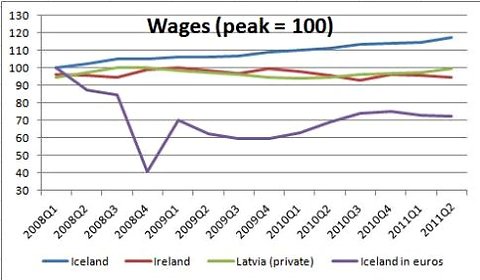
Interndevalvering via Ådalsmetoden
Fiscal Policy Works
Paul Krugman, New York Times, December 24, 2011
Via Brad DeLong, there’s a paper by David Romer (pdf) summarizing recent research on fiscal policy, inspired by the crisis and aftermath.
And his conclusion is not at all what you hear on the talk shows; it is that there is now overwhelming evidence that fiscal policy does in fact work when it’s not offset by monetary policy.
And since we’re now in a liquidity trap in which conventional monetary policy has no traction, that’s the world we’re in.
Keynes
Finding the human causes of this financial crisis can set us on the road to recovery
The starting point is to recognise that this proto-depression is not natural or inevitable.
It is not the result of destruction through earthquake, or famine.
It results from human actions and inactions.
Roger Bootle, Daily Telegraph 9 Oct 2011
Confronting the painful reality of depression conditions in the 1930s, he /Keynes/explained how this happened,
why it might persist and what needed to be done to overcome it.
So why did the prime minister change his speech at the last minute?
There’s a school of thought out there that suddenly having every consumer in the country
close his or her wallet might not be terribly good for the economy.
Tim Harford, FT October 7, 2011
- Aha, this is the famous paradox of thrift?
- Not quite. The paradox of thrift is the idea that when we all try to pay off our debts, in fact we end up more indebted than ever.
- Huh?
Tim Harford is economics leader writer for the Financial Times and writes the “Undercover Economist” columns on Saturdays.
EU finance ministers this week will discuss whether governments with the strongest public finances can provide some budget stimulus to help support flagging economic growth in the 27-nation bloc.
That means governments with the strongest finances—Germany, the Netherlands, Sweden, Finland and Luxembourg—could run smaller surpluses or bigger deficits than expected, diplomats said.
WSJ 2 October 2011
"There are countries for which fiscal consolidation is less useful than others," said one diplomat.
I really wonder about the state of economics education.
Paul Krugman on Ireland
New Yourk Times 23 Sept 2011
Snillen spekulerar
“The evidence is very clear,” said EU employment commissioner Laszlo Andor at a European Parliament hearing.
“The most rapid increases of the unemployment rate in the last one year were observed in countries that underwent very tough austerity.”
WSJ 22 sept 2011
The truly screwy thing about both op-eds is that they both pretend that the problem that caused the recession was a downturn in business investment, with Barro saying not a word about construction and Mankiw only slightly better:
Barro:
How to Really Save the Economy: [T]he main driver of business cycles is investment… the main decline in G.D.P. during the recession showed up in the form of reduced investment…. What drives investment? Stable expectations of a sound economic environment…
Mankiw:
Business Investment as a Key to Recovery: "he most volatile component of G.D.P. over the business cycle is spending on investment…. From the economy’s peak in the fourth quarter of 2007 to the recession’s official end, G.D.P. fell by only 5.1 percent, while investment spending fell by a whopping 34 percent. The subpar recovery has coincided with a historically weak investment recovery. Compare our recent experience with that of the early 1980s, when the nation last experienc…. While the sluggish housing market can explain the slow pace of residential investment, it is not the whole story…
http://delong.typepad.com/sdj/2011/09/
Governments are pushing austerity; bankers are hoarding cash; a recession looms in the United States and Europe.
But Adam S. Posen has a solution: a shock-and-awe display of coordinated central bank attacks aimed at reviving sluggish economies.
An American economist on the Bank of England’s monetary policy committee, Mr. Posen is no academic scribbler or lonely blogger
New York Times 17 Sept 2011
Mr. Posen’s central premise is that governments in Japan, Europe and the United States are running the risk of repeating the policy mistakes of the 1930s, when the conventional wisdom called for strict monetary policy and budget cutting, only deepening the Depression.
”I am here to warn policy makers in the United States, Europe, everywhere that we cannot take our foot off the pedal,” Mr. Posen said before a roomful of small-business leaders and bankers. “The outlook is grim — the right thing to do now is engage in more monetary stimulus.”
The cult of home ownership is dangerous and damaging
You would think that the residential property bubble and subsequent crisis of the past decade
would make people leery of widespread home ownership, and governments reluctant to pump it up.
Yet, here we are again
Adam Posen, Financial Times, July 26, 2013
Interestingly, for all the anti-Keynesian rhetoric of the German government
in 2008/9, as a share of GDP, Germany launched the largest Keynesian expansion of any G7 country.
Roger Bootle, 11 Sepember 2011
G-7 Torn Between Stimulus and Cuts
The inability of finance ministers and central bankers from the Group of Seven nations to come up with a decisive response
so far to problems of growth was reflected in U.S. and European markets, which tumbled as the G-7 officials met in a palace overlooking the sea.
Wall Street Journal, September 10 2011
The difficulty in coming up with a common solution was reflected in the group's communique, which hovered between backing stimulus and backing austerity.
"Fiscal policy faces a delicate balancing act," the G-7 said.
"Given the still fragile nature of the recovery, we must tread the difficult path of achieving fiscal adjustment plans while supporting economic activity, taking into account different national circumstances."
During the height of the global financial crisis in 2008 and 2009, the G-7—the U.S., Canada, Britain, Germany, France, Italy and Japan—came together with others in the G-20 to stimulate their economies and limit the global downturn.
Top of pageThe prime minister revels in his pre-Keynesian views.
When weak demand is the immediate constraint on output, that is simply terrifying.
Martin Wolf, FT October 13, 2011
Alice's Adventures in Wonderland
The prospect that one of these people may well be our next president is, frankly, terrifying.
Republican debate on the economy, like falling down a rabbit hole into a fantasy world
Paul Krugman, New York Times October 13, 2011
Reading the transcript of Tuesday’s Republican debate on the economy is, for anyone who has actually been following economic events these past few years, like falling down a rabbit hole. Suddenly, you find yourself in a fantasy world where nothing looks or behaves the way it does in real life.
And since economic policy has to deal with the world we live in, not the fantasy world of the G.O.P.’s imagination, the prospect that one of these people may well be our next president is, frankly, terrifying.
Down the Rabbit-Hole
Alice was beginning to get very tired of sitting by her sister on the bank, and of having nothing to do: once or twice she had peeped into the book her sister was reading, but it had no pictures or conversations in it, `and what is the use of a book,' thought Alice `without pictures or conversation?'
So she was considering in her own mind (as well as she could, for the hot day made her feel very sleepy and stupid), whether the pleasure of making a daisy-chain would be worth the trouble of getting up and picking the daisies, when suddenly a White Rabbit with pink eyes ran close by her.
Read more here
Finanskrisen blev speciell för Sveriges del. Exporten säckade ihop, vilket slog hårt mot BNP och de anställda i industrin,
men många andra fick det bättre ekonomiskt tack vare jobbskatteavdrag, höjd lön och sänkta räntor.
P J Anders Linder Chefredaktör Ledare, SvD 8 januari 2012
Interndevalvering
Grekland står sannolikt inför en nationell kollaps.
Den europeiska makteliten har fastslagit att vägen till ekonomisk balans i de sydeuropeiska eurokrisländerna är s k interndevalvering.
Nils Lundgren, Newsmill, 2011-11-08
David Cameron låter som Johanna Möllerström.
Det är inget beröm.
Rolf Englund blog 14 oktober 2011
Finanspolitiken har varit för stram i recessionen, menar Calmfors.
Socialdemokraterna har av taktiska skäl anslutit sig till en felaktig politik.
Och journalisterna undviker att ställa frågor
Danne Nordling 25 april 2012
Socialdemokrater av olika slag tycks göra allt för att låtsas som om problemet inte existerade. Och journalisterna undviker att ställa frågor av principiell natur.
Socialdemokraterna var snarare först med en omorientering mot mer finanspolitisk konservatism, som också skett i de flesta andra länder. Det är ett synsätt som överlåter stabiliseringspolitiken till penningpolitiken - tyvärr med ödesdigra risker för successiv uppbyggnad av bostads- och fastighetsbubblor med våldsamma kriser som följd.
Procyklisk
Man bör vara kritisk mot regeringens ovilja att i recessionen 2008/09 föra en mer expansiv finanspolitik.
Och i år kommer finanspolitiken enligt regeringens egna beräkningar att vara åtstramande trots en förväntat svag konjunktur.
Lars Calmfors, kolumn DN, 24 april 2012
Detta verkar spegla finansministerns alldeles egna syn på finanspolitiken: om det blir dåliga tider ska politiken stramas åt för att öka handlingsutrymmet ifall det skulle bli ännu sämre längre fram.
Med denna uppläggning tenderar finanspolitiken att bli procyklisk så att den förstärker, i stället för motverkar, konjunktursvängningarna. I dagsläget kan följden bli en dålig stabiliseringspolitisk ”mix”. Riksbanksdirektionens majoritet vill inte stimulera konjunkturen genom fler räntesänkningar av rädsla för att det kan leda till alltför höga fastighetspriser. I den situationen är en mer expansiv finanspolitik önskvärd.
Finansministerns argumentation är alltför grov. Synpunkter om en lite mer expansiv politik bemöts reflexmässigt med att vi då kan hamna i Greklands eller Spaniens situation. Sanningen är förstås att Sverige med sina starka offentliga finanser spelar i en helt annan division. Tyvärr har regeringens argumentation på denna punkt haft så starkt genomslag att Socialdemokraterna av taktiska skäl inte vågar ifrågasätta den.
Anders Borgs motivering för den försiktiga budgeten är den internationella osäkerheten och de risker som en konjunkturavmattning innebär.
Det kan låta klokt. Men det finns samtidigt skäl att reflektera över principerna för regeringens finanspolitik.
Det är en olämplig konjunkturpolitik med större reformer i goda tider än i dåliga, vilket blir fallet om konjunkturdämpningar får leda till att utrymmet för reformer revideras ner.
En sådan procyklisk finanspolitik förstärker konjunktursvängningarna.
Lars Calmfors, Kolumn DN 22 sept 2011
Budgeten är utformad så att det faktiska finansiella sparandet blir precis noll nästa år.
Det verkar som om regeringen infört ett ytterligare budgetmål: att undvika underskott även i en lågkonjunktur av det slag som förutses. Om målet uppnås, kommer förmodligen överskottsmålet, som ju gäller över en hel konjunkturcykel, att överskridas.
Ett sådant budgetbalansmål kan därför innebära en avsevärd skärpning av de budgetpolitiska ambitionerna.
Riksbankens inflationsmål bör höjas från nuvarande 2 till 3 eller 4 procent för att skapa bättre möjligheter att möta framtida kriser.
Det säger professor Lars Calmfors 2011-09-05
Det skall bli intressant att se hur de svenska ny-hooveristerna
skall ta emot President Obamas senaste stimulanspaket på 447 miljarder dollar.
Rolf Englund blog 10 september 2011
SvD genom Johan Ingerö om Obamas stimulanspaket på 447 miljarder dollar
10 september 2011
The U.S. economy would get a boost of up to 2 percent under President Barack Obama’s $447 billion jobs plan,
say economists at Goldman Sachs Group Inc., Moody’s Analytics Inc. and JPMorgan Chase & Co.
Bloomberg 10/11 2011
Mark Zandi, chief economist at Moody’s
“The plan would go a long way toward stabilizing confidence, forestalling another recession and jump-starting a self-sustaining economic expansion.”
JPMorgan chief U.S. economist Michael Feroli:
“It offsets what would otherwise have been a huge drag from the fiscal restraint” that was due next year, he said.
“The plan reduces the risk of a recession in 2012, though it doesn’t do much for growth in the second half of this year.”
Restraint or stimulus?
Markets and governments swap roles
Stephanie Flanders, BBC Economics editor, 7 September 2011
There was a time, not so long ago, when politicians were profligate and the markets begged for restraint. Not any more.
Now it is politicians - on both sides of the Atlantic - who demand fiscal restraint and spending cuts. While the financial markets seem to be looking for stimulus.
Interest rates are already extremely low. And the talk in Washington - and across Europe - is all of fiscal austerity. This has many on Wall Street extremely concerned.
To cite just one example - a recent report by economists at Bank of America/Merrill Lynch says that "while fiscal austerity could help the long-run outlook, near-term fiscal consolidation threatens the recovery in developed economies".
The biggest constraints on action in the major developed economies now have less to do with those economic realities and
more to do with political paralysis, misplaced fears about inflation and moral hazard,
and unwarranted disaffection with the efficacy of the traditional fiscal tools of tax cuts and investment to encourage growth.
Tim Geithner, FT 8 September 2011
It is time to take the bull by the horns and say that
fiscal policy should aim to balance the economy and not just the national budget,
especially at times when monetary policy cannot do the job on its own.
Samuel Brittan, FT, 8 September 2011
How can we do this without giving every spending authority an excuse for going on a spree when it likes?
I suggest that the national budget should be divided into three parts.
Listen to the markets. They are saying: borrow and spend, please.
Yet those who profess faith in the magic of the markets are most determined to ignore the cry.
Martin Wolf, FT 6 September 2011
Are the markets mad? Yes, insist the wise folk: the biggest risk is not slump, as markets fear, but default.
Yet if markets get the prices of such governments’ bonds so wrong, why should one ever take them seriously?
I cannot be the only person who fears that the situation we are in is causing Martin Wolf's mind to crack.
BradDeLong 6 september 2011
The worst of the euro crisis is yet to come
The most disturbing aspect about the eurozone right now is that
every crisis resolution strategy depends on a moderately strong economic recovery.
Wolfgang Münchau, FT September 4, 2011
Riksbankens inflationsmål bör höjas från nuvarande 2 till 3 eller 4 procent för att skapa bättre möjligheter att möta framtida kriser.
Det säger professor Lars Calmfors 2011-09-05 (Rolf Englund Blog med länkar)
Det säger professor Lars Calmfors i en intervju med Dagens Nyheter
Något för Klas Eklund
"Give Karl Marx a Chance to Save the World Economy"
George Magnus, senior economic adviser at UBS and author of “Uprising: Will Emerging Markets Shape or Shake the World Economy?”
Bloomberg 29 August 2011
Policy makers struggling to understand the barrage of financial panics, protests and other ills afflicting the world would do well to study the works of a long-dead economist: Karl Marx.
The sooner they recognize we’re facing a once-in-a-lifetime crisis of capitalism, the better equipped they will be to manage a way out of it.
So how do we address this crisis? To put Marx’s spirit back in the box, policy makers have to place jobs at the top of the economic agenda, and consider other unorthodox measures.
The crisis isn’t temporary, and it certainly won’t be cured by the ideological passion for government austerity.
Full textKommentar av Rolf Englund:
Klas Eklund var Trotskyist, "trottare", som han, som chefsekonom på SEB, leende brukade säga,
varvid direktörerna skrockade.
Men Trotsky var inte snäll bara för att han blev mördad av Stalin
The current UK depression will be the longest since at least the first world war.
Without a dramatic surge in growth, it is also quite likely to generate a bigger cumulative loss of output than the “great depression”.
All this is disturbing enough. What is even more disturbing is the near universal view that almost nothing can be done to change the prognosis.
Martin Wolf, Financial Times, 1 September 2011
Worse, what almost no one initially foresaw is now seen as next to irremediable.
In an important pamphlet, Bill Martin, at the Centre for Business Research at Cambridge, forcefully attacks this pessimism. His conclusion is that the problem has been the collapse in demand, not in potential supply. Worse, he notes, the longer output remains depressed, the more likely it is that supply potential will be needlessly damaged.
The private sector is seeking to improve balance sheets, by paying down its debt. Frightened by deficits, the government is now trying to do the same. This can add up, without a prolonged slump in activity, if and only if the economy shifts into huge external surplus.
Full textMany ask whether high-income countries are at risk of a “double dip” recession. My answer is: no,
because the first one did not end. The question is, rather, how much deeper and longer this recession or “contraction” might become.
Martin Wolf, Financial Times, 30 August 2011
The fading out of the stimulus is already and noticeably leading to substantial withdrawal of government demand.
Paul Krugman, New York Times 3 September 2011
Look, in particular, at actual government purchases of goods and services — governments at all levels buying stuff — which is what standard macroeconomics says should have the highest multiplier, since unlike transfers and tax cuts it is by definition spent rather than saved. Here’s the picture, showing changes in real spending over the previous year:
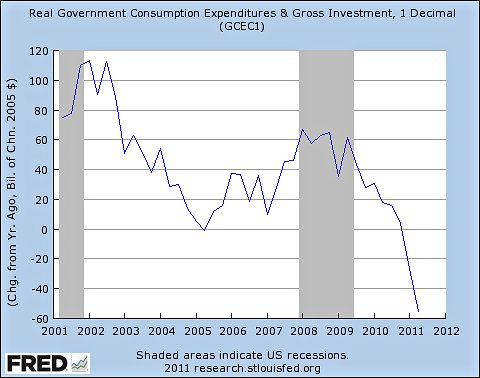
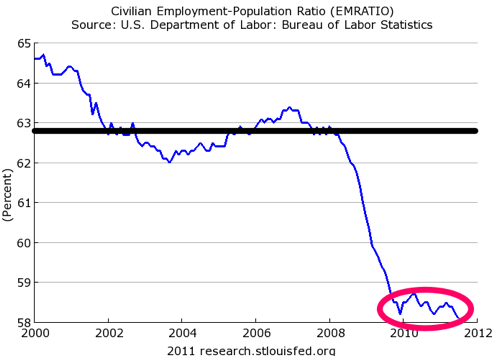
The Disaster That Is American Macroeonomic Policy
Brad DeLong 29 August 2011
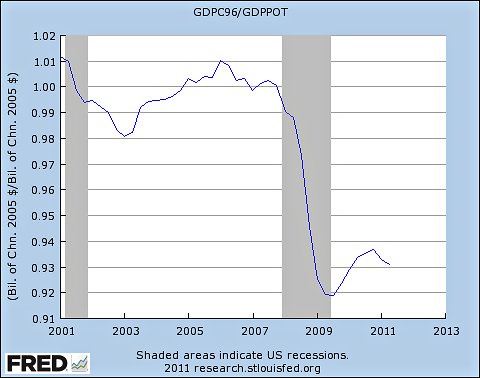
Does that look like a solid if slow recovery? Of course not.
Paul Krugman 26 August 2011
Jackson Hole will be a Black Hole for Those Hoping for QE3
Hope still springs eternal in the financial markets, where there remains the perennial hope that the Fed will “do something.”
/But/ The problem is a failure of demand which has to be addressed via demand measures – that is, fiscal policy.
Auerback/Parenteau August 25, 2011, via Rolf Englund blog 25 augusti 2011
Att Merkel och Sarkozy lägger förslag som i bästa fall är ineffektiva och i värsta fall direkt dubiösa är bara en del av Europas problem.
En annan del är att dessa ledare – men långt ifrån bara de – skjuter in sig så ensidigt på makroekonomin.
Det känns inte 100-procentigt säkert att den här åtgärdslistan kan ställa Europas affärer till rätta (om åtgärderna mot all förmodan skulle bli verklighet)
Svenska Dagbladet, ledare 18 augusti 2011
Det hägrande överskottet i de offentliga finanserna uteblir helt.
Desto viktigare alltså att hålla i; vad motsatsen leder till finns många otäcka exempel på ute i Europa.
DN-ledare 27 augusti 2011
Konjunkturinstitutet har angett det så kallade reformutrymmet till 30 miljarder kronor, men Borg ser bara 10–15 miljarder. Därtill kan spelrummet inte användas som tänkt, utan tyngdpunkten landar på tillfälliga efterfrågestimulanser och arbetsmarknadspolitik.
Men regeringen måste akta sig för att bli för passiv. Ekonomin kan behöva robust stöd.
Full text*
Anders Borg: merparten av reformutrymmet kan komma att användas till ett antal tillfälliga efterfrågestimulanser
Den sortens politik tjänade Sverige väl under krisåren 2008–2009
SvD-ledare 27 augusti 2011
Inhemsk efterfrågan (stimulerad bland annat genom Rut och Rot) drev på tjänstesektorn medan den mer kapitalintensiva industrin säckade ihop.
Regeringen nu räknar med ett årligt inkomstbortfall på 50–60 miljarder kronor under mandatperioden, jämfört med tidigare prognoser.
Av det 30 miljarder kronor stora reformutrymme som Borg skissade på i våras, återstår sannolikt inte mer än max hälften.
Full text*
- Rent sakligt talar fortfarande mer för än emot att sänka skatterna nästa år.
Det skulle inte äventyra stabiliteten i de offentliga finanserna, det skulle däremot dämpa nedgången i efterfrågan och därmed tillväxtfallet.
Men eftersom Moderaterna investerat allt i imagen av ekonomiskt ansvarstagande sätter Reinfeldt och Borg stopp.
Nu kan de säga "skapa säkerhetsmarginaler" lika ofta som "vara garant för ordning och reda i de offentliga finanserna".
Det låter bra
Expressen-ledare 18 augusti 2011
*
In 2008 the world economy was saved from depression by a bold and co-ordinated plan
to shore up banks and counter the slump with fiscal and monetary stimulus.
And, to the extent that policies have a common theme, it is the wrong one:
politicians across the rich world are taking too short-term a view of fiscal austerity
The Economist, editorial print 27 augusti 2011
Today there is no boldness (the euro-zone crisis is the epitome of politicians doing too little too late).
There is no co-ordination.
And, to the extent that policies have a common theme, it is the wrong one: politicians across the rich world are taking too short-term a view of fiscal austerity—a bout of budget-cutting which will only increase the risk of another recession.
Full textReinfeldt och Borg kommer att argumentera för att skjuta på skattesänkningar. Moderaterna trycker på pausknappen.
Rent sakligt talar fortfarande mer för än emot att sänka skatterna nästa år. Det skulle inte äventyra stabiliteten i de offentliga finanserna, det skulle däremot dämpa nedgången i efterfrågan och därmed tillväxtfallet. Säkert är det inte. Men sannolikheten är sisådär 70 procent.
Men eftersom Moderaterna investerat allt i imagen av ekonomiskt ansvarstagande sätter Reinfeldt och Borg stopp.
Nu kan de säga "skapa säkerhetsmarginaler" lika ofta som "vara garant för ordning och reda i de offentliga finanserna".
Det låter bra
Expressen-ledare 18 augusti 2011
The crusade for a balanced-budget amendment that roiled American politics this summer reached Paris this week,
with the announcement from Nicolas Sarkozy and Angela Merkel that every country in the euro zone would commit to passing a balanced-budget amendment to their constitutions by next summer.
Wall Street Journal 18 August 2011
Who says there's no tea party in Europe?
Alas, who says that Europe is immune from the tea party's bad ideas?
We doubt it would be possible to get 17 democracies to approve such an amendment.
We doubt even more that it would be possible to enforce those amendments
— certainly not any more than it proved possible to enforce the Maastricht Treaty rules for the currency union,
which France and Germany were among the first to violate.
Europe's economy slides towards disaster
The EU leaders’ rhetoric in Paris makes it clear that they are not facing up to the existential crisis.
Jeremy Warner, Daily Telegraph 17 Aug 2011
A reporter asked Perry what he would do about the Federal Reserve.
Standing next to a "Perry President" sign, the governor replied,
"If this guy prints more money between now and the election, I don't know what y'all would do to him in Iowa, but we would treat him pretty ugly down in Texas."
"I mean, printing more money to play politics at this particular time in American history, is almost treacherous, or treasonous, in my opinion," he added.
A Federal Reserve spokesman said the central bank had no comment.
CNN 16 August 2011
Christine Lagarde urged policy makers to include measures to support economic growth in the short term
as they implement fiscal tightening plans under market pressure.
Bloomberg Aug 16, 2011
“For the advanced economies, there is an unmistakable need to restore fiscal sustainability through credible consolidation plans,” Lagarde wrote in the Financial Times. “At the same time we know that slamming on the brakes too quickly will hurt the recovery and worsen job prospects.”
A prevailing misconception about US economic policy is that no good options remain.
Fiscal policy is all used up. With interest rates at zero and its balance sheet engorged, the Federal Reserve is powerless too. Revised figures for recent growth show a failing recovery – and there is nothing anybody can do.
This is wrong.
Clive Crook, FT August 14, 2011
This is wrong. Policymakers could act if they chose to. Over the next few months, it is especially important that the Fed shows some gumption – but the point applies more broadly. Politics, not economics, has neutered US policy.
---
Poirier Martinsson, SvDs ledarsida och Tea party-rörelsen
Rolf Englund blog 15 augusti 2011
Sparprogram är standardmedicinen för alla stater dessa dagar.
Men om alla följer detta mode och drar åt till sista hålet
så riskerar den ekonomiska cirkulationen att skadas rejält, skriver Per Lindvall.
e24, 15 augusti 2011
The Greenspan put is not out of the money: it simply no longer exists.
If you can’t count on policy to support equity prices, you’re left with book value, cash flow, and dividends.
That’s a sobering message. As Buttonwood notes, valuations are still not cheap based on long-term earnings trends.
http://www.economist.com/blogs/freeexchange/2011/08/markets-and-fed
Skuldproblemen i Europa och USA beror i grund och botten på en ohållbar budgetpolitik.
Lättnaderna i EU:s stabilitetspakt har visat sig få ödesdigra konsekvenser för Europa och USA:s grundproblem är ju inte att man hade problem att höja skuldtaket, nu senast. Problemet är att det har höjts tio gånger på tio år. Man lånar för att ha råd med de befintliga lånen.
Till syvende och sist handlar västvärldens ekonomiska problem om att regeringar under lång tid har spenderat mer än vad de har. Mer av samma kommer bara att göra saker och ting värre. Mycket värre.
Expressen-ledare 7 augusti 2011
On Wednesday Mr Sarkozy summoned members of his government back from holiday for an emergency meeting
In a statement after the two hour meeting in the Elysee Palace in Paris, Mr Sarkozy said France’s pledge to reduce the budget deficit from last year’s 7.1 per cent to 3 per cent by 2013
“will be kept whatever the evolution of the economic situation”.
Financial Times 10 August 2011
The general view is now that in this, the next round of the Great Recession,
there is a high risk of things getting worse, with no effective instruments at governments’ disposal.
The first point is correct but the second is not quite right.
Throughout the crisis – and before it – Keynesian economists provided a coherent interpretation of events
Joseph Stiglitz, August 9, 2011
Throughout the crisis – and before it – Keynesian economists provided a coherent interpretation of events. Pre-crisis, America, and to a large extent the world economy, was sustained by a bubble.
The breaking of the bubble has left a legacy of excess leverage and real estate.
Consumption will therefore remain weak and austerity on both sides of the Atlantic now ensures the state will not fill the void.
Given this, it is not surprising that companies are unwilling to invest – even those that can get access to capital.
The Federal Reserve pledged for the first time to keep its benchmark interest rate at a record low at least through mid-2013
in a bid to revive the flagging recovery after a worldwide stock rout.
Bloomberg Aug 9, 2011
Interest rate cuts work their way through to the real economy by a number of transmission channels.
Cui bono? The banks, of course. The bank-bailout channel will be the only monetary transmission mechanism to function like clockwork.
So do not be fooled by anybody who says that the central bank should cut interest rates for the benefit of innocent citizens
Wolfgang Munchau, FT January 20 2008
Nouriel Roubini och Arne "Ratos" Karlsson oense
Another recession may not be preventable. But policy can stop a second depression.
Nouriel Roubini
Ett så kraftigt kursfall förutsätter att man tror det ska bli en global djup recession,
och det tror inte jag
säger Arne Karlsson, vd på Ratos
Rolf Englund blog 10 augsti 2011
Jag har tidigare hävdat att det enda genomförbara sättet att förkorta den kommande perioden av smärtsamma nedskärningar och långsam tillväxt är en bibehållen måttlig inflation på till exempel 4–6 procent i flera år.
Kenneth Rogof, Kolumn DN 16 augusti 2011
Inflation är ju en orättvis och godtycklig överföring av kapital från sparare till låntagare, men en sådan övergång är faktiskt den kortaste vägen till snabbare återhämtning. Det är den väg man kommer att ta, något Europa just nu får känna av.
Somliga anser att minsta antydan om en ens blygsamt förhöjd inflation är kätteri. Men stora kontraktioner är till skillnad från recessioner mycket sällsynta och inträffar kanske en gång på 70 eller 80 år. Nu måste centralbankerna offra lite av den trovärdighet som de samlar på sig i normala tider.
Ett lån i dag på två miljoner kostar 56 000 kronor om året i räntor efter skatteavdrag.
Om vi får en inflation på 5-6 procent kan räntan stiga med ytterligare ett par procentenheter till säg 7.
Då ska lönekronorna räcka till räntebetalningar på 98 000 kronor om året.
Annika Creutzer, e24, 16 augusti 2011
US government debt is a safe haven the way Pearl Harbor was a safe haven in 1941.
Niall Ferguson, FT February 10 2010
Everyone agrees that bold action is required, but what kind of bold action?
Kenneth Rogoff, Financial Times August 8, 2011
It is far from clear that any huge temporary fiscal stimulus will rev up the engine enough to achieve self-sustaining growth. Higher government debt adds an overhang of higher expected future taxes on top of pre-existing private debt overhang. True, in the classic analysis of a zero interest rate liquidity trap, the ideal policy is a money-financed temporary surge in government spending. But the canonical model completely ignores debt overhang.
The eurozone is a modern version of the gold standard
with the expectation that long and painful adjustment processes in deficit countries would unfold without a systemic crisis.
Miguel Carrion, Eurointelligence 19 July 2011
At Bretton Woods, Lord Keynes proposed an International Clearing Union with a surplus recycling mechanism and penalties for both deficit and surplus countries.
Today, we ignore at our peril that trade imbalances cannot be moderated by taking corrective action on the deficit side alone, especially in the presence of a fixed-exchange-rate regime such as the gold standard of Keynes' time or a monetary union without fiscal union where the central bank's price stability mandate trumps concerns over financial stability or full employment.
When the debt-financed asset-price bubble burst in the deficit countries, as such bubbles eventually do, a “balance sheet recession" ensued, with the corresponding banking crisis.
This has also been known essentially since the Great Depression when Irving Fisher formulated his Debt Deflation theory but, like Keynes' contemporaneous insight on international trade imbalances, it has been studiously ignored since
What about the spectre of “debt deflation”?
This was invented by the leading US economist, Irving Fisher, after he had bankrupted himself in the 1929 stock market crash.
Samuel Brittan, Financial Times January 29 2009
We also studied historical financial crisis as well as the existing literature that was available at the time.
Especially I remember that Irving Fisher’s well-known paper in Econometrica, “The Debt-Deflation Theory of Great Depressions” from 1933 provided inspiration.
Bo Lundgren
There are four deflationary spirals presently at work in the world economy, i.e.
the Keynesian savings paradox, Fisher’s debt deflation,
the cost cutting deflation, and the bank credit deflation.
Each of these deflationary spirals can be dealt with when they occur in isolation.
They become lethal when they interact with each other.
Paul de Grauwe 6/4 2009
Raising taxes or cutting spending has side effects that cannot be ignored.
Either one or both will make it more difficult for the economy to grow. Let’s quickly look at a few basic economic equations.
The first is GDP = C + I + G + net exports, or
GDP is equal to Consumption (Consumer and Business) + Investment + Government Spending + Net Exports (Exports – Imports).
This is true for all times and countries.
John Mauldin 16 July 2011
Now, if you mess with our equation, what you find is that Investments = Savings.
For the last several years, the real growth in GDP has come from the US government borrowing money. Without that growth in debt, we would be in what most would characterize as a depression.
This is why Paul Krugman and his fellow neo-Keynesians argue that we need larger deficits, not smaller ones.
For them the issue is final aggregate consumer demand, and they believe you can stimulate that by giving people money to spend and letting future generations pay for that spending.
And sine WW2 they have been right, kind of.
But others (and I am in this camp) argue that business-cycle recessions are normal and that recoveries would come anyway, and are not caused by increased government debt and spending but by businesses adjusting and entrepreneurs creating new companies. Correlation is not causation. Just because recoveries happened when the government ran deficits does not mean that they were the result of government spending.
Nygammal kunskap om orsak och verkan budgetunderskott och konjunktur
Rolf Englund blog 27 maj
Keynes /The Treatise on Money's/ message was that savings and investment, being different activities carried on by different people, could not simply be presumed identical. It took interest rate to bring them into equilibrium
Grekland, Persson och Jens Henriksson
Det blir inte bättre av att det blir sämre
Rolf Englund blog 5 juli 2011
The Sorrow and the Pity of Another Liquidity Trap
I had read Hicks. I even knew Hicks. But I thought that his era, the Great Depression, had passed.
Brad DeLong, Bloomberg 5 July
While Democrats favor tax increases and mild adjustments to entitlements, Republicans pound the table for trillions of dollars of spending cuts and an axing of Obamacare.
Both, however, somewhat mystifyingly, believe that balancing the budget will magically produce 20 million jobs over the next 10 years.
Bill Gross, July 2011
Stall speed
Richard Yamarone notes that if year-over-year GDP growth dips below 2%, a recession always follows.
John Mauldin 2 July 2011
Many commentators remain complacent about the debt ceiling;
the very gravity of the consequences if the ceiling isn’t raised, they say, ensures that in the end politicians will do what must be done.
But this complacency misses two important facts about the situation: the extremism of the modern G.O.P.,
and the urgent need for President Obama to draw a line in the sand against further extortion.
Paul Krugman, New York Times, 30 June 2011
In about a month, if nothing is done, the federal government will hit its legal debt limit. There will be dire consequences if this limit isn’t raised. At best, we’ll suffer an economic slowdown; at worst we’ll plunge back into the depths of the 2008-9 financial crisis.
Friedman and Keynes
Many economists agree that the drastic measures taken probably prevented a repeat of the Great Depression. But...
Howard Gold, MarketWatch 1 July 2011
But the “recovery” has been so weak that much of the public thinks, with good reason, that we never emerged from recession.
Truth is, the giants Friedman and Keynes have met their Waterloo in a housing depression that shows few signs of recovery,
a financial crisis that has suppressed growth and a looming debt crisis in Europe and the U.S.
Click here for a nice try, that so far has failed
Together we will create The Hayek-Friedman-Keynes Synthesis
Rolf Englund blog 2005-02-07
Debt ceiling
Although it is still very likely that Republican leaders in Congress will strike a last-minute deal with the White House,
the very fact that the two sides can contemplate a fight to the death over this issue is truly frightening,
not only for America but for the world as a whole.
Anatole Kaletsky, The Times July 6 2011
It reminds us that the greatest threat to global prosperity and peace in the coming decades is not global warming or public debt or the rise of China. It is the risk that America, the nation that has led, protected and inspired the world, both politically and economically, for the past century, may now be in terminal decline.
When the Soviet Union began to collapse it was described as “Upper Volta with rockets”.
Is it possible that the US could become a Greece with Google?
This is a question that does not bear asking — just like the question of whether the US Treasury will decide to pay its debts.
The key point here is the difference between raising the economy’s long-run growth rate, which is very hard,
and increasing demand when the economy is operating below potential, which isn’t hard at all.
Paul Krugman blog 12 July 2011
Look: under normal conditions, when interest rates are well above zero and there’s room for conventional monetary policy to operate, we actually take it for granted that the Fed can produce dramatic acceleration of short-run growth.
When Paul Volcker decided in 1982 that the economy had suffered enough, he loosened the reins — and it was Morning in America.
I den med rätta uppmärksammade boken, Capitalism 4.0, av Anatole Kaletsky,
USA:s tidigare centralbankschef Paul Volcker är mest känd för att ha blivit tillsatt av Ronald Reagan för att få ner inflationen, vilket lyckades genom en hård åtramning med recession som följd. Det ryktet kvarlever med märklig kraft.
Men Kaletsky menar att det var Paul Volcker som ledde återgången till "demand management".
Read more here
Turn on your TV and you’ll see some self-satisfied pundit declaring that nothing much can be done about the economy’s short-run problems (reminder: this “short run” is now in its fourth year), that we should focus on the long run instead.
This gets things exactly wrong.
The truth is that creating jobs in a depressed economy is something government could and should be doing
Paul Krugman NYT 10 July 2011
Excuse No. 4: We tried to stimulate the economy, and it didn’t work.
Everybody knows that President Obama tried to stimulate the economy with a huge increase in government spending, and that it didn’t work. But what everyone knows is wrong.
Think about it: Where are the big public works projects? Where are the armies of government workers?
There are actually half a million fewer government employees now than there were when Mr. Obama took office.
---
A strange thing has happened to policy discussion: on both sides of the Atlantic,
a consensus has emerged among movers and shakers that nothing can or should be done about jobs.
Paul Krugman 29 May 2011
In the first half of last year a strange delusion swept much of the policy elite on both sides of the Atlantic
— the belief that cutting spending in the face of high unemployment would actually create jobs.
Paul Krugman, New Yourk Times, 13 September 2011
I went after this stuff early and hard (I suspect that the confidence fairy will be one of my lasting contributions to economic discourse); still, it’s good to have a steadily mounting weight of evidence about just how wrong that view was.
The latest entry is a comprehensive review of past episodes of austerity by economists at the IMF.
Unfortunately, austerity programs are now the rule everywhere; even if the new Obama plan became law, which it won’t, it would only slow the pace of fiscal consolidation in America, and there’s nothing like it even on the table elsewhere.
Economic policy: we’re doing it wrong.
This is truly a tragedy
Barack Herbert Hoover Obama
Paul Krugman, New York Times, July 2, 2011
From today’s radio address:
"Government has to start living within its means, just like families do. We have to cut the spending we can’t afford so we can put the economy on sounder footing, and give our businesses the confidence they need to grow and create jobs. "
Yep, the false government-family equivalence, the myth of expansionary austerity, and the confidence fairy, all in just two sentences.
This is truly a tragedy:
the great progressive hope (well, I did warn people) is falling all over himself to endorse right-wing economic fallacies.
http://sv.wikipedia.org/wiki/Herbert_Hoover
Greklands höger har inte någon Thatcher
Lady Thatcher, dåvarande premiärminister i Storbritannien, gjorde sig först känd som skicklig politisk kommunikatör när hon inför britterna i slutet av 70-talet jämförde statens ekonomi med ett vanligt hushålls matkassa. Man kan inte handla för mer än vad som finns i plånboken, det visste varje brittisk husmor, och detsamma gällde statens finanser.
Maria Ludvigsson, ledare SvD, 21 juni 2011
Rolf Englund blog om Maria Ludvigsson
Why austerity alone risks a disaster
Martin Wolf, Financial Times June 28, 2011
The debate over post-crisis monetary and fiscal policy has been heating up, on both sides of the Atlantic.
So who is right? It will come as no surprise that economists disagree deeply.
Martin Wolf, Financial Times, 2 June 2011
The Arab uprisings and the world financial crisis
What they have in common is the complete failure of almost all these experts to predict them.
The moral is to try to understand a bit more and compute a bit less.
Samuel Brittan, FT, May 26 2011
This elementary point has not been well covered in the so-called literature on the origins of the credit tsunami. But it has been made very well in June’s issue of Foreign Affairs by Nassim Taleb (of Black Swan fame) and Mark Blyth. “The critical issue in both cases is the artificial suppression of volatility in the name of stability,” they write. One moral is that the US government should stop supporting dictatorial regimes “for the sake of pseudostability” and that a robust economic system encourages early failures. Alan Greenspan is criticised for intervening at the slightest sign of a downward tick.
They argue that political and economic “tail events” (ones that are unlikely in terms of conventional statistics) are inherently unpredictable “no matter how many dollars are spent on research”.
They illustrate this by the now familiar analogy of the tipping point. Imagine someone who keeps adding sand to a pile until it crumbles. The foolish and common error is to blame the collapse on the last grain rather than on the structure of the pile.
Nothing has done more to discredit serious economic analysis than its identification with the guesses about output, employment, prices and so on which politicians feel obliged to make. The fundamental error springs from the identification of scientific method with prophecies, which was demolished long ago by the philosopher of science Karl Popper.
The moral is to try to understand a bit more and compute a bit less.
Nygammal kunskap om orsak och verkan budgetunderskott och konjunktur
Rolf Englund blog 27 maj 2011
The ECB's governors might usefully study
Systematic Monetary Policy and the Effects of Oil Price Shocks, a seminal work in 1997 by a Professor Ben Bernanke of Princeton.
The reason why such shocks often lead to slumps is because policymakers make a hash of it.
Ambrose Evans-Pritchard 7 March 2011
"The majority of the impact of an oil price shock on the real economy is attributable to the central bank’s response, not the inflationary pressures engendered by the shock,” wrote Bernanke.
The ECB seems caught in a 1970s time-warp, wedded to the fallacy that the Yom Kippur oil shock caused the Great Inflation.
The actual cause was rampant growth of the broad money supply, US spending on the Vietnam War and the Great Society, and a near ubiquitous picture of over-stimulus and over-heating across the West.
It was a demand story, not a supply shock.
No doubt ECB governors need to prove their hawkishness after Bundesbank chief Axel Weber walked out of the Eurotower in disgust, more or less stating that he did not wish to take over a body that had departed so far from orthodoxy, and succumbed to political pressure by purchasing the bonds of bankrupt states.
Abstract
Macroeconomic shocks such as oil price increases induce a systematic
(endogenous) response of monetary policy. We develop a VAR-based
technique for decomposing the total economic effects of a given
exogenous shock into the portion attributable directly to the shock and
the part arising from the policy response to the shock. Although the
standard errors are large, in our application, we find that a
substantial part of the recessionary impact of an oil price shock
results from the endogenous tightening of monetary policy rather than
from the increase in oil prices per se.
More
Those new GDP figures I mentioned yesterday showed real household disposable income falling by 0.8% in 2010.
That's the first time this measure has fallen since 1981.
As Graham Turner of GFC Economics has pointed out, it's also the largest annual decline since 1977
Stephanie Flanders, the BBC's economics editor, 30 March 2011
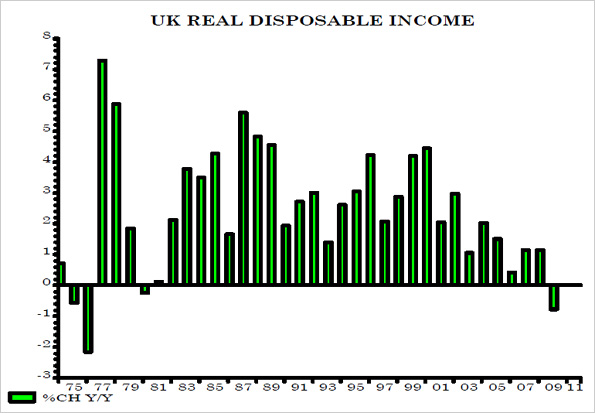
Comment by Rolf Englund
It looks like 1975
More about thoset terrible years
Dominique Strauss-Kahn, managing director of the IMF,
warned countries against cuttting their budgets
too far and creating long-term unemployment
Daily Telegraph 13/4 2011
"Fiscal tightening can lower growth in the short term, and this can even increase long-term unemployment, turning a cyclical into a structural problem," Mr Strauss-Kahn said in a speech in Washington DC.
"The bottom line is that fiscal adjustment must be done with an eye kept keenly on growth."
Many European banks need bigger capital cushions to restore market confidence and help reduce the risk of another financial crisis,
according to the IMF's Global Financial Stability Report
Why economic recovery has been so long in coming
Some economists expected a rapid bounce-back once we were past the acute phase of the financial crisis
— what I think of as the oh-God-we’re-all-gonna-die period —
which lasted roughly from September 2008 to March 2009.
Paul Krugman, New York Times March 3, 2011
Sverige har länge haft stora överskott i bytesbalansen och trenden fortsätter.
Under fjolårets fjärde kvartal var överskottet 53,3 miljarder kronor.
Det var en ökning från motsvarande kvartal 2009 då överskottet uppgick till 39,9 miljarder.
Viktor Munkhammar, DI 3/3 2011
Sverige bekräftar nu sin plats bland tigerekonomierna.
Under fjärde kvartalet 2010 växte Sveriges bruttonationalprodukt (BNP) med 7,3 procent och tillväxten för hela fjolåret blev 5,5 procent, den högsta siffran sedan 1970.
e24 2011-03-01
For those of us who lived through the ERM crisis of 1992 and followed German events closely at that time, all this has a familiar ring.
It was not just recession in the UK, Italy, Spain, and parts of Scandinavia that caused the fixed exchange system to blow up, it was the deadly cocktail of slumps and banking troubles in these countries combining with German overheating. The mix triggered the final crisis.
Ambrose Evans-Pritchard, February 21st, 2011
Ever since the early 1970s, every single time oil prices have spiked sharply (rising by 80pc or more),
regular as clockwork the US has entered recession.
Given America's massive influence on worldwide economic sentiment,
the past five global recessions have all come in the wake of sharp jumps in the price of crude.
Liam Halligan, Daily Telegraph, 26 Feb 2011
Tack vare regeringens framgångsrika hantering av finanskrisen har Sverige inte drabbats av de underskott som nu plågar så många europeiska länder.
Detta budskap har upprepats så många gånger det senaste året att det förvandlats till ett slags sanning, höjd över varje form av ifrågasättande.
Men hur väl stämmer finansministerns version överens med vad som faktiskt inträffat?
Peter Wolodarski, DN 20/2 2011
Highly recommended
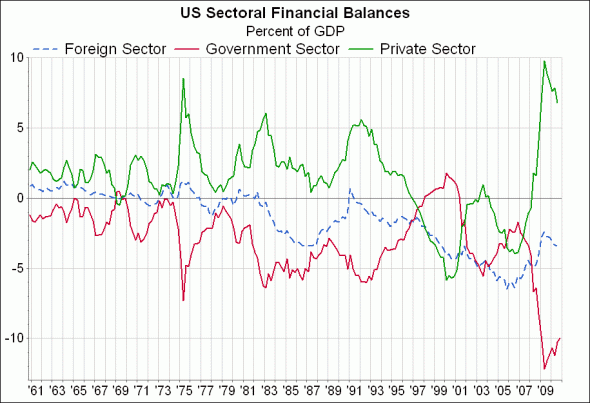
Gavyn Davies, blogsft, December 22 2010
Because the three sectors cover all of the activities of the US economy, at home and abroad, their financial balances must sum to zero.
After 2007, falling house prices and the financial panic caused both households and companies to slash their spending relative to their income, and to generate excess cash.
The shift in the private balance was a remarkable 14 per cent of GDP, and the consequent collapse in spending caused the recession.
In comments on that post, Martin Wolf, Tom and others suggested that I should break the private sector into at least two parts, comprising the household sector and the business sector. Here is the resulting graph:
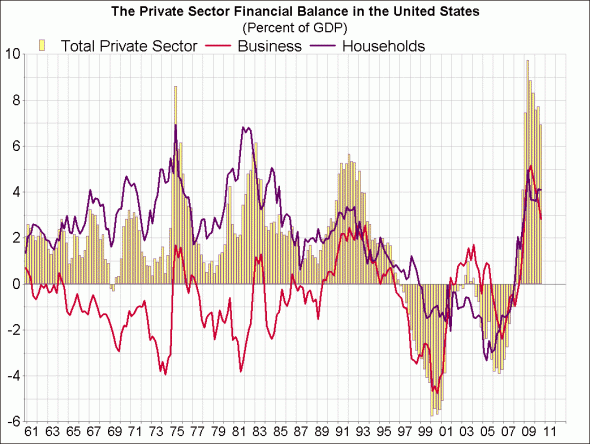
When the housing market peaked in 2005, households realised that they should correct their financial imbalance, and eventually this led to a slowdown in the economy and a collapse in the bloated financial sector. Only then – not before – did the business sector also seek to move into financial surplus, and this combined shift by businesses and households together triggered a very deep recession.
Payroll employment is still 7.7 million below the pre-recession peak,
and if the the U.S. adds 2.5 million payroll jobs per year it would take 3+ years to return to the pre-recession peak.
And that doesn't include population growth
CalculatedRisk with nice charts, as usual, 6/2 2011
Best Reagan Clips from 1980 Carter debate
Youtube
I den med rätta uppmärksammade boken, Capitalism 4.0, av Anatole Kaletsky,
USA:s tidigare centralbankschef Paul Volcker är mest känd för att ha blivit tillsatt av Ronald Reagan för att få ner inflationen, vilket lyckades genom en hård
åtramning med recession som följd. Det ryktet kvarlever med märklig kraft.
Men Kaletsky menar att det var Paul Volcker som ledde återgången till "demand management".
Click here
Roubini:
Europe needs growth to prevent a disorderly collapse of the euro area.
Der Spiegel 11/1 2011
Portugal
Åtstramningarna som har framtvingats av marknaderna gör saken inte bättre, i alla fall inte på kort sikt. Medan länder som Tyskland och Sverige växer så det knakar väntas Portugals BNP sjunka i år,
precis som investeringarna, sysselsättningen och den offentliga och privata konsumtionen.
Hur Portugal i det läget ska klara av att sänka budgetunderskottet är för många en gåta.
Tomas Lundin, SvD Näringsliv 12/1 2011
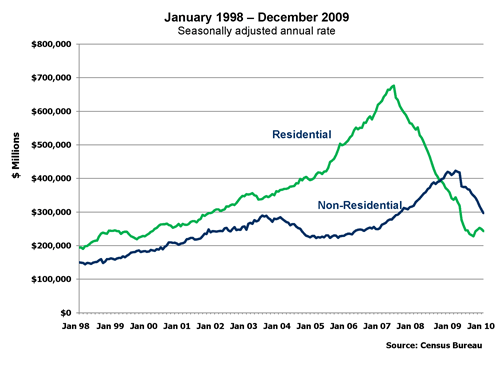
Over the next week some of the world’s leading policymakers and economists will be addressing in the FT the all-consuming contemporary economic debate: austerity versus stimulus. The writers, including Larry Summers, Jean-Claude Trichet and the FT’s Martin Wolf will argue whether cutting now risks suffocating the fragile recovery of the global economy.
FT July 18 2010
I use the term advisedly: the sudden consensus among Very Serious People that everyone must balance budgets now now now wasn’t based on any kind of careful analysis.
It was more like a fad, something everyone professed to believe because that was what the in-crowd was saying.
Paul Krugman, NYT October 21, 2010
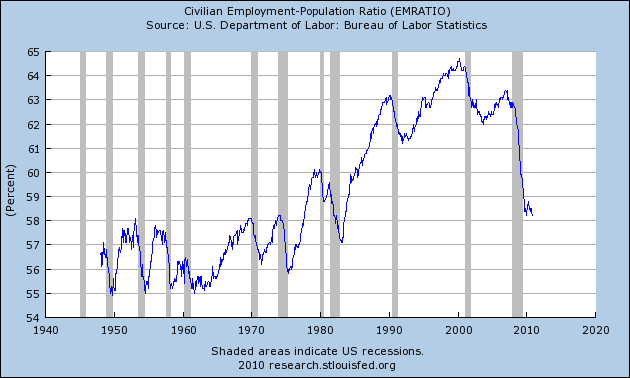
Portugal is the next example of a country to demonstrate that austerity in the middle of a financial crisis is a sure recipe for disaster.
The mood in the bond markets is deteriorating sharply, as Portuguese, and Spanish, spreads reach new records,
amid expectation that the crisis is very certain to spill over to Portugal, and possibly even to Spain.
FT Deutschland makes the remark the Portuguese spreads are about as high now as the Greek spreads
were ahead of the rescue.
Eurointelligence 24/11 2010
Rep. Mike Pence, a Republican from Indiana
"The Fed can print money, but they can't print jobs,"
"Printing money is no substitute for sound fiscal policy
CNN December 3, 2010
We ought to be looking to the Congress to embrace the kind of policies that will get this economy moving again."
A House bill introduced last month by Rep. Mike Pence, a Republican from Indiana, seeks to scale the dual mandate back to a single goal of focusing only on prices, and leave job creation policy up to Congress.
Full textBetween 2010 and 2015, the UK is forecast to have the third largest reduction in the share of government borrowing in national income among 29 high-income countries:
only Iceland and Ireland are to cut more.
The reduction in cyclically adjusted borrowing, is even forecast to be the second largest, after Greece.
Yet the UK has had no fiscal crisis. That makes its austerity remarkable.
Martin Wolf, FT 8/2 2011
The Dark Ages, Returned In Full
Schumpeter, Wolfgang Schauble, the government of China,
Narayanan Kocherlakota, and Sarah Palin
Paul Krugman November 17, 2010
There’s a famous passage in Schumpeter’s writings during the Great Depression, in which he lays out the extreme liquidationist position, arguing not just against the use of fiscal policy to fight unemployment but even against monetary policy, lest it get in the way of the “work of depressions”.
That passage has been held up by many people as an example of the wrong-headedness that prevailed at the time.
But here we are, in 2010 — and something very much like that position is being forcefully advocated by Wolfgang Schauble, the government of China, Narayanan Kocherlakota, and Sarah Palin.
History lessons for a world out of balance
The prevailing rhetoric about currency wars smacks of the 1930s
John Plender, FT November 11 2010
The prevailing rhetoric about currency wars smacks of the 1930s, when a sauve qui peut mentality marred international monetary relations. What are the lessons of that beggar-thy-neighbour period for Group of 20 policymakers meeting at a time of renewed uncertainty in sovereign debt markets?
While the world has so far avoided the extreme loss of output experienced in the Great Depression, history suggests, among other things, that competitive devaluations and capital controls are the inevitable consequence of surplus countries failing to take any responsibility for global payments imbalances.
Ben S. Bernanke’s push to jump-start the U.S. economy this week may weaken the dollar
Within 33 hours this week, fallout from the Fed could cause even ECB change course if the euro surges
Bloomberg 1/11 2010
This week’s meetings are the greatest concentration of monetary-policy action by leading central banks since the first week of October 2008, when they met in emergency sessions to fight the global financial crisis. On that occasion, all except Japan joined an unprecedented coordinated interest-rate cut.
Let dollar fall or risk global disorderMartin Wolf, Financial Times, May 9 2006
The Economist, QE och finanspolitisk stimulans
Rolf Englund blog 2010-10-29
Republicans
Mellon-style liquidationism is now the official doctrine of the G.O.P.
“Liquidate labor, liquidate stocks, liquidate the farmers, liquidate real estate.”
Paul Krugman, New York Times, March 31, 2011
“Liquidate labor, liquidate stocks, liquidate the farmers, liquidate real estate.”
That, according to Herbert Hoover, was the advice he received from Andrew Mellon, the Treasury secretary, as America plunged into depression.
To be fair, there’s some question about whether Mellon actually said that; all we have is Hoover’s version, written many years later
Two weeks ago, Republican staff at the Congressional Joint Economic Committee released a report, “Spend Less, Owe Less, Grow the Economy,” that argued that slashing government spending and employment in the face of a deeply depressed economy would actually create jobs.
Here’s the report’s explanation of how layoffs would create jobs: “A smaller government work force increases the available supply of educated, skilled workers for private firms, thus lowering labor costs.”
Dropping the euphemisms, what this says is that by increasing unemployment, particularly of “educated, skilled workers” — in case you’re wondering, that mainly means schoolteachers — we can drive down wages, which would encourage hiring.
“Spend Less, Owe Less, Grow the Economy,”
From the report: Sweden’s economy was shrinking in the early 1990’s. After reducing Swedish government spending by 11.4 percentage points of GDP from 1994 to 2000, Sweden’s negative growth economy revived – to an average 3.4% annually.
Goodbye Keynes, hello Hoover
To Keynesian critics the switch to austerity is a colossal blunder.
The Economist print July 1st 2010
In the spring of 2010, fiscal austerity became fashionable.
I use the term advisedly: the sudden consensus among Very Serious People that everyone must balance budgets now now now wasn’t based on any kind of careful analysis.
It was more like a fad, something everyone professed to believe because that was what the in-crowd was saying.
Paul Krugman, NYT October 21, 2010
The victims are the people of Britain, who have the misfortune to be ruled by a government that took office at the height of the austerity fad and won’t admit that it was wrong.
Britain, like America, is suffering from the aftermath of a housing and debt bubble. Its problems are compounded by London’s role as an international financial center: Britain came to rely too much on profits from wheeling and dealing to drive its economy — and on financial-industry tax payments to pay for government programs.
Over-reliance on the financial industry largely explains why Britain, which came into the crisis with relatively low public debt, has seen its budget deficit soar to 11 percent of G.D.P. — slightly worse than the U.S. deficit. And there’s no question that Britain will eventually need to balance its books with spending cuts and tax increases.
The operative word here should, however, be “eventually.” Fiscal austerity will depress the economy further unless it can be offset by a fall in interest rates. Right now, interest rates in Britain, as in America, are already very low, with little room to fall further. The sensible thing, then, is to devise a plan for putting the nation’s fiscal house in order, while waiting until a solid economic recovery is under way before wielding the ax.
British Budget Cuts 'A Dangerous Experiment'
British Prime Minister David Cameron is embarking on a painful period of austerity.
Some economists say his savings plan is dangerous. Some German columnists agree.
Der Spiegel 21/10 2010
The Financial Times Deutschland writes:
"It may make good political sense to be this brutal when the next elections are so far off. But from an economic point of view, it would have made more sense to enact this savings package more gradually. The British economy has only just started to emerge from the recession. In such a situation, if politicians dampen demand to the degree that the savings package is suspected to do so, then it becomes a dangerous experiment. It could stifle the upturn, and by doing so, diminish the tax revenues that the government needs so badly."
Den brittiska finansministern George Osborne sätter den ekonomiska återhämtningen på spel med de kraftiga nedskärningarna han föreslagit.
Det säger en av årets Nobelpristagare i ekonomi, Christopher Pissarides.
DI/TT 24/10 2010
- En kund sa till mig, ”förr lånade jag till 14 procent, i dag lånar jag till 3-4 procent. Och jag är mer orolig i dag”.
Och det är nog så, att det är inte sunt med så låga räntor.
Annika Falkengren SvD Näringsliv 13 juli 2012
Interest rate cuts work their way through to the real economy by a number of transmission channels.
Cui bono? The banks, of course. The bank-bailout channel will be the only monetary transmission mechanism to function like clockwork.
So do not be fooled by anybody who says that the central bank should cut interest rates for the benefit of innocent citizens
Wolfgang Munchau, FT January 20 2008
Keynes’s landmark 1936 General Theory
As he saw it, the propensity to save has exceeded the propensity to invest throughout most of recorded history.
The unpopularity of very low interest rates leads to what is known in financial circles as “the search for yield”.
Samuel Brittan, FT March 31 2011
The answer of orthodox economists was that the rate of interest would bring savings and investment into line without excess unemployment. Keynes did indeed prescribe low interest rates as part of a long-term full employment policy, although he believed that this required active monetary policies. This is how he arrived at his famous slogan of the “euthanasia of the rentier”.
But he feared that the lowest feasible interest rate might not be enough to deter saving and encourage private investment to the required extent. Hence his advocacy of state investment to the extent that “Keynes” stands in the popular mind for public works.
The fact is that low real rates – let alone the negative real rates that sometimes occur – are extremely unpopular with millions of people, not merely top-hatted financiers but small savers looking forward to retirement pensions or merely looking for a safe haven where their money will not lose its value too quickly.
The unpopularity of very low interest rates leads to what is known in financial circles as “the search for yield”. It is this that lies behind the banking scandals, the epidemic of frauds and, on a lesser level, the public toleration for bankers’ refusal to pass on to their customers the very low “policy interest rates” established by central bankers
"Savings and investment, being different activities, carried on by different people, could not simply be presumed identical."
A Treatise on Money
Interest rate cuts work their way through to the real economy by a number of transmission channels.
Cui bono? The banks, of course. The bank-bailout channel will be the only monetary transmission mechanism to function like clockwork.
So do not be fooled by anybody who says that the central bank should cut interest rates for the benefit of innocent citizens
Wolfgang Munchau, FT January 20 2008
Jag tycker det är skriande uppenbart att räntan världen över är för låg
och att en större del av stimulanserna borde ske via finanspolitiken
Rolf Englund blog
Laughable
35 business leaders back Osborne's cuts
The 35 also make one statement that will amuse many economists.
They say "everyone knows that when you have a debt problem,
delaying the necessary action will make it worse not better".
Robert Peston, BBC 17 October 2010
That may be true of individuals and even for most businesses. But there is a whole school of economists, largely those who call themselves Keynesian in some way, who would describe that statement as laughable.
They would argue that it was the application of prudent principles of personal finance to the level of the state that was to a large extent responsible for the severity of the Great Depression of the 1930s.
The scale and speed of these reforms, intrinsically desirable though some may be, could nonetheless prove damaging to the economy and the coalition Government.
Anatole Kaletsky, The Times, October 13 2010
There are three broad reasons for this paradox.
First, there is the short-term macroeconomic impact of cuts on unemployment, growth and consumer spending, which has nothing to do with the long-term benefits that cuts may produce.
Second, there is the risk that a slowdown will make fiscal targets unattainable. Since hitting these targets has been presented as the main justification for spending cuts, the consensus in favour of reforms is likely to collapse if the targets are missed.
Finally, there is the challenge of political acceptability. To back the fiscal programme, the public must be convinced that the priorities embodied in the cuts are fair and sensibly balanced. The Government is heading for big trouble on all these counts.
Come and meet the world's leading Austrian economist
Jesús Huerta de Soto, who is delivering the annual Hayek Lecture at the LSE
Daniel Hannan October 22nd, 2010
Ben Bernanke declared war today - not on China, but on the possibility of deflation.
He knows that a vicious cycle of slow growth, stagnant or falling prices and high unemployment poses a much greater threat to America's way of life than China's silly exchange rate.
But like it or not, the exchange rate will be caught up in the Fed's response.
Stephanie Flanders, BBC 15 October 2010
It is fitting that on September 15 Japan, the world's only major economy battling actual deflation, initiated what has come to be a global round of quantitative easing.
Quantitative easing involves a central bank creating money to buy securities, adding reserves to the banking system, and hoping to increase lending and economic activity in the process.
By John H. Makin AEI Online October 2010
Japan's deflation problem, while fairly acute, is symptomatic of a typical post-financial-crisis problem. The huge erasure of wealth brought on by a collapse in the U.S. housing market has weakened private-spending growth in the United States. For the end of the second quarter, substantial growth of federal government spending and transfers cushioned the weakness in U.S. demand growth, but that fiscal thrust has turned to fiscal drag since midyear.
Another source of substantial fiscal drag comes from the sovereign-debt crisis in Europe, where pledges for drastically contractionary policy by southern-European governments have further subtracted from global demand growth, notwithstanding the spotty record of achievement on such tightening to date.
John Makin is one of my Gurus
For more gurus, click here
Roubini vänder sig mot synen att skuldkrisen ska lösas genom att alla länder med underskott i den offentliga sektorn ska bedriva åtstramningspolitik.
Det leder till deflation och att allt blir ont värre.
Men dessvärre är Roubinis sätt att måla fan på väggen något som inte kan negligeras.
Den mera nyanserade analys som Barry Eichengreen framförde i juli ser vi inte mycket av längre. Det bådar inte gott.
Danne Nordling 16 oktober 2010
Federal Reserve Chairman Ben S. Bernanke said additional monetary stimulus may be warranted
because inflation is too low and unemployment is too high.
Blooomberg Oct 15, 2010 2:43 PM GMT+0200
Är Diamond, Mortensen och Pissarides värda Nobelpriset?
Men transaktionskostnader läste jag om på universitetet redan på på 1960-talet.
Rolf Englund blog 2010-10-11
“You can’t cut debt by borrowing.” How often have you read or heard this comment from “austerians” (a nice variant on “Austrians”),
who complain about the huge fiscal deficits that have followed the financial crisis?
The obvious response is: so what?
Martin Wolf, September 26, 2010
The obvious response is: so what? Shifting debt from people who cannot support it to those who can - the population at large, both now and in future - seems to make a great deal of sense if the alternative is an economic collapse that leads to a loss of output and investment now and so of income in the long term.
Indeed, under the latter alternative, even the fiscal deficits may end up little, if any, smaller if one tries to slash them, as the UK could be about to discover.
How can people reduce their indebtedness or restore their net worth, after an unforeseen fall in asset prices?
There are three mechanisms: sale; bankruptcy; and frugality. Let us consider each of these, in turn.
But remember that, at the global level, debt cancels out: net debt is zero. So, in paying down debt, one is also reducing credit by an equal amount.
The third approach is repayment. Under any imaginable resolution of the debt overhang, some people are going to seek to pay down their loans. Indeed, a great many are going to try to do so: those who dislike the idea of bankruptcy, including the stigma; and those whose assets are worth not much less than their loans. To these groups of higher savers should be added those who are simply poorer than they thought they would be and so decide to save more.
My conclusion, then, is the exact opposite of the conventional wisdom with which I began: the only way that the private sector can de-leverage, when large economies are in a post-crisis recession, is for the government to leverage.
Video of Krugman, Feldstein and Hatzius
I'm not sure who is the most pessimistic.
CalculatedRisk on 10/07/2010
Here is the video of Professors Paul Krugman and Martin Feldstein (former Reagan advisor and NBER president), and Jan Hatzius, chief economist of Goldman Sachs:
The Economic Policy Institute conference on October 5, 2010
The IMF’s foolish praise for austerity
Some argue that we have no right to bequeath higher debt to future generations.
But why would it be wise to bequeath a smaller economy to posterity, instead?
Martin Wolf, FT September 30, 2010
Adam Posen, a member of the Bank’s monetary policy committee, in a powerful recent speech
(entitled “The Case for Doing More”)argues: first, that the UK economy now possesses large, possibly very large, excess capacity
Second, the big danger is not a resurgence of inflation, but deflation, as happened to Japan; and,
third, there is a substantial risk that prolonged weak demand will make temporary losses in output
structural and permanent, via weak investment and long-term unemployment:
“The damage to our economy, our companies and our workforce can be made permanent through inaction by policymakers.”
Mr Trichet and other devotees of “expansionary fiscal consolidations” believe that belt-tightening can actually aid growth in the short term?
The intellectual backing for these claims comes from a study by two Harvard economists, Alberto Alesina and Silvia Ardagna, which studied past fiscal adjustments in rich countries*.
They found that, more often than not, fiscal adjustments that relied on spending cuts boosted growth, even in the very short run.
But a new study by economists at the IMF reckons that the Harvard study was seriously flawed**.
The Economist Sep 30th 2010
What can be done about mass unemployment?
All the wise heads agree: there are no quick or easy answers.
all the facts suggest that high unemployment in America is the result of inadequate demand — full stop.
Saying that there are no easy answers sounds wise, but it’s actually foolish
Paul Krugman, NYT, September 26, 2010
But don’t bother asking for evidence that justifies this bleak view. There isn’t any. On the contrary, all the facts suggest that high unemployment in America is the result of inadequate demand — full stop. Saying that there are no easy answers sounds wise, but it’s actually foolish: our unemployment crisis could be cured very quickly if we had the intellectual clarity and political will to act.
In other words, structural unemployment is a fake problem, which mainly serves as an excuse for not pursuing real solutions.
We live in an amazing world. Everybody has big budget deficits and big easy money
but somehow the world as a whole cannot fully employ itself,”
said former Fed chair Paul Volcker in
Chris Whalen’s new book Inflated: How Money and Debt Built the American Dream.
Ambrose Evans-Pritchard, 26 Sep 2010
RE: Very Important Article
A 69-year-old plan for dealing with imbalances in currency unions
One weekend in September 1941, John Maynard Keynes sat down in his farmhouse in Tilton to consider
how the world’s currencies might be managed once the war was over.
Within a few days the prolific economist produced two papers.
These set out his thoughts on what lay behind the breakdown in the early 1930s of the gold standard, in which currencies were linked at fixed rates to the gold price and so to each other.
The Economist September 23rd 2010
Portugal
That is what happens when you cut interest rates suddenly from 16 to 3 per cent
yields back to May crisis levels when the EU faced its "Lehman moment"
Ambrose Evans-Pritchard, 19 Sep 2010
Ireland has shown what happens when you grasp the fiscal nettle, slashing public wages by 13pc –
to applause from EU elites – without offsetting monetary and exchange stimulus.
Ambrose Evans-Pritchard, 19 Sep 2010
TO: President Obama FROM: Thomas I. Palley
Plan B for Obama on the economy
FT, September 6, 2010
RE: How to avoid stagnation and restore shared prosperity
Mr President,
With hopes of a V- or U-shaped recovery fading, there is the increasing prospect of an L-shaped future of long stagnation, or even a W-shaped future in which W stands for something worse.
The reason for this dismal outlook is economic policy is trapped by failed conventional thinking that can only deliver wage stagnation and prolonged mass unemployment.
Your administration’s current economic recovery programme has been marked by four major failings:
1. Inadequate fiscal stimulus.
2. Failure to cauterise the housing market
3. Failure to neutralise the trade deficit
4. Failure to restore the link between wage and productivity growth
Throughout the crisis, policy has disproportionately benefited banks and corporations. It has largely failed to help households directly and has instead relied on hopes of trickle-down effects from banks, combined with expensive tax subsidies to attract new home buyers.
The failure to directly help households has been a grievous policy error
The adverse effects of the trade deficit can be understood through the metaphor of a bathtub. Fiscal and monetary stimulus is being poured into the tub but that demand is leaking out through the plughole of the trade deficit. Moreover, it is not just demand that leaks out, but also jobs and investment due to off-shoring.
The trade deficit and off-shoring are significantly attributable to China’s under-valued exchange rate
Escaping the Great Recession requires jumpstarting the economy by increasing demand.
...
1938 in 2010
PAUL KRUGMAN, NYT September 5, 2010
This early cycle weakness is often associated with fears of another recession.
During my own professional career, I can recall the US “growth scares” of 2002, 1992 and 1984.
Is the “growth scare” of 2010 different?
Sushil Wadhwani, FT September 8 2010
Sushil Wadhwani is chief executive of Wadhwani Asset Management and a former member of the UK Monetary Policy Committee
It is worrying that European policymakers have not created a mechanism for dealing with an insolvent state in the European Monetary Union.
Sushil Wadhwani, FT September 8 2010
It is even more worrying that many of these governments do not appear to have a Plan B with respect to providing fiscal stimulus if growth is weaker than expected.
SCB, reviderar upp det andra kvartalets BNP-tillväxt från tidigare 3,7
till urstarka 4,6 procent i årstakt.
DI 2010-09-08
The Great Recession almost certainly marks its end
Martin Wolf's Exchange August 23, 2010
The conservative economic counter-revolution associated with the names of Ronald Reagan and Margaret Thatcher began some three decades ago. The Great Recession almost certainly marks its end. What follows will be something different, though how different it will is still unclear. This is a good opportunity to assess the broad economic consequences of that revolution.
Central bankers are flying blind.
With short-term policy rates at or near zero,
getting more of a monetary boost means expanding a set of instruments whose efficacy, and side-effects, are ill-understood (see article).
The Economist Sep 2nd 2010
Mr Bernanke and his colleagues have no shortage of proposals, from buying more government bonds to promising to keep interest rates low. But some ideas are untested. And those that have already been used, such as printing money to buy government bonds, are likely to suffer from diminishing returns. To make a further meaningful dent in bond yields, for instance, the Fed might need to buy another $1 trillion-2 trillion of government debt.
Sverige klarade finanskrisen bättre än de flesta andra länder
genom att de offentliga finanserna var goda från början och regeringen fortsatte värna dem.
DN-ledare 6/10 2010
Delta Force
GDP = C + I + G + Net Exports (that is, exports minus imports)
Savings = Investments
We believe that the recent stimulus in the US, as an example, did in fact have a temporary effect and kept the US out of what might have been a depression, but not without its own costs. That debt must be repaid.
John Mauldin 4/9 2010
...
Double-entry bookkeeping was a great invention.
It is a shame that so many macroeconomists and political pundits – and therefore, politicians themselves – seem to have forgotten it.
Paul McCulley July 2010
/The Treatise on Money's/ message was that
savings and investment, being different activities
carried on by different people,
could not simply be presumed identical.
It took interest rate to bring them into equilibrium
John Maynard Keynes
- Krisen orsakades av en global finansiell krasch där giriga spekulanter tog orimliga risker, skriver Alliansen i sitt valmanifest 2010
- Vi ska vårda den ljusnande konjunkturen och föra Sverige tillbaka till överskott.
Annons från Alliansen 28/8 2010
Enligt Ekonomifakta var det svenska bytesbalansöverskottet 2009, runt 7,5 procent av BNP,
av samma storleksordning som USA:s bytesbalansunderskott.
Ekonomifakta
Pressmeddelande från SCB 2010-06-02
2009 Överskott 230 miljarder kr
2008 Överskott 299,8 miljarder kr
USA:s bytesbalansunderskott
Klicka här
Two results from Gallup, in March 1938:
Do you think government spending should be increased to help get business out of its present slump?
37% Yes - 63% No
In your opinion which will do more to get us out of the depression: increase government spending, or reduce taxes on business?
15% Increase government spending - 63% Reduce taxes on business - 21% No opinion
Paul Krungman 4 september 2010
The improvement in Germany’s economic growth is driven not by productivity gains but by real devaluation.
The intra-eurozone imbalances will not only persist, but probably increase.
This will make the economic adjustment for Spain, Portugal or Greece even more difficult than it already is.
Those persistent imbalances, much more than the build-up of debt, are my deep cause of concern about the long-term health of the eurozone.
Wolfgang Münchau, FT August 29 2010
As the policy debate intensifies, investors might spare a thought for Korekiyo Takahashi,
Bank of Japan governor from 1911 to 1913.
Gillian Tett, FT September 2 2010
How I Learned to Stop Neoclassicizing and Love the Liquidity Trap
There is only one real law of economics: the law of supply and demand.
If the quantity supplied goes up, the price goes down.
Brad DeLong, November 05, 2011
At the end of 2008, as the economy collapsed and the pace of net Treasury debt increases quintupled, it seemed we were about to discover that limit. I presumed we had a little time for expansionary fiscal policy to boost the economy -- a year, maybe 18 months -- before the bond-market vigilantes would arrive. They would demand higher interest rates on Treasury bonds, which would begin seriously crowding out the benefits of fiscal stimulus. The U.S. government would have to react, pivoting from fighting joblessness, via deficit spending, to reassuring the bond market via long-run tax increases and spending cuts to Medicare and Medicaid.
But it didn’t happen in 2009. It didn’t happen in 2010. And it isn’t happening in 2011. There are no signs from asset prices that the market is betting heavily that it will happen in 2012. Looking at the yield curve, it appears the market intends to swallow every single bond that the Treasury will issue in the foreseeable future -- and at high prices. The prices of inflation-protected bonds suggest that the market expects the new Treasury issues to be devoured without any acceleration in inflation.
There are clear-cut things that you do if you’re in a liquidity trap.
A liquidity trap is simply defined as when the private sector is in a deleveraging mode, or a de-risking mode,
or an increasing savings mode — all of which you can also call deleveraging phenomena —
because of enduring negative animal spirits caused by legacy issues associated with bubbles.
Paul McCulley, at John Mauldin, 3 October 2011
Highly Recommended
Fiscal Policy Works
Paul Krugman, New York Times, December 24, 2011
Paul Krugman has a piece up on his blog which he appears to regard as
a knockout blow to the concept of "Ricardian Equivalence"
Andrew Lilico, Daily Telegraph, December 27th, 2011
(i.e. the doctrine that, under most circumstances, funding government spending with a deficit does not increase output relative to funding that same government spending with tax).
OK. So funding the bridge with the deficit might not provide a stimulus, but mightn't the $100,000 injected into the economy by building the bridge create some kind of multiplier effect, such that the total increase in output is more than the initial $100,000 outlay?
Perhaps, but then why wouldn't similar multipliers apply to the taxes raised to fund the bridge-building (a question asked by Lucas in Krugman's piece)?
Klas Eklund, Danne Nordling, Claes-Henric Siven, Peter Stein och några till kan läsa
Full text here
However unclear monetary policy might be, the current state of thinking around fiscal policy was far worse.
Why Even Central Bankers Are Unsure What to Do Now
Jean-Claude Trichet, president of the European Central Bank, tried to reclaim the Ricardian high ground
The late economist Hyman Minsky came more and more into the discussions
For monetary policy, the financial crisis has been the geologic equivalent of the faults that uplifted the Grand Tetons.
CNBC 30 Aug 2010
Geology of the Grand Teton area
Jackson Hole – a disappointing speech and an interesting debate
Eurointelligence 30/8 2010
The Bernanke trap
Speech at the annual Federal Reserve retreat in Jackson Hole
to do whatever is necessary to keep the economy from stumbling down the Japanese path
CNN/Fortune, August 27, 2010, with good links
In Friday's highly touted speech at the annual Federal Reserve retreat in Jackson Hole, Wyo.,
Bernanke pledged to do whatever is necessary to keep the economy from stumbling down the Japanese path to a debilitating spiral of falling prices known as deflation.
The Fed chief expressed confidence that he will be able to do so, despite widespread assertions that the Fed is out of bullets.
The NBER committee in April issued a statement that it was too soon to declare an end to the recession that began in December 2007.
How the hell can the NBER put odds of a double-dip at 5% to 33% without having declared the end to the last recession?
Mish 28/8 2010
Bernanke, in his Aug. 27 speech in Jackson Hole, Wyoming
“Strong and stable” growth will “require appropriate and effective responses from economic policy makers across a wide spectrum”
“We all know that the main gorilla in the room is fiscal policy,” Jacob Frenkel, a former Bank of Israel governor who’s now chairman of JPMorgan Chase International
Bloomberg 30 August 2010
USA-ekonomins Moment 22
Fastighetsmarknaden vänder inte uppåt förrän arbetsmarknaden förbättras.
Och arbetsmarknaden förbättras inte förrän fastighetsmarknaden vänder uppåt
Rolf Englund blog 2010-08-27
The problem in America is not bankers who won’t lend
Corporations are already sitting on record-setting amounts of profits and cash, but production and hiring are not booming.
The problem is that ordinary people at the foundation of our economy, the people whose desires for goods and services drive the production that employs our resources, are lacking income.
They do not want more credit and more debt. They want more income.
Dan Kervick, neweconomicperspectives, April 4, 2012
There is no central bank shortcut to the goal of full employment
If one is really determined to boost demand, production and employment by pumping money into the economy,
the clear preference should be for the fiscal pumps.
Dan Kervick, neweconomicperspectives, April 6, 2012
What are we learning about the relative role of monetary and fiscal policies?
As Joseph Stiglitz argued in the FT this week... Monetary policy has worked, in practice, via credit expansion.
It is, as a result, at least partly responsible for the debt crisis of today.
Who can now confidently state that reliance on a policy which worked by financing overpriced housing was better than using surplus savings for higher public investment?
Martin Wolf, FT October 19 2010
Similarly, who can confidently state that it must be better to rely on relaunching a private credit boom than on higher public investment? Monetary policy is not self-evidently the most reliable instrument for tackling the implosion of a prior private debt explosion.
Englund, Stiglitz, Martin Wolf och finanspolitiken
Rolf Englund blog 2010-10-20
Englund, Stiglitz och finanspolitiken
Rolf Englund blog 2010-10-19
It is folly to place all our trust in the Fed
The US Federal Reserve may make funds available to banks at close to zero interest rates,
but if the banks make those funds available it is at a much higher rate.
Joseph Stiglitz, FT October 18 2010
In certain circles, it has become fashionable to argue that monetary policy is a superior instrument to fiscal policy
A quarter-century ago proponents of monetary policy argued, with equal fervour, in favour of monetarism: the most reliable intervention in the economy was to maintain a steady rate of growth in the money supply
The fundamental reason should be obvious: what matters for most companies (or consumers) is the availability of funds and the terms that borrowers have to pay. The US Federal Reserve may make funds available to banks at close to zero interest rates, but if the banks make those funds available to small and medium-sized enterprises at all, it is at a much higher rate.
Indeed, in the last US recession, the Fed’s lowering interest rates did stimulate the economy, but in a way that was disastrous in the long term.
Companies did not respond to low rates by increasing investment. Monetary policy (accompanied by inadequate regulation) stimulated the economy largely by inflating a housing bubble, which fuelled a consumption boom.
By contrast, if we extend unemployment benefits we know, not perfectly but with some degree of precision, how much of that money will be spent
Cui bono?
- Cui bono? The banks, of course.
Jag tycker det är skriande uppenbart att räntan världen över är för låg och att
en större del av stimulanserna borde ske via finanspolitiken.
Rolf Englund blog, 2009-12-05
Future generations will curse us for cutting in a slump
In 1937 Keynes wrote: “The boom, not the slump, is the right time for austerity at the Treasury.” Jean-Claude Trichet disagrees.
Robert Skidelsky and Michael Kennedy, FT July 27 2010
Economics is not hard - Part I: Don’t let professional economists tell you otherwise
Why did economics bloggers appear in the years after the collapse of the tech bubble in the early 2000s and flourish during the rise of the housing bubble starting in 2002?
Answer: to fill the vacuum created by the professional economics community that repeatedly failed to protect consumers from the ravages of not one but two asset bubbles in ten years that resulted in the greatest wealth transfer in world history and the near dismantling of the remnants of the world’s once most productive economy.
Itulip 13/7 2010
Joseph Stiglitz, winner of the Nobel Prize for Economics in 2001, said austerity as a policy to end the global crisis was a "disaster",
adding that Europe was heading towards more economic difficulties if politicians meant what they say when they promised to cut back spending rather than just trying to calm down markets.
CNBC 8 Sep 2010
The European economy is at risk of sliding back into a recession as governments cut spending to reduce their budget deficits.
Nobel Prize-winning economist Joseph Stiglitz, Bloomberg 24/8 2010
“Because so many in Europe are focusing on the 3 percent artificial number, which has no reality and is just looking at one side of a balance sheet, Europe is at risk of going into a double-dip,” Stiglitz said.
---
Nobel Prize-winning economist Joseph Stiglitz
The U.S. economy must grow at least 3 percent to create enough jobs for new entrants into the labor force
CNBC 21 Dec 2009
I know it’s over the top, but here it is anyway:
the policy elite — central bankers, finance ministers, politicians who pose as defenders of fiscal virtue
are acting like the priests of some ancient cult,
demanding that we engage in human sacrifices to appease the anger of invisible gods.
Paul Krugman, New York Times 19/8 2010
When, however, the economy suffers from Post Bubble Disorder,
characterised by private sector deleveraging and a fat-tail risk of deflation
In such a liquidity trap, private sector demand for credit is, axiomatically, very inelastic to low interest rates,
as evidenced by contracting private sector debt footings, even when the central bank’s policy rate is pinned against zero.
In such circumstances, the central bank has a profound duty to act unconventionally
Paul McCulley August 2010
Double-entry bookkeeping was a great invention.
It is a shame that so many macroeconomists and political pundits – and therefore, politicians themselves – seem to have forgotten it.
Paul McCulley July 2010
Wynne Godley’s analytical framework should be the workhorse of discussions of global rebalancing, in the context of a deciency of global aggregate demand.
Let’s start with a simple tautology for any individual country:
Household Financial Balance +
Business Financial Balance +
Government Financial Balance +
Foreign Financial Balance = 0
Again, double-entry bookkeeping: The only way that one of the four sectors can run a deficit or surplus is for one or more of the other three sectors to run the opposite.
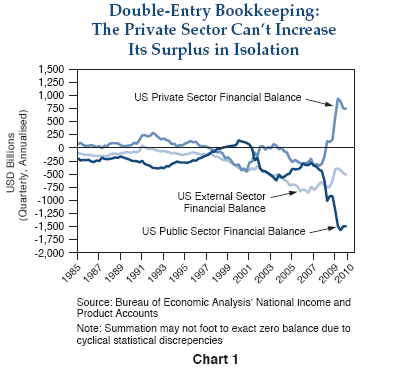
Ricardian Equivalence is the notion that governmental deficits cause the private sector to increase its surpluses, so as to save for the future increase in taxes that inevitably will be required to reduce the government deficits. Thus, current evangelists of front-loaded fiscal austerity preach that if only governments would reduce their deficits, the private sector, freed from the fear of future tax increases, will spontaneously reduce their surpluses. Put differently, it is argued, if only governments would put their fiscal houses in order, the private sector would immaculately regain confidence in their own financial affairs, pull down their savings and borrow more, boosting aggregate demand. Really, that is the argument, made with a straight face.
It is most disheartening to hear born-again cyclical fiscal austerians (Hats off to my friend and fellow Minsky follower Rob Parenteau for recently coining this delightful word) tout the notion that somehow there will not be a deflationary negative shock to global aggregate demand, if their course is followed.
Martin Wolf declaring that the austerians’ reverse-Ricardian cyclical path to salvation may be right, musing that “the moon may be made of green cheese, too.”
Rolf Englund:
BNP är C + I + G +/- X
Skall det vara så svårt att förstå för microhjärnorna?
Det frågade jag på denna blog i februari.
There is neither the political will nor the public appetite for a new round of spending to create jobs.
A recent Time magazine poll found that only 24% of Americans favored a fresh stimulus program, as against 67% who opposed it.
Fortune 11 August 2010
Republican critics of the Obama administration, when they have anything at all to say about unemployment, seem to imagine that tax cuts and deregulation will unleash animal spirits in the private sector, leading to a wave of investment and consequent job creation.
Is America facing an increase in structural unemployment?
When an economy experiences a severe recession associated with a sharp decline in aggregate demand, we should not begin by asking whether structural unemployment is the problem.
Instead, we should first try to see how much of the unemployment can be explained by nominal shocks.
Structural unemployment is a sort of residual; it represents those long-term unemployed that would be without jobs even if aggregate demand was on target.
Scott Sumner The Economist July 25th 2010
When the private sector is deleveraging even with zero interest rates, the economy enters a deflationary spiral as it loses aggregate demand equal to the sum of unborrowed savings and debt-repayments every year.
If left unattended, the economy will continue to contract until either private sector balance sheets are repaired, or the private sector has become too poor to save any money (=depression).
The last time this deflationary spiral was allowed to materialise was during the Great Depression in the US.
Richard Koo, Chief economist, Nomura Research Institute, The Economist Jul 26th 2010
Since the government cannot tell the private sector NOT to repair its balance sheets, the only thing the government can do to keep the economy going is for the government to borrow and spend the unborrowed savings in the private sector and put them back into the economy’s income stream.
In other words, fiscal stimulus becomes indispensible in a balance sheet recession. Moreover, the stimulus must be maintained until private sector deleveraging is over.
In fact, banks have virtually ceased to function as financial intermediaries since 2008, preferring to use the zero cost of money provided by the Fed to finance purchases of Treasury securities instead of supplying loans to households and small businesses.
John H. Makin, American Enterprise Institute, July 2010
After a financial crisis, banks become much more risk averse, as is manifest in their willingness to lend only to the government instead of to households and businesses. That development is deflationary because it means that a sharp boost in the monetary base engineered by the Fed does not translate into faster monetary growth at a time when the precautionary demand for money has been boosted by elevated uncertainty.
The increased demand for money that results from higher desired precautionary balances and stingy monetary creation by the banks is deflationary, just as an excess supply of money is inflationary.
The fear that a sharp rise in the size of the Fed's balance sheet--the reflection of a sharp boost in the monetary base--is inflationary is misplaced for two reasons.
First, such fear does not recognize that the money multiplier has dropped so rapidly that the money supply--a key determinant of inflation--has stagnated.
Additionally, it overlooks the increase in the precautionary demand for money that adds to the deflationary excess demand for money.
There is a bigger risk that deflation will intensify sharply because once the price level actually starts to fall, the demand for money will be further enhanced. A deflationary spiral--a self-reinforcing, accelerating drop in the price level--can result.
This is because a falling price level means that cash "earns interest" since it enhances the purchasing power of otherwise sterile cash assets that pay zero interest, just as interest on a bond adds to its value in terms of its ability to be used to buy goods and services.
Full text---
So do not be fooled by anybody who says that the central bank should cut interest rates for the benefit of innocent citizens, Wolfgang Munchau and
Let me tell you a little secret, folks. A few years of nice profits will help offset the big losses from past blunders, Allan Sloan
What lessons does history have to teach us about Jean-Claude Trichet’s call for immediate, rapid, and substantial fiscal and monetary retrenchment and austerity
- his full-throated endorsement of the agenda of the Pain Caucus?
Brad DeLong, FT July 23 2010
Unfortunately, the front-loaded deficit reductions may push economically weak countries into recession for the next year or two. That is the cost of achieving the needed long-term deficit reduction in the current economic and political environment.
However, government officials are not warning the public that this is the choice that they have made.
Instead they are claiming that the front-loaded fiscal deficit reductions will not weaken the economy
Martin Feldstein, FT July 22 2010
Our economies are emerging from the worst economic crisis since the second world war, and without the swift and appropriate action of central banks and a very significant contribution from fiscal policies, we would have experienced a major depression.
Now is the time to restore fiscal sustainability.
But the timing remains disputed.
Jean-Claude Trichet, FT July 22 2010
The world economy is entering a new phase after the failure of fiscal stimulus to create a sustained recovery in either the US or Europe.
Consumers will not provide the engine of recovery, nor should they after overspending for a decade.
Jeffrey Sachs FT July 21 2010
The Fed Can Print More Money, But It Can’t Print Jobs
Larry Kudlow 10 Aug 2010
With a trillion dollars of excess bank reserves already in the system, there’s no shortage of money. The recovery is being held up by the tax-and-regulatory threats and anti-business attitude coming out of Washington.
...
Kudlow On The Trade Deficit
Mr. Kudlow's rhetoric typifies an ongoing Wall Street, government, and media propaganda effort
that would even amaze George Orwell.
Peter Schiff 11/3 2005
The abysmal results came as no surprise to those who knew that
the Keynesian doctrine of spending your way to prosperity had been discredited decades ago.
Research conducted by Harvard economist Robert Barro, for instance, found that the extra economic impact of government spending – also known as the Keynesian multiplier effect, which must be greater than one for any fiscal stimulus to be effective – was “insignificantly different from zero”.
The Romer-Bernstein report, however, dubiously assumed a multiplier of 1.57.
Darrell Issa, FT, February 7 2011
The writer is a Republican member of the US House of Representatives, and chairman of the committee on oversight and government reform
Today’s Keynesians have learnt nothing
Niall Ferguson, FT July 19 2010
It is far too soon to end expansion
Greece, Ireland, Spain, Portugal and Italy need to be austere.
But Germany, Britain, America and Japan do not.
Brad DeLong, FT July 19 2010
My new maxim, never to stand in the middle of a fight between Paul Krugman and Niall Ferguson
It says a lot about the talents of John Maynard Keynes – and just as much about the shortcomings of modern macroeconomics – that when the financial crisis struck, policymakers instinctively reached not for their fancy models, but for the Keynesian idea of fiscal stimulus
Tim Harford, FT July 20 2010
The academic evidence on Keynesian growth effects of fiscal deficits is thoroughly inconclusive.
Kenneth Rogoff, July 20 2010
Krugman versus Ferguson: Round Two
Not since Ken Rogoff’s famous attack on Joe Stiglitz has the dismal science of economics provoked such pompous, self-important, personalised squabbling.
The reality is that nobody knows what cutting the deficit into a weak economic recovery is going to do to output and jobs
Jeremy Warner, The Daily Telegraph, 20 July 2010
Jeremy Warner, assistant editor of The Daily Telegraph,
is one of Britain's leading business and economics commentators.
Professors Paul Krugman and Niall Ferguson, of course, have form; they’ve been at it on and off for nearly a year now over the efficacy of deficit spending in fighting the downturn
Ferguson, an eminent economic historian, has penned for the Financial Times on the dangers of attempting to spend your way to economic recovery. Foolishly – or perhaps deliberately, for it is sometimes possible to imagine that the two have secretly agreed to slag each other off for the publicity – he mentions Krugman by name.
Quick as flash, Krugman has risen to the bait. On his New York Times blog, he writes “Brad DeLong does the necessary on Niall Ferguson; no need for me to pile on”.
Ferguson is a “mere” historian of finance. Krugman, by contrast, is a Nobel prize winner. The last time they quarrelled, Krugman wrote:
The reality is that nobody knows what cutting the deficit into a weak economic recovery is going to do to output and jobs
And as for citing the historical evidence of the Depression, where apparently premature fiscal tightening caused the economy to dip back down again, the precise mechanisms by which this occurred are again highly debatable
---
In an unusually personal and public rebuke, the International Monetary Fund's top economist accused Nobel-winning economist Joe Stiglitz of slander, self-aggrandisement and intellectual vanity.
Mail Guardian Online 1 January 2002
The blunt assault on Stiglitz, a former World Bank chief economist, came from IMF Chief Economist Ken Rogoff in response to the Columbia University professor's best-selling new book, "Globalization and its Discontents," which takes what the IMF man sees as too many cheap shots.
In his book, Stiglitz contends that IMF prescriptions of demanding that crisis-torn countries implement budget cuts and higher interest rates to restore market calm worsen recessions and plunge more people into abject poverty.
---
"Vi anser att aktiv stabiliseringspolitik inte skall bedrivas"
Someone has to actually run a current account deficit.
"Åtstramning för expansion"
I sydeuropeiska länder kan finanspolitiken fungera på ett omvänt sätt.
Stora underskott och viss risk för statsbankrutt kan behöva motverkas med drastiska nedskärningar.
Men detta borde inte gälla mer välskötta länder trots deras underskott.
Danne Nordling 17/7 2010
Ekonomkåren har manifesterat en avsevärd vilsenhet det senaste året både när det gäller att dimensionera och varaktighetsbestämma finanspolitisk stimulans.
Detta har särskilt blivit manifest i samband med Greklandskrisen våren 2010.

Den ekonomiska vetenskapen har inte kunnat komma fram till en teori som beskriver hur den finansiella ekonomin hänger ihop med den reala.
Danne Nordling blog 5 juni 2010
Economics may be dismal, but it is not a science
The failures of economics in the recent crisis are most evident in two areas:
The inadequacies of the efficient market hypothesis, the bedrock of modern financial economics,
and The irrelevance of recent macroeconomic theory.
John Kay, FT April 13 2010
Det är ett sedan länge känt faktum att sysselsättningen svänger med konjunkturen. Hög efterfrågan, från in- och utland, gör att sysselsättningen stiger. Låg efterfrågan, från in- och utland, gör att sysselsättningen sjunker.
Den närmast till hands liggande förklaringen är således att se efter hur det är med efterfrågan, från in- och utland, i Sverige och i USA, nu och i gången tid. Som alla vet är det inte bara att öka efterfrågan, från in- och utland, för att få ökad tillväxt och stigande sysselsättning. Då hotar nämligen handelsbalansen att försämras, när importen stiger. När handelsbalansen försämras blir det antingen (vid fast växelkurs) valutakris följt av förlorade år, eller (vid rörlig växelkurs) fallande växelkurs och ökande inflationstryck.
I dag har Sverige ett större handelsbalansöverskott än Japan i förhållande till BNP. USA har nu ett rekordstort handelsunderskott. Huvudspåret är således att den låga sysselsättningen i Sverige beror på för låg efterfrågan, och att den höga sysselsättningen i USA beror på för hög efterfrågan. Detta är huvudspåret.
Om man vill förklara världen med hjälp av nya eror (USA) eller strukturproblem av gammalt datum (Sverige) har man bevisbördan.
Rolf Englund i polemik med Mats Svegfors 1998
Sverige, Estland och Luxemburg
Den ekonomiska krisen har slagit sönder många länders offentliga finanser.
3 av 27 länder som inte är föremål för EU:s underskottsförfarande
Anders Borg DN Debatt 2010-07-13
It is far too soon to end expansion
Greece, Ireland, Spain, Portugal and Italy need to be austere.
But Germany, Britain, America and Japan do not.
Brad DeLong, FT July 19 2010
With their debts valued by the market at heights I had never thought to see in my lifetime, the best thing they can do to relieve the global depression is to engage in co-ordinated global expansion.
Expansionary fiscal, monetary and banking policy, are all called for on a titanic scale.
But, the members of the pain caucus say, how will we know when we have reached the limits of expansion? How will we know when we need to stop because the next hundred billion tranche of debt will permanently and irreversibly crack market confidence in dollar or sterling or Deutschmark or yen assets?
Followers of the US economist Hyman Minsky say the monetarists and the Hicksians (usually called Keynesians, much to the distress of many who actually knew Keynes) are sometimes right but definitely wrong when the chips are as down as they are now.
expansionary monetary and fiscal and banking policy, we need all of them – until further government action begins to crack the status of the US Treasury bond as a safe asset
The US has exorbitant privileges that give it freedom of action that others such as Argentina and Greece do not have.
Trust me, we will know when the time comes to stop expansion.
Financial markets will tell us.
Many today are complaining about Alan Greenspan’s monetary stewardship, which kept these three locomotives stoked:
“serial bubble-blower” is the most polite phrase that I have heard.
But would the world economy really be better off today under an alternative monetary policy that kept unemployment in America at an average rate of 7% rather than 5%?
Brad DeLong April 05, 2008
There are two schools of thought on how to respond.
On the one hand, we have the new and unexpected coalition of monetarists and Keynesians.
On the other, there is the Austrian school
Jamil Baz, FT July 13 2010
The so-called “Washington consensus” /monetarists and Keynesians/ sees policymakers in the US pursuing a combination of fiscal expansion and monetary stimulus, thus uniting former ideological enemies in an attempt to reprime the world financial and economic system.
On the other, there is the Austrian school, which draws on the ideas of Ludwig von Mises, Carl Menger, Friedrich von Hayek and others, and is given expression in the restrictive monetary and fiscal policy favoured by the EU today.
These economists are social libertarians who believe the role of the state in society should be limited. While this conjures up visions of Tea Party extremists and hillbillies decamping to Montana, their ideas have a substantial intellectual pedigree.
Pressure from the bond market has forced Greece to deleverage, and it is the continuing indulgence of the bond market that allows the US to prolong the party by maintaining its twin budget and trade deficits.
Dagens globala finanskris har utlöst en kris för ämnet nationalekonomi.
Sökandet efter bättre ekonomisk analys pågår för fullt.
Lars Jonung kolumn DN 29/4 2010
Keynes Versus Hayek, 1932
It’s deeply tragic that we’re having to have this debate all over again,
as the world economy slides into deflation and stagnation
Paul Krugman July 9, 2010
Kevin Daly som är makroekonom på finansjätten Goldman Sachs, och som nu besöker Almedalen, håller med om att den svenska ekonomin ser stark ut.
Och han tillägger att den svenska regeringen gått och väl skulle kunna lätta på finanskranarna för att stimulera ekonomin ytterligare
Ekot 5 juli 2010
Samtidigt som det svenska skattetrycket går ned kraftigt och börjar närma sig EU-snittet, har Borg etablerat de borgerliga som mer trovärdiga i ekonomiska frågor än de rödgröna.
Borg har vittring på något stort. Han får se upp så att framgången inte stiger honom åt huvudet.
Peter Wolodarski, DN 2010-07-05
So what is the material difference between the optimists and the pessimists?
The optimists divide into two groups. There are those who have difficulties counting to zero,
who cannot add up the global private, public, and foreign balances, which must equal zero by definition.
Wolfgang Münchau, FT July 11 2010
The pessimists believe that a strong global recovery is unlikely given the persistence of financial stress, and the deleveraging of the private and public sectors across the industrialised world.
The optimists divide into two groups. There are those who have difficulties counting to zero, who cannot add up the global private, public, and foreign balances, which must equal zero by definition.
And then there are the rational optimists, whose expectations of resurgence in private sector demand must surely rest on the assumption of a return to even greater global imbalances than before the crisis, to which the eurozone will this time contribute actively. But this is surely not a sustainable position.
Grekland, Spanien och grunderna i macro
Rolf Englund blog 2010-05-29
They (G-20) may hope that retrenchment now will spur on private spending.
But what is their plan if it turns out that it does not?
Martin Wolf, July 6 2010
The efficient-markets hypothesis
My conclusion, then, is that the advanced countries remain highly short of demand.
In this environment, rapid cuts in fiscal support make sense if, and only if, monetary policy can be effective on its own and expanding the interest-elastic parts of the economy is the best way to climb out of the hole. There is reason to doubt both ideas.
Martin Wolf, July 6 2010
Homeowners - the root of all evil?
On Monday, the yield on 10-year government bonds was 1.1 per cent in Japan, 2.6 per cent in Germany, 3 per cent in the US and 3.3 per cent in the UK.
Based on yields on index-linked securities, real interest rates on borrowing by these governments are very low (1.2 per cent, or less, in the US, Germany and UK).
Investors are saying that they view the risk of depression and deflation as greater than that of default and inflation.
Martin Wolf, July 6 2010
Next Bubble Is Forming: U.S. Government Bonds
Is monetary policy too expansionary or not expansionary enough?
Martin Wolf blog June 27, 2010
First, the monetary base does not itself have any impact on spending by the public.
Second, such reserves have no direct impact on lending by commercial banks (their assets) or on the broad money supply (their liabilities).
Fourth, the policy of expanding the balance sheet of the central bank has an inflationary impact if and only if it succeeds in expanding the overall broad money supply beyond what the public wishes to hold, given the levels of economic activity, interest rates and expected inflation.
Such an inflationary impact of “money printing” can indeed only happen if the overall money supply starts to grow rapidly. This is not now happening.
what is happening to broader measures of money (principally the liabilities of the banking system). The former has exploded. But the growth rate of the latter is extremely low. (Look at the chart that accompanied my column, “Why it is right for central banks to keep printing”)
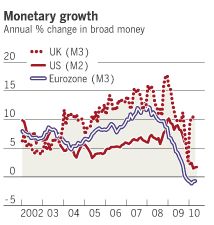
What matters is the overall supply of credit and money in economies. This continues to be stagnant in the developed world. Concern about an imminent outbreak of inflation is consequently a grave mistake. To the extent that there is a danger of “monetisation” of debt, it will emerge only if we fail to return to growth, because that is the situation in which it is most likely that public sector deficits will fail to close.
...
Why it is right for central banks to keep printing
By Martin Wolf, FT June 22 2010
If the economy were a coal mine, the job market would be an 800-pound canary,
warning of a recovery that is running out of oxygen. Congress has failed to provide even the most basic support — extended unemployment benefits and bolstered aid to states.
New York Times editorial 2nd July 2010
http://www.wisegeek.com/what-does-it-mean-to-be-a-canary-in-a-coal-mine.htm
http://www.wisegeek.com/what-do-people-mean-when-they-refer-to-an-800-pound-gorilla.htm
There is undeniably a risk that tightening policy too early will cause the economy to dip back into recession. But ...
In the view of The Times, the balance of risks suggests that policymakers should begin to withdraw the stimulus.
The Times editorial, July 2 2010
When the financial crisis of 2007-08 plunged the global economy into recession, policymakers adopted exceptional measures to arrest the downturn. But economics is no exact science, and the remedial measures have turned out to have consequences. Policymakers at the Bank of England have expressed concerns this week about a steady rise in inflation even while economic recovery remains fitful. Their comments are timely.
There is undeniably a risk that tightening policy too early will cause the economy to dip back into recession. But there are always uncertainties in any economic course, and these are magnified when the statistics are volatile.
In the view of The Times, the balance of risks suggests that policymakers should begin to withdraw the stimulus. The coalition Government is right to embark early and decisively on deficit reduction. The Bank should be wary of maintaining an easy monetary stance for long.
Could the West simply start saving and paying back its debt?
If too many debtors pursued this path at the same time, the ensuing reduction in consumption would lead to lower growth, higher unemployment, and correspondingly less income,
making it more difficult for other debtors to save and pay back.
This phenomenon, described by Irving Fisher in 1933 in The Debt-Deflation Theory of Great Depressions, can result in a deep and long recession,
combined with falling prices (deflation).
David Rhodes and Daniel Stelter, via John Mauldin, January 2012
This is amplified when governments simultaneously pursue austerity policies — such as we see today in many European countries and will see in the U.S. beginning in 2012.
A reduction in government spending by 1 percent of GDP leads to a reduction in consumption (within two years) of 0.75 percent and a reduction in economic growth of 0.62 percent.
Saving (or, more correctly, deleveraging) will reduce growth, potentially trigger recession, and drive higher debt-to-GDP ratios—not lower debt levels.
Indeed, during the early years of the Great Depression, President Hoover — convinced that a balanced federal budget was crucial to restoring business confidence — cut government spending and raised taxes.
In the face of a crashing economy, this only served to reduce consumer demand.
Irving Fisher, The Debt-Deflation Theory of Great Depressions
Amazon
Goodbye Keynes, hello Hoover
To Keynesian critics the switch to austerity is a colossal blunder.
Supporters of the shift to austerity believe by boosting firms’ and households’ confidence and lowering the risk premium on government debt, well-designed fiscal consolidation can actually boost growth.
(RE: Ha, ha, ha. Det var det som Bildt, Wibble, Carl B Hamilton och Olle Wästberg, med flera trodde)
The Economist print July 1st 2010
To Keynesian critics the switch to austerity is a colossal blunder. Paul Krugman, an economist who writes in the New York Times, frets that officials who “seem to be getting their talking points from the collected speeches of Herbert Hoover” will push the world economy into a depression. With unemployment high, output far below its potential, private spending still weak and interest rates close to zero, Mr Krugman and his allies argue that fiscal stimulus remains an essential prop to the economy and that deficit-cutting now will spell stagnation and deflation.
From the other side, supporters of the shift to austerity believe it is both essential and appropriate: deficit spending cannot go on for ever, and by boosting firms’ and households’ confidence and lowering the risk premium on government debt, well-designed fiscal consolidation can actually boost growth. Jean-Claude Trichet, president of the European Central Bank, argues that fiscal thrift will increase private spending by reducing uncertainty about government tax policy and debt.
Both sides in the row over stimulus v austerity exaggerate, but the austerity lobby is the more dangerous
Gabriel Stein: The BIS ought to know better"
The Bank for International Settlements has warned authorities across the developed world that they cannot rely on ultra-low interest rates to cushion the blow of austerity measures.
The Swiss-based "bank for central bankers" said ultra-low rates and massive fiscal stimulus saved the world from an economic meltdown during the credit crisis, but the balance of advantage has since shifted.
Ambrose Evans-Pritchard, 28 JunE 2010
"Such powerful measures have strong side-effects, and their dangers are becoming apparent. The time has come to ask how they can be phased out," it said.
"There are limits to how long monetary policy can remain expansionary. Keeping interest rates near zero for too long, with abundant liquidity, leads to distortions and creates risks for financial stability. We cannot wait for the resumption of strong growth to begin the process of policy correction."
Dominique Strauss-Kahn, the IMF chief, warned against zealous self-flagellation at the G20 summit. "It could be a catastrophe if all the countries were tightening, it could totally destroy the recovery."
Gabriel Stein, of Lombard Street Research, said the BIS is playing with fire. "Fiscal and monetary tightening were tried in tandem in the early 1930s and it didn't work then. The BIS ought to know better," he said.
Alla kan inte exportera sig ur krisen, för då är det ingen som köper.
Grekland och Spanien måste skära ned drastiskt, inget annat kan återställa finansmarknadernas förtroende.
Tyskland ska ha ordning på statsfinanserna, men ....
DN-ledare 29 juni 2010
Likaså måste det finnas grader när det gäller hur länder hanterar sina budgetunderskott. Grekland och Spanien måste skära ned drastiskt, inget annat kan återställa finansmarknadernas förtroende. Tyskland ska ha ordning på statsfinanserna, men behöver också stimulera den haltande inhemska privata konsumtionen. Detsamma gäller Kina, som dessutom behöver bygga ut de sociala skyddsnäten. USA klarar att ha större underskott. En yngre befolkning och större invandring gör det lättare att möta den demografiska utmaningen än i Europa och Japan.
Världsekonomin är nära en ny depression, och om en sådan utveckling blir verklighet beror det främst på en misslyckad politik.
Paul Krugman i New York Times med anledning av helgens G20-möte i Toronto.
DI 2010-06-28
Han konstaterar att medan recessioner är vanliga så är depressioner mycket ovanliga. Enligt Paul Krugman är det bara två perioder som kan betraktas som depressioner; den "långa" depressionen med deflation och instabilitet som följde på den stora paniken 1873, och den "stora" depressionen, åren med massarbetslöshet som följde finanskrisen 1929-1931.
"Och denna tredje depression kommer primärt vara ett politiskt misslyckande. Runt om i världen - senast vid helgens nedslående G20-möte - oroar sig regeringarna för inflation när det verkliga hotet är deflation, de predikar behovet att dra åt svångremmen när det verkliga problemet är otillräckliga utgifter", skriver Paul Krugman.
---
The Third Depression
You might have expected policy makers to realize that they haven’t yet done enough to promote recovery.
But no: over the last few months there has been a stunning resurgence of hard-money and balanced-budget orthodoxy
Paul Krugman, New York Times June 27, 2010
Future historians will tell us that this wasn’t the end of the third depression, just as the business upturn that began in 1933 wasn’t the end of the Great Depression. After all, unemployment — especially long-term unemployment — remains at levels that would have been considered catastrophic not long ago, and shows no sign of coming down rapidly. And both the United States and Europe are well on their way toward Japan-style deflationary traps.
In the face of this grim picture, you might have expected policy makers to realize that they haven’t yet done enough to promote recovery. But no: over the last few months there has been a stunning resurgence of hard-money and balanced-budget orthodoxy.
Why the wrong turn in policy? The hard-liners often invoke the troubles facing Greece and other nations around the edges of Europe to justify their actions. And it’s true that bond investors have turned on governments with intractable deficits.
But there is no evidence that short-run fiscal austerity in the face of a depressed economy reassures investors.
On the contrary: Greece has agreed to harsh austerity, only to find its risk spreads growing ever wider; Ireland has imposed savage cuts in public spending, only to be treated by the markets as a worse risk than Spain, which has been far more reluctant to take the hard-liners’ medicine.
---
Only a closer union can save the eurozone
I am aware that, at a time of rising nationalism and regionalism throughout the EU, there is no consensus for such sweeping reforms
Wolfgang Münchau, FT, June 27 2010 19:52
Wolfgang Munchau on the BIS annual report
ultra-low nominal interest rates play a significant role during the built-up of bubbles – a role that may not yet be sufficiently understood
Eurointelligence 30 June 2010
In his FT Deutschland column, Wolfgang Munchau says the Bank for International Settlements had a disturbing good track record during the crisis, and that one should listen when it says that persistently low interest rates would cause a rerun of the crisis.
He says such a recommendation is not rooted in any macroeconomic models currently in use, but he suspects that the BIS might be right nevertheless, that ultra-low nominal interest rates play a significant role during the built-up of bubbles – a role that may not yet be sufficiently understood.
...
Jag tycker det är skriande uppenbart att räntan världen över är för låg och att en större del av stimulanserna borde ske via finanspolitiken. Finanspolitiska Rådets chef Lars Calmfors är inne på liknande tankar:
- Lars Calmfors budskap är: Riksbanken måste agera. Annars hotar en bolånebubbla
The age of easy credit and its aftermath
Is there life after debt?
The Economist print, Jun 24th, 2010
For a long time debt in the rich world has grown faster than incomes. As our special report this week spells out, it is not just government deficits that have swelled. In America private-sector debt alone rose from around 50% of GDP in 1950 to nearly 300% at its recent peak
The origins of the boom go even further back, reflecting huge changes in social attitudes. In the 19th century defaulting borrowers were sent to prison. The generation that lived through the Great Depression learned to scrimp and save. But the wider take-up of credit cards in the 1960s created a “buy now, pay later” society. Default became just a lifestyle choice. The reckless lender, rather than the imprudent debtor, was likely to get the blame.
For policymakers, the priorities are clear. First, they need to focus on generating growth.
Second, policymakers need to begin the long task ofrebalancing the world economy.
GDP = C + I + G + (X-M)
John Mauldin 18 June 2010
We have discussed the above equation before, but let's look at it again from a different angle. Basically, the equation is another accounting identity. GDP (Gross Domestic Product) for a given country is the total of Consumption (personal and business) plus Investments plus Government spending plus exports minus imports.
The Keynesians argue that when there is a drop in C due to a recession that the G must rise to offset the drop. That was at the heart of the argument for stimulus packages in so many countries. And there is no doubt that stimulus did help keep a very deep recession from turning into an even deeper depression. One can legitimately argue about the size of the stimulus, or about the nature of the spending, but it is difficult to argue that it did not have an effect.
Now, of course, the hope is that a recovery will allow C to begin to rise so that there is no more need for government deficits. Keynes argued that governments should run surpluses in good times, which is conveniently forgotten by most government spending types. The problem is that we are still running massive deficits. Tax receipts are way down (10% unemployment will do that to you!) and show no sign of turning back up soon all over the developed world.
If you reduce government spending, that also has a negative effect on GDP in the short run. But in past recoveries the growth of the private sector has overcome that negative effect. Normally at this time in a recovery growth is in the 7% range. This is a very tepid recovery in the US and the developed world.
There are loud calls in the US and elsewhere for more fiscal constraints. I am part of that call. Fiscal deficits of 10% of GDP is a prescription for disaster. As we have discussed in previous letters, the book by Rogoff and Reinhart (This Time is Different) clearly shows that at some point, bond investors start to ask for higher rates and then the interest rate becomes a spiral. Think of Greece. So, not dealing with the deficit is simply creating a future crisis even worse than the one we just had.
But cutting the deficit too fast could also throw the country back in a recession. There has to be a balance.
---
Grekland, Spanien och grunderna i macro
BNP är C + I + G +/- X Skall det vara så svårt att förstå för microhjärnorna?
Rolf Englund blog 2010-05-29
Euron är främst ett politiskt projekt, ett nödvändigt steg mot Europas Förenta Stater.
Om det bara handlade om ekonomi finns det fördelar med euron, men också nackdelar. Jag menar att fördelarna uppväger, men det är ganska jämt.
De politiska fördelarna med att vara med i eurokretsen är däremot huvudskälet för att vara med.
OLLE WäSTBERGS NYHETSBREV 17 JUNI 2010
Att Euron är en problematisk valuta har sagts från början. Länderna som ingår har olika förutsättningar att parera ”asymmetriska chocker”, d v s stora utifrån kommande problem som drabbar ett land. Ett gemensamt valutaområde kräver både penning- och finanspolitik, och euroområdet har bara penningpolitik, d v s endast en riksbank och inget finansdepartement.
Keynes är verkligen död
John Maynard Keynes (och samtidigt Bertil Ohlin och andra i Stockholmsskolan) lanserade för 75 år sedan tanken på att stater ska kunna parera konjunktursskiften genom en aktiv finanspolitik. Det är en politik som fått nytt uppsving i de senaste finanskriserna. Obamas stora stimulans tycks fungera.
Jag tillhör de skeptiska. När Keynes och Stockholmsskolan kom med sina teorier hade de utvecklade ekonomierna mindre än 15 procent av sin ekonomi i den offentliga sektorns regi. Måttliga ekonomiska stimulanser i dåliga tider och skatteökningar i sämre fungerade. När nu den offentliga andelen av ekonomin i Sverige ligger på 50 procent är stimulansvapnet långt mer trubbigt.
Dessutom fungerade demokratin för 75 år sedan sämre i den bemärkelsen att människor hade svårare att följa vad som hände i makroekonomin samtidigt som politikerna var mindre beroende av den omedelbara folkopinionen.
Regeringar klarar att stimulera i dåliga tider, men att strama åt i goda är långt svårare. Det är svårt att i en opinionskänslig och ganska upplyst demokrati bedriva konjunkturpolitik. Och den internationella finansmarknaden slår tillbaka med räntehöjningar när stater börjar låna för mycket.
När stater stimulerar står det en hord av bankekonomer i TV-rutan och talar om att det kommer surt efter – och då väljer många att spara. Därför fungerar Keynes recept dåligt idag.
It appears the existing home inventory is still rising,
Calculated risk July 21, 2010
The initial response to the crisis (sharp cuts in interest rates, bank bailouts, stimulus spending) probably averted a depression.
But the crisis has also battered the logic of all major theories: Keynesianism, monetarism and "rational expectations."
Robert J. Samuelson, June 28, 2010
The Keynesian logic seems airtight. If consumer and business spending is weak, government raises demand through tax cuts or spending increases.
But in practice, governments' high debts impose financial and psychological limits. The ratio of government debt to the economy (gross domestic product) is 92 percent for France, 82 percent for Germany and 83 percent for Britain, reports the Bank for International Settlements in Switzerland.
That's lunacy, writes Martin Wolf, chief economic commentator for the Financial Times. Concerted austerity may destroy the recovery.
Exactly, echoes Nobel Prize-winning economist and New York Times columnist Paul Krugman, who argues that the U.S. economy needs more stimulus and bigger deficits. "Penny-pinching at a time like this . . .," he writes, "endangers the nation's future."
There's a great deal economists don't understand. Not surprisingly, the adherents of "rational expectations" -- a theory that people generally figure out how best to respond to economic events -- didn't anticipate financial panic and economic collapse. The disconnect between theory and reality seems ominous.
Krugman: "That '30s Feeling" In the NY Times
Suddenly, creating jobs is out, inflicting pain is in. Condemning deficits and refusing to help a still-struggling economy has become the new fashion everywhere ...
CalculatedRisk 6/17/2010
Many economists, myself included, regard this turn to austerity as a huge mistake. It raises memories of 1937, when F.D.R.’s premature attempt to balance the budget helped plunge a recovering economy back into severe recession.
Alan Greenspan writes in the WSJ:
An urgency to rein in budget deficits seems to be gaining some traction among American lawmakers. If so, it is none too soon.
I believe Greenspan is flat wrong
Den kritiska frågan är:
Hur ska man få ned den totala skuldsättningen i världsekonomin
utan att förvärra krisen ännu mer?
Det oroande svaret på denna fråga om åtstramningar är nog att det inte finns några framträdande ekonomer som kan ge besked.
Danne Nordling blog 11 juni 2010
De akademiska nationalekonomerna är pinsamt medvetna om sitt eget tillkortakommande. Det framgick t ex av diskussionen på Nationalekonomiska föreningen i januari 2010. Ytterligare en indikation finns i senaste numret av Ekonomisk Debatt (4/10) där hela häftet ägnas åt "makroekonomins kris".
Här inleder professor Assar Lindbeck med en artikel (pdf) om "Lärdomar av finanskrisen".
Han är kritisk till teorin om effektiva finansiella marknader och s k ny klassisk makroteori.
Professor em Axel Leijonhufvud avslutar med en mera personlig redogörelse för olika nationalekonomiska inriktningar och skolor.
Teorin drev fram de s k DSGE-modellerna (dynamisk stokastisk allmän jämvikt) som kan kalibreras med empiriska data. Denna Lucasversion av monetarismen ersattes sedan med teorin om reala konjunkturcykler där den monetära utvecklingen inte finns med som en förklaringsfaktor. Diskretionära finans- och penningpolitiska åtgärder ses där som farliga och skadliga.
Den ekonomiska vetenskapen har inte kunnat komma fram till en teori som beskriver hur den finansiella ekonomin hänger ihop med den reala.
Nästa steg är att denna (hypotetiska) teori måste få sådant genomslag att aktörer och kommentatorer agerar utifrån denna institutionella ram.
Först därefter kan man med större säkerhet uttala sig om vilka olika konsekvenser störningar och stabiliseringsåtgärder sannolikt kommer att ha.
Danne Nordling blog 5 juni 2010
Nationalekonomins makroteori och den stabiliseringspolitiska teoribildningen står inför en mödosam uppbyggnadsprocess. Den kommer att ta många år.
Are these hardships necessary?
The trick of the British establishment is to turn discussion from “whether to” into “how to” questions. The media debate is on which government services to cut or on the balance between spending cuts and tax increases. Once the discussion has been channelled into these trenches the establishment has won.
The real argument, however, should be on whether we need unparalleled fiscal austerity or not.
Samuel Brittan, FT June 17 2010
In the last resort, however, the government can borrow directly from the Bank, a course recommended in such situations not by Keynes but by no less dangerous a firebrand than Milton Friedman.
We could live with an old-time religion Conservative Budget if the rest of the world stayed with sensible demand management. The real harm is that the British government has tipped the balance in favour of ill-timed financial austerity at gatherings such as the Group of 20.
And all is not lost so long as the Obama administration and China’s leaders stick to quasi-Keynesian policies.
While it's certainly too early for historical perspective on the stunning events of 2007-2009, I venture to guess that, when the history of the period is written, it will read something like this:
For a host of reasons the U.S. economy was struck by a calamitous financial crisis followed by a vicious recession.
The government—including two administrations, Congress, and the Fed—marshaled enormous resources to save the financial system and to fight the recession.
It worked.
Alan S. Blinder, WSJ 16 June 2010
Mr. Blinder, a professor of economics and public affairs at Princeton University and vice chairman of the Promontory Interfinancial Network, is a former vice chairman of the Federal Reserve Board.
---
Enligt en allmänt vedertagen uppfattning bör industriländerna möta globaliseringen med satsningar på utbildning så att den egna sysselsättningen kan uppgraderas när låglöneländer tar över de enklare jobben.
Alan Blinder avfärdar det som en myt och konstaterar att sambandet mellan utbildning och outsourcing är nästan noll.
Lennart Pehrson, DN 15/4 2007
In a sea of academic economic literature, there are a handful of essays that provide lifelong analytical anchors.
Some Unpleasant Keynesian-Minsky Logic
Paul McCulley June 2010
The unemployment rate for teenagers remains at 26.4 percent, while 15.5 percent of African Americans and 12.4 percent of Hispanics can’t find jobs.
Seventeen states, along with the District of Columbia, still have jobless rates well in the double digits, and the fate of the long-term unemployed is terrifying.
Newsweek 4 June 2010
The BIS noted in a separate report that, while large depreciations in currencies tend to be associated with substantial permanent losses of output, since the losses usually take place before the fall in the currency, it is likely the factors that spur the drop in the currency's value rather than the depreciation itself that is the trigger.
Taken alone, the currency depreciation can actually be good for output.
Wall Street Journal 14 June 2010
.The eurozone’s tragic small-country mindset
One of the most important characteristics of a small open economy is that its own actions have little impact on the rest of the world.
Wolfgang Münchau, FT 13 June 2010
BNP är C + I + G +/- X Skall det vara så svårt att förstå för microhjärnorna?
Rolf Englund blog 2 februari 2010
Grekland, Spanien och grunderna i macro
Rolf Englund blog 2010-05-29
Tyskland, G20, Grekland EU/SPV
Rolf Englund blog 2010-06-08
The fixed-exchange mechanism had gone horribly wrong
The tragedy of the interwar years in Germany was that the Social Democrats - then the world’s foremost socialist party - became fatally tainted by acquiescing in /accepting/ Bruning’s deflation torture from 1930 to 1932.
They did so, of course, because they dared not confront the orthodoxies of the Gold Standard.
The result in Germany was the Reichstag election of July 1932 when the Communists and Nazis won over the half the seats.
Ambrose Evans-Pritchard 23 May 2010
It is an elementary fact of accounting that the private sector as a whole can only spend less than it earns if some other sector spends more than it earns.
That sector has tended to be the government, usually as automatic stabilizers kicked in while recessions deepened.
nakedcapitalism MAY 17, 2010
Indeed, most of the dramatic widening of government deficits is due to a collapse in tax revenues, not to discretionary stimulus.
Pursuing fiscal retrenchment in order to reduce government debt default risk will merely raise the odds of private sector debt defaults. Cash flow will be taken from households and firms attempting to rebuild their net saving positions, and private debt servicing will falter.
BNP är C + I + G +/- X Skall det vara så svårt att förstå för microhjärnorna?
Rolf Englund blog 2010-02-02
G20 drops support for fiscal stimulus
FT June 5 2010
Finance ministers from the world’s leading economies ripped up their support for fiscal stimulus on Saturday, recognising that financial market concerns over sovereign debt had forced a much greater focus on deficit reduction.
The meeting of the Group of 20 finance ministers and central bank governors in Busan, South Korea, also dropped proposals for a global banking levy, instead giving countries leeway to do what they thought best for their domestic circumstances.
The communiqué of the meeting made it clear that the G20 no longer thought that expansionary fiscal policy was sustainable or effective in fostering an economic recovery because investors were no longer confident about some countries’ public finances. “The recent events highlight the importance of sustainable public finances and the need for our countries to put in place credible, growth-friendly measures, to deliver fiscal sustainability,” the communiqué stated.
“Those countries with serious fiscal challenges need to accelerate the pace of consolidation,” it added. “We welcome the recent announcements by some countries to reduce their deficits in 2010 and strengthen their fiscal frameworks and institutions”.
These words were in marked contrast to the G20’s previous communiqué from late April, which called for fiscal support to “be maintained until the recovery is firmly driven by the private sector and becomes more entrenched”.
The G20 communiqué in full - Jun-05
Tyskland ska spara 771 miljarder
DI 2010-06-07
Right or wrong – whether this plunges the whole world into a deflationary abyss from which there is no escape or if, somehow, this has the desired effect of restoring financial stability over time –
it’s nice to see that there are at least a few elected officials in the world who question the idea of simply piling on more debt to cure the world’s economic ills.
Tim Iacono 7 Jun 2010
Madmen in Authority
Rereading my post on the folly of the G20, it seems to me that I didn’t fully convey just how crazy the demand for fiscal austerity really is.
Here’s the IMF’s estimate of sources of the growth in debt over the next few years
Paul Krugman 7 June 2010
So how much we spend on supporting the economy in 2010 and 2011 is almost irrelevant to the fundamental budget picture. Why, then, are Very Serious People demanding immediate fiscal austerity?
To repeat: the whole argument rests on the presumption that markets will turn on us unless we demonstrate a willingness to suffer, even though that suffering serves no purpose.
Lost Decade, Here We Come
The deficit hawks have taken over the G20
Paul Krugman June 6, 2010
It’s basically incredible that this is happening with unemployment in the euro area still rising, and only slight labor market progress in the US.
But don’t we need to worry about government debt? Yes — but slashing spending while the economy is still deeply depressed is both an extremely costly and quite ineffective way to reduce future debt. Costly, because it depresses the economy further; ineffective, because by depressing the economy, fiscal contraction now reduces tax receipts.
A rough estimate right now is that cutting spending by 1 percent of GDP raises the unemployment rate by .75 percent compared with what it would otherwise be, yet reduces future debt by less than 0.5 percent of GDP.
Yet the conventional wisdom now is that these countries must nonetheless cut — not because the markets are currently demanding it, not because it will make any noticeable difference to their long-run fiscal prospects, but because we think that the markets might demand it (even though they shouldn’t) sometime in the future.
Utter folly posing as wisdom. Incredible.
...
Time to plan for post-Keynesian era
Mainstream Keynesian economics is facing its last hurrah. The global fiscal stimulus championed last year by the Obama administration is coming undone, repudiated by the same Group of 20 that endorsed it last year.
Jeffrey Sachs, FT June 7 2010
The new OECD Economic Outlook is a terrifying document
OECD wants the Fed to start raising interest rates soon
what’s scary is the utter folly that now passes for respectable opinion
Paul Krugman, NYT 27 May 2010
What possible reason would there be to tighten monetary policy now, when the economy will still have vast excess capacity and inflation that’s too low at the end of next year?
What’s so scary about this is that the OECD virtually defines conventional wisdom; it’s a numbered-paragraph sort of place, where a committee has to sign off on everything, policing the nuances as they say.
So what we get from this is that among sensible people the idea that you should undermine recovery to appease those who think there might be inflation even though actually there isn’t has become conventional wisdom — so conventional that it’s treated as self-evident.
This is really, really bad.
What’s the greatest threat to our still-fragile economic recovery?
I currently find most ominous is the spread of a destructive idea:
the view that now, less than a year into a weak recovery from the worst slump since World War II, is the time for policy makers to stop helping the jobless and start inflicting pain.
Paul Krugman 30 May 2010
When the financial crisis first struck, most of the world’s policy makers responded appropriately, cutting interest rates and allowing deficits to rise. And by doing the right thing, by applying the lessons learned from the 1930s, they managed to limit the damage: It was terrible, but it wasn’t a second Great Depression.
Both textbook economics and experience say that slashing spending when you’re still suffering from high unemployment is a really bad idea — not only does it deepen the slump, but it does little to improve the budget outlook, because much of what governments save by spending less they lose as a weaker economy depresses tax receipts.
It sounds crazy. And it is. Yet it’s a view that’s spreading. And it’s already having ugly consequences. Last week conservative members of the House, invoking the new deficit fears, scaled back a bill extending aid to the long-term unemployed
Paul Krugman blogs (Martin Wolf Is Not A Serious Person): And neither am I.
As Ricardo Caballero says (It’s the general equilibrium, stupid), the big problem right now is that the world economy has too little safe high-quality financial assets, and thus excess demand for them is, by Walras's Law, producing excess supply of goods and services
Brad DeLong 30 May 2010
Hur långt är ett snönre?
How long is an "Extended Period"?
Short answer: Longer than many analysts expect.
CalculatedRisk on 4/28/2010 with very nice chart
This graph shows the effective Fed Funds rate (Source: Federal Reserve) and the unemployment rate (source: BLS)
In the early '90s, the Fed waited more than a 1 1/2 years after the unemployment rate peaked before raising rates. The unemployment rate had fallen from 7.8% to 6.6% before the Fed raised rates.
Germany
Four professors will launch a legal challenge in early May at the Verfassungsgericht (high court).
Should they secure an injunction, EMU may fly apart.
EMU shut the warning signals, disguising risk.
What investors overlooked is that currency risk mutates into default risk in a monetary union
The EU-IMF "therapy" of deflation for Greece repeats the catastrophic errors of Chancellor Heinrich Bruning in the early 1930s and must lead to a depression
Ambrose Evans-Pritchard, 25 Apr 2010
The Taylor Rule
Professor Taylor made one huge, simplifying assumption, that the neutral real Fed funds rate is a constant 2%.
Paul McCulley April 2010
A year later, the evidence is in: Depression 2.0 has indeed been avoided.
No, I haven’t yet bought that second home. In fact, I actually sold my only one, at a good level, as I was no longer using it, preferring to live in a little rental house on the water where I have my 32-foot fishing boat, named the Moral Hazard, and my 18-foot electric Duffy boat, named the Minsky Moment. Yes, I am sorta non-normal.
Paul McCulley April 2010
More evidence has arisen that the "strategic default" consumer spending thesis is correct
- and that the economic recovery on the whole is based on a rotten sham.
In this sleazy imitation of a free market economy, liars, cheats and deadbeats are the ones getting rewarded.
Marcet Oracle, Apr 20, 2010 By: Justice_Litle
Financial markets and rating agencies fail to see
the interconnectedness of government and private debt
Paul De Grauwe Eurointelligence 6/5 2010
It is true of course that government deficits and debt levels in the Eurozone, but also in the US and the UK, are not sustainable, and that at some point measures to reduce these deficits will be necessary. Financial markets and rating agencies today focus on this fact.
They fail to see, however, the interconnectedness of government and private debt.
The main reason, if not the only one, why government debts have exploded is that governments correctly judged that the expanion of their own debt was necessary to save the private sector, and in particular, the financial institutions. For every euro of extra government debt stands a euro of private debt that has been taken over or made sustainable by the government.
Deflation is the only way Greece can effectively tackle its debt problems,
International Monetary Fund (IMF) Managing Director Dominique Strauss-Kahn was quoted on Monday as saying.
CNBC 12 Apr 2010
Greece must squeeze a further 13pc of GDP from the budget to stabilise debt costs by 2012, and do so during a slump when every euro of tightening leads to €1.5 to €2 in lost demand.
"The risk is of a viscious downward cycle," Mr Johnson, the IMF's former chief economist, wrote in the Huffington Post.
Ambrose Evans-Pritchard, 11 Apr 2010
The most audacious monetary experiment in modern history ended on April Fools' Day.
The US Federal Reserve has completed its purchase of $1.7 trillion of mortgage securities, agency debt and US Treasuries,
the conjuring trick of "credit easing" that allowed Ben Bernanke to create stimulus equal to 12pc of GDP.
Ambrose Evans-Pritchard, 04 Apr 2010
audacious = intrepidly daring, adventurous, recklessly bold
The Fed's money creation has been more or less the size of Washington's borrowing needs for the last year, as Beijing notes with suspicion.
We will never know whether it was wise to go nuclear. My view – anathema to readers, I fear – is that Ben Bernanke and Britain's Mervyn King saved us from potential calamity. We were all too close to the tipping point illustrated in Irving Fisher's Debt Deflation Causes of Great Depressions, the moment when the sailing ship catches water and capsizes instead of righting itself by natural rhythm.
The orthodoxy on inflation is certainly shifting.
The best policy may well be to talk tough about inflation while keeping interest rates low for as long as possible.
The Economist print March 11th 2010
Across Europe, from profligate Greece to newly strait-laced Ireland, countries are promising deep, painful cuts in public spending even as they face the likelihood of a new recession.
But some argue that Berlin is pressing too hard, and that the region’s new fixation on debt has created a “cult of austerity” that could make it harder to recover from the slump.
New York Times 17/3 2010
Det finns alltid bedömare som i vaga ordalag hävdar att utvecklingen kommer att gå åt skogen. Svårigheten ligger i att kunna skilja fantasterna från dem som har hittat fundamentala orosfaktorer av sådan karaktär att de borde tas på allvar.
En sådan person är den iransk-israeliske ekonomen Nouriel Roubini
Vad som skulle behövas är en utvärdering av varför Roubinis varningar inte togs på allvar. Hur såg de första varningarna i september 2006 ut?
Danne Nordling 16/3 2010
Greece, Ireland, Portugal and Spain will cut the demand
So, unless as-yet-unspotted foreign cavalry ride to Europe’s rescue by buying up the continent’s products, aggregate demand will fall.
Less competitive Eurozone countries will be forced to deflate and shrink their economies to match Europe’s diminished and diminishing circumstances.
FT Editorial March 15 2010 20:16
So, to use Ms Lagarde’s tactful phrase, “those with surpluses could do a little something”.
If the big savers were to start consuming, they could allow the continent’s big spenders to cut back and start living within their means without dooming Europe to years of hairshirted stagnation.
Europe must rebalance. It can do so, as Mr Schäuble would have it, by forcing Europe to import less from Germany. Or, as Ms Lagarde suggests, Germany could start importing more from the rest of the currency union
Greece, Ireland, Portugal and Spain - Germany
Thomas Mayer, economist at Deutsche Bank, said the latest Greek austerity measures could cause the economy to shrink by 4 per cent this year, making the government’s task even more formidable.
“The adjustment remains a Herculean task, and the costs of the adjustment in terms of lost output could be larger than policymakers currently anticipate,” Mr Mayer said.
FT March 15 2010
Establishing the EMF would require a new treaty
We must note an even greater difficulty. The notion that the big threat is fiscal indiscipline is false.
Martin Wolf FT March 9 2010
Leading the PIIGS to an (as yet) Unrecognized Slaughter
Everyone cannot export their way out of this crisis.
Someone has to actually run a current account deficit.
Rob Parenteau at John Mauldin 9/3 2010
If we divide the economy into three sectors
- the domestic private (households and firms), government, and foreign sectors,
the following identity must hold true:
Domestic Private Sector Financial Balance + Fiscal Balance + Foreign Financial Balance = 0
It is not out of the question that fiscal rectitude at this juncture could place the private sectors of a number of nations on a debt deflation path - the very outcome policy makers were frantically attempting to prevent but a year ago.
If eurozone countries try to return to 3% fiscal deficits by 2012, as many of them are now pledging, unless the euro devalues enough or some other measure produces a large current account swing, then either
a) the domestic private sectors of many nations will have to adopt a deficit spending trajectory, or
b) nominal private income will deflate, and Irving Fisher's paradox will apply (as in the very attempt to pay down debt leads to more indebtedness), thwarting the ability of policy makers to achieve fiscal targets.
we remain hard pressed to identify which nations or regions of the remainder of the world are prepared to become consistently larger net importers of Europe's tradable products. Countries currently running large trade surpluses view these as hard won and well deserved gains. They are unlikely to give up global market shares without a fight, especially since they are running export led growth strategies.
Policymakers are desperate to unwind the “unconventional support”, to activate “exit strategies” and begin the long march back to normality.
But there is still little sign of the sustained private-sector recovery required to take up the slack.
Jeremy Warner Daily telegraph 5 Mar 2010
At the level of the early 80s.
A very nice graph shows the employment-population ratio;
this is the ratio of employed Americans to the adult population.
Calculated Risk 5 March 2010
Even long-term rates are low — the real interest rate on
10-year bonds is below 1.5 percent.
Paul Krugman NYT March 5, 2010
Keynes och moral hazard
Min hypotes är att det finns en makroekonomisk moral hazard (ung trygghetsrisktagande) som innebär att själva föreställningen, att det finns en kraftfull stabiliseringspolitik att ta till om det skulle gå snett, kan leda till stora obalanser.
Danne Nordling 4 mars 2010
"Rädslans politik" är rubriken på en signerad ledarartikel i DN idag 4/3-10 av Henrik Berggren. Den handlar om ideologier med tillbakablick mot Keynes och Hayek
Han tar sin utgångspunkt i en artikel av den brittiske historikern Tony Judt i NYRoB som utmynnar i att socialdemokratin inte står för någon särskild idé om staten: Alla partier delar nu socialdemokratins föreställning att staten har ett grundläggande ansvar för medborgarnas välbefinnande.
även om deras slutsatser skiljer sig åt är både Hayeks och Keynes teorier födda ur rädsla.
De är inte utopiska, de utlovar inget framtida lyckorike. De säger bara att den som följer deras läror har en god chans att undvika social kollaps, anarki och diktatur.
DN-ledare 4 mars 2010 signerad Henrik Berggren
även om borgerliga partier över hela Europa kanske vill ha en något mindre stat i allmänhet delar man i stort sett socialdemokratins föreställning om denna stats grundläggande ansvar för medborgarnas välbefinnande.
Det var inte rädsla som skapade ett brett stöd för välfärdsstat och marknadsekonomi över hela västvärlden på femtio- och sextiotalet utan medborgarnas framtidstro och hopp om ett bättre samhälle.
Top of page with links to Hayek and Keynes
"I allt väsentligt kan staten jämföras med hushållet", skriver Svegfors,
med en formulering som kan komma att bli (herostratiskt?) ryktbar.
ökar penningmängden för mycket kan det bli överhettning i ekonomin.
Att det läget inte nu råder beror på att andra aktörer, hushåll, byggbolag, banker, ägnar sig åt kreditkontraktion, i st f kreditexpansion som under 80-talet.
Mats Svegfors har humor. Det framgår av att han idag 940531 skriver att Keynes och Friedman har tänkt fel och att Anne Wibble har tänkt rätt.
Rolf Englund 13 jun 1994
Rolf Englund 5 mars 2010:
Jag kom att tänka på mitt meningsutbyte med Svegfors sommaren 1994 när jag häromdagen såg ett diagram i en artikel av Martin wolf.
Jumps in fiscal deficits are the mirror image of retrenchment by battered private sectors.
In the US, the financial balance of the private sector (the gap between income and expenditure) shifted from minus 2.1 per cent of GDP in the fourth quarter of 2007 to plus 6.7 per cent in the third quarter of 2009, a swing of 8.8 per cent of GDP.
Martin Wolf February 16 2010
The big intolerably uncertain question for Britain and America (and for Greece, Ireland and others) is
can we reduce our debts in an orderly way
- one which would be gruelling for us, as we save more and consume less, but not unbearable?
Robert Peston, the BBC's business editor, 30 December 2009
The “inflation fundamentalists”
This elite of central bankers, top economic officials, politicians, academics and journalists maintains the risks of allowing inflation to climb above 2 per cent are unacceptable.
Uri Dadush and Moisés Naím, FT March 4 2010
Their view is informed by the disastrous experience with hyperinflation in Germany in the 1930s and stagflation in industrial countries in the 1970s and 1980s. Undoubtedly, moderate inflation can creep up to become high inflation. But, like many good ideas that take on the mantle of a cult, inflation fundamentalism can hurt.
There is little if any empirical evidence that moderate inflation that stays moderate hurts growth.
This misunderstanding pops up now and then, also in this article:
"the disastrous experience with hyperinflation in Germany in the 1930s"
But the hyperinflation was in the 1920s, not in the 1930s.
In the 1930s there was unemploymnet, as we all know.
Rolf Englund FT March 4 2010
We need a Plan B to curb the debt headwinds
An unsustainable level of private sector debt
is the main factor explaining the present severe downturn,
as well as many previous downturns in history.
William White FT March 2 2010
The writer is chair of the Economic and Development Review Committee at the OECD and was economic adviser at the Bank for International Settlements
Policymakers have responded to successive economic downturns in essentially the same Keynesian way since the 1950s.
Fiscal deficits have been allowed to rise and interest rates to fall to stimulate aggregate demand.
Though Keynes hardly anticipated such repeated use of macro instruments, these policies have worked.
The problem with debt is that it constitutes a claim on future earnings, which cannot be met if earnings expectations fail to materialise.
Both monetary and fiscal policies may now have reached the limits of their effectiveness.
Encouraging an orderly deleveraging of balance sheets, both household and financial, is one route. But as saving rates rise, multiplier and accelerator effects might interact to produce a much less orderly outcome than anticipated.
Economics is often about hard choices. If the headwinds of debt have overwhelmed the capacity of macro policies to stimulate real growth, then other, more structural, measures must be turned to. Failing to muster the political will to do so would increase the likelihood of an inflationary solution to the debt problem.
Why have markets reached their exposed position? The answer is that success breeds excess.
This is the argument of a fascinating new paper from William White, economic adviser to the Bank for International Settlements.
Martin Wolf, Financial Times 24/5 2006
To begin with, let’s get reacquainted with the fundamental economic problem of our age – lack of global aggregate demand – and how we got to where we are today:
(1) Twenty years of accelerated globalisation incrementally undermined the real incomes of most developed countries’ workers/citizens,
forcing governments to promote leverage and asset price appreciation in order to fill in what is known as an “aggregate demand” gap – making sure that consumers keep buying things.
Bill Gross March 2010
What if, as Carmen Reinhart and Kenneth Rogoff have pointed out in their book, “This Time is Different”, our modern era was similar to history over the past several centuries when financial crises led to sovereign defaults or at least uncomfortable economic growth environments where real GDP was subpar based on onerous debt levels – sovereign and private market alike.
What if – to put it simply – you couldn’t get out of a debt crisis by creating more debt?
The West risks a slow grind into debt-deflation unless central banks offset fiscal tightening with monetary stimulus – QE, of course – to keep demand alive.
Yet the Fed and the European Central Bank are letting credit contract.
Ambrose Evans-Pritchard, 28 Feb 2010
- Det är klart att Göran Perssons historiska insats är monumentalt betydelsefull för Sverige. Vi kan ha haft olika synpunkter på hur man borde sanerat vår ekonomi. Men den sanering de gjorde är oerhört viktig för att vi har en god ordning i vår ekonomi.
Anders Borg ref. i DN 2010-02-19
The risk premium on Greek government bonds continues to hover around 3 per cent, depriving Greece of much of the benefit of euro membership. If this continues, there is a real danger that Greece may not be able to extricate itself from its predicament whatever it does. Further budget cuts would further depress economic activity, reducing tax revenues and worsening the debt-to-GNP ratio. Given that danger, the risk premium will not revert to its previous level in the absence of outside assistance.
George Soros FT February 21 2010
Cantillon, en irländsk ekonom, bankir och börsspekulant på 1700-talet, var först med att poängtera att
effekten av penningpolitiken beror på de kanaler genom vilka nya pengar pumpas in i samhällsekonomin,
på vem som får pengarna och vad de används till.
Lars Jonung Kolumn DN 2009-12-17
Nu trycker Riksbanken frenetiskt in nya pengar i svensk ekonomi för att möta den globala krisen. Kreditökningen kanaliseras i betydande utsträckning till fastighetsmarknaden. De svenska huspriserna har sedan 1990-talets finanskris stigit mer än de amerikanska huspriserna – innan den amerikanska bolånekrisen bröt ut och huspriserna störtdök i USA.
Vår kris är emellertid en exportkris – inte en bostadskris som i USA. Exporten av Volvobilar kan inte hållas uppe med låga räntor i Sverige.
Dagens låga styrränta är inte långsiktigt hållbar. Den måste förr eller senare höjas. Då finns risken att vi på nytt överraskas av en fastighetsbubbla som brister med dystra konsekvenser. Uppgången i bopriserna har kusliga likheter med den fas då en finansiell bubbla pumpas upp.
Alan Greenspan, förre chefen för den amerikanska centralbanken, ansåg att centralbanken ska ta hand om bubblor först när de spruckit. Bolånekrisen i USA ger oss det motsatta budskapet. Nu vet vi att en politik som ignorerar prisbubblor bär fröet till kommande krasch. Det förstod redan Cantillon. Han gjorde sig nämligen en enorm förmögenhet genom att sälja innan den stora finansbubblan 1719–20 sprack.
Full textKommentar av Rolf Englund:
Det är detta, tror jag, som är en av grundbultarna i tänkandet hos Hayek och de andra österrikarna.
Om man stimulerar ekonomin med sänkta räntor och borttagen fastighesskatt, då ökar efterfrågan på bankaktier, fastigheter, filipinska hembiträden, krogar och Porsche-bilar.
Om man stimulerar eftrfrågan med högre barnbidrag, då ökar efterfrågan på helt andra saker.
Ganska självklart, egentligen.
Both groups might be right.
The Sunday Times letter argued that “the government’s goal should be to eliminate the structural current budget deficit over the course of a parliament”, instead of the two planned by the government.
In response, opponents argued that it would be foolish to slash the structural deficit if this led to a deeper recession and so to an offsetting rise in the cyclical deficit.
Martin Wolf February 25 2010
If all the economists in the world were laid end to end, they would not reach a conclusion. The “battle of the letters” – two letters in the FT, from Lord Skidelsky and others and Lord Layard and others, replying to a letter in the Sunday Times from Professor Tim Besley and others – brings this hoary joke to mind.
An obvious way to combine credibility with a pro-growth stimulus is to close the structural current deficit relatively rapidly, while introducing credibly temporary offsets, particularly via spending on investment and tax holidays.
Jumps in fiscal deficits are the mirror image of retrenchment by battered private sectors.
In the US, the financial balance of the private sector (the gap between income and expenditure) shifted from minus 2.1 per cent of GDP in the fourth quarter of 2007 to plus 6.7 per cent in the third quarter of 2009, a swing of 8.8 per cent of GDP.
Martin Wolf February 16 2010
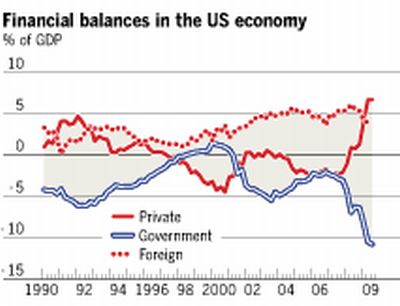
This massive swing occurred despite the Federal Reserve’s efforts to sustain lending and spending. Similar shifts occurred in other crisis-hit countries.
If these governments had decided to balance their budgets, as many conservatives demand, two possible outcomes can be envisaged: the plausible one is that we would now be in the Great Depression redux; the fanciful one is that, despite huge increases in taxation or vast cuts in spending, the private sector would have borrowed and spent as if no crisis at all had happened.
In other words, a massive fiscal tightening would actually expand the economy. This is to believe in magic.RE: This is to be believe in Rational expectations/The Efficient Market Theory
The Case For Higher Inflation
Olivier Blanchard, currently the chief economist at the IMF,
conclusion, central banks have been setting their inflation targets too low
I’m not that surprised that Olivier should think that; I am, however, somewhat surprised that the IMF is letting him say that under its auspices. In any case, I very much agree.
Paul Krugman, Febr 13 2010
“Why did no one see the crisis coming?”, Queen Elizabeth asked
A seminar at the British Academy tried to answer and the FT has taken up the discussion.
Robert Skidelsky, FT, August 5 2009
What we in the western world are about to learn is that there is no such thing as a Keynesian free lunch. Deficits did not “save” us half so much as monetary policy – zero interest rates plus quantitative easing – did.
First, the impact of government spending (the hallowed “multiplier”) has been much less than the proponents of stimulus hoped.
Second, there is a good deal of “leakage” from open economies in a globalised world.
Last, crucially, explosions of public debt incur bills that fall due much sooner than we expect
Niall Ferguson, FT February 10 2010
My new maxim, never to stand in the middle of a fight between Paul Krugman and Niall Ferguson
Fiscal multipliers are certainly fun.
If the fiscal multiplier is 0.5, we’re getting government projects at half price: the government project draws half its resources away from private-sector activity, but the other half is just soaking up slack
Tim Harford, FT July 20 2010
Highly recommended
If new-classical and new-Keynesian economics are both wrong, where do we go from here?
For 30 years, macroeconomists have been of two stripes: new-classical and new-Keynesian.
Neither has anything interesting to say about the current crisis.
Roger E.A. Farmer FT January 28, 2010
In new-classical and new-Keynesian economics, all unemployment is temporary and unemployed workers will quickly find jobs. According to the Keynes of The General Theory, very high unemployment can persist forever. Nobody has taken this Keynesian idea seriously in respectable academic circles since the 1950s
Samuelson’s interpretation of Keynes evolved into a modern incarnation - new-Keynesian economics.
According to new-Keynesians, recessions occur because some firms are stubbornly unwilling to lower their prices in the face of a fall in demand. Workers quit their jobs and choose to take a prolonged vacation. This is not the main theme of The General Theory. But the idea that some firms are slow to change prices is central to new-Keynesian economics. To explain why firms don’t change prices, the new-Keynesians assume that a firm must wait until it’s randomly chosen to be given the privilege to change its price. This option is facetiously referred to as a ‘visit from the Calvo fairy’ after a paper by economist Guillermo Calvo who first introduced the idea into macroeconomics. I don’t believe in fairies.
Many economists recognise that it is time for economics to change. But so far, theoretical economists are trotting out the same tired old solutions and empirical economists are a long way from a consensus on the magnitude of the multiplier.
Say the US government orders a $10bn (£6bn) aircraft carrier. You might assume the effect of this would be merely to pump $10bn into the US economy. Under the multiplier argument, the actual effect would be bigger. The shipbuilder takes on more employees and generates more profits; its workers spend more on consumer goods. Depending on the average consumer’s “propensity to consume”, this could raise total economic output by far more than the amount of public money actually injected.
If the $10bn increase caused total United States economic output to rise by $5bn, the multiplier would be 0.5; if it rose by $15bn, the multiplier would be 1.5.
Read more here
The policies that new-Keynesian economists are advocating stem from a theory that is built on sand. Before economists become policy advocates we need a theory that is internally consistent and that can explain the evidence from the Great Depression, the stagflation of the 1970s and the current economic collapse. The Keynes of The General Theory was right about the problem, but he was wrong about the solution. High unemployment can persist forever unless we do something about it. But fiscal policy is not the way to restore full employment.
If new-classical and new-Keynesian economics are both wrong, where do we go from here?
I answer these questions from a new perspective in two new books, Expectations Employment and Prices(written for academics) and How the Economy Works: Confidence Crashes and Self-Fulfilling Prophecies(written for the general public). I argue that the solution is not to replace private demand by public demand through massive fiscal stimulus programs. A more effective policy solution is to maintain and extend the programs of quantitative easing that have been engaged in by central banks throughout the world.
Roger E. A. Farmer's Macroeconomics Page
KeynesAtt stänga av respiratorn
Nu ska räddningspaketen avvecklas.
Första stegen blir strypta lån och högre räntor.
Anders Billing Fokus 22/1 2010
I Sverige har både Riksbanken och Riksgälden åtgärder som fortfarande är i funktion. Riksbanken har till exempel 80 miljarder kronor utlånade till ett antal svenska finansföretag (vilket är långt mindre än de flera hundra miljarder kronor som utlåningen låg på som mest under fjolåret).
Riksgälden har i sitt garantiprogram fortfarande sex banker och finansföretag anslutna (som Swedbank, SBAB och Volvofinans) som med hjälp av garantierna vid årsskiftet hade lånat mellan 250 och 300 miljarder kronor.
För det andra har centralbankerna spelat en aktiv roll genom framför allt räntesänkningar till historiskt låga nivåer under 1 procent, men också genom att tillföra pengar till marknaden via lån. Riksbanken har i dag strax under 300 miljarder i tre sådana lån, som löper ut i sommar och tidig höst.
Full textEven the normally sober Martin Wolf has fallen for this line (FT, December 16 2009). The pre-crisis UK economy, he says, was a “bubble economy”. The bubble made UK output seem larger than it actually was!
Robert Skidelsky December 22 2009
This is old-fashioned Puritanism: the boom was the illusion, the slump is the return of reality.
The government must cut its spending now, because this is what “the markets” expect. These are the same markets that so wounded the banking system that it had to be rescued by the taxpayer. This is unacceptable. The duty of governments is to govern in the best interests of the people who elected them not of the City of London. If that means calling the bankers’ bluff, so be it.
Lars Calmfors har rätt
Det fanns en tid när detta budskap kunde framföras:
"Svenskt Näringsliv avstyrker det föreslagna finanspolitiska rådet. Det finns inget behov för ett sådant eftersom vi anser att aktiv stabiliseringspolitik inte skall bedrivas."
Jag tycker det är skriande uppenbart att räntan världen över är för låg och att en större del av stimulanserna borde ske via finanspolitiken. Finanspolitiska Rådets chef Lars Calmfors är inne på liknande tankar:
- Lars Calmfors budskap är: Riksbanken måste agera. Annars hotar en bolånebubbla
The Great Moderation
The emotional markets hypothesis and Greek bonds
Gillian Tett, FT April 9 2010
The average British, German or American fund investors might have seen some market shocks in their lives. Just think of the 2001 internet crash or 1997 Asian crisis. But these prior shocks tended to be short-lived, relatively contained, and – crucially – did not threaten to bring down the entire system.
Instead, in the decade before 2007 the macro-economic climate appeared to be so utterly benign and stable that economists dubbed it the “Great Moderation”. Investors were so confident – or complacent – that this “moderation” would last, that they kept borrowing more and more, and accepting lower returns for the same risk.
The efficient-markets hypothesis
Paul Krugman in The Economist
Olivier Blanchard, the IMF’s chief economist called for several bold innovations.
Central banks should raise their inflation targets—perhaps to 4% from the standard 2% or so.
The Economist print Feb 18th 2010
Hyman Minsky, points out that stability leads to instability.
The longer a given condition or trend persists (and the more comfortable we get with it), the more dramatic the correction will be when the trend fails.
The problem with long-term macroeconomic stability is that it tends to produce highly unstable financial arrangements. If we believe that tomorrow and next year will be the same as last week and last year, we are more willing to add debt or postpone savings for current consumption.
Thus, says Minsky, the longer the period of stability, the higher the potential risk for even greater instability when market participants must change their behavior.
John Mauldin 26/3 2010
The Great Stabilisation
The Economist print Dec 17th 2009
It has become known as the “Great Recession”, the year in which the global economy suffered its deepest slump since the second world war. But an equally apt name would be the “Great Stabilisation”. For 2009 was extraordinary not just for how output fell, but for how a catastrophe was averted.
Twelve months ago, the panic sown by the bankruptcy of Lehman Brothers had pushed financial markets close to collapse. Global economic activity, from industrial production to foreign trade, was falling faster than in the early 1930s. This time, though, the decline was stemmed within months.
Full textWhy have markets reached their exposed position?
The answer is that success breeds excess.
This is the argument of a fascinating new paper from William White, economic adviser to the Bank for International Settlements.
Martin Wolf, Financial Times 24/5 2006
Was inflation sown in moderation?
"The Great Inflation and Its Aftermath", By Robert Samuelson
Review by Clive Crook, Financial Times December 14 2008
Did inflation targeting fail?
Central banks have mostly escaped blame for the crisis.
How can it have gone so wrong?
Martin Wolf, Financial Times, May 5 2009
Just over five years ago, Ben Bernanke, now chairman of the Federal Reserve,
gave a speech on the “Great Moderation”
Read more here
Recession? What Recession?
Talk about a recession from a very small group of people need to be balanced
against the fact that no major strategist is predicting a recession.
This "great moderation" of the economy has been explained many ways
Bob Pisani, CNBC 24 Aug 2007
'Prophets of doom' will be right in the end
Rolf Englund, Financial Times, June 5 2007
Mot bakgrund av den kraftigaste recessionen i världsekonomin sedan andra världskriget finns det anledning att se över om den politik som centralbanker bedriver kan utformas för att bättre kunna främja en balanserad ekonomisk utveckling.
Vice riksbankschef Karolina Ekholm 2009-12-04
Om hushållens upplåning fortsätter att öka med 8 procent är det inte riktigt hållbart", säger SEB:s chefsekonom Robert Bergqvist.
Det är Statistiska centralbyråns, SCB:s, senaste finansmarknadsstatistik som ser ut som om Riksbanken misslyckats totalt i sin räntepolitik.
Tanken var ju att garantera företagen billiga lån för att få igång investeringarna och skapa nya jobb.
DI 27/10 2009
Hushållens samlade skulder uppgick i september till 2.274 miljarder kronor varav 1.508 miljarder var bostadslån.
Villaägarna - Roten till allt ont?
Idag är John Maynard Keynes mer relevant än någonsin, skriver Krugman bland annat. Han beskriver världsdepressionen i början av 30-talet som en efterfrågekris:
”Det som satte stopp för trettiotalsdepressionen i USA var ett massivt underskottfinansierat program för offentliga arbeten som kallas andra världskriget”.
Carl Johan Gardell, Understreckare SvD 13 augusti 2009
Multiplying multipliers
Mark Thoma, Menzie Chinn, and The Economist all have posts on the question of the size of the fiscal multiplier.
Paul Kruman, October 1, 2009
This piece by Ilzetzki et alis interesting, and offers a wide range of multipliers depending on a country’s situation.
The question for the United States is which estimate is most relevant.
The US Job Numbers for September
263,000 more jobs lost in September, and unemployment now at 9.8 percent
The only reason the numbers don't look worse is that 571,000 workers dropped out of the labor force.
Remember that the economy needs about 125,000 new jobs every month just to keep up with a growing population.
Robert Reich 2/10 2009
Why the Dow is Hitting 10,000 When Consumers Can't Buy And Business Cries "Socialism"
Robert Reich 22/9 2009
The explanation is simple. The great consumer retreat from the market is being offset by government’s advance into the market. Consumer debt is way down from its peak in 2006; government debt is way up. Consumer spending is down, government spending is up. Why have new housing starts begun? Because the Fed is buying up Fannie and Freddie’s paper, and government-owned Fannie and Freddie are now just about the only mortgage games remaining in play.
Tidigare riksbankschefen Lars EO Svensson har nyligen argumenterat för att en lägre ränta i själva verket skulle ge lägre risker
men det resonemanget gav inte Stefan Ingves mycket för.
– Blir det billigare att låna så lånar man mer.
SvD Näringsliv, 5 september 2013
Lars EO Svensson:
En lägre ränta hade lett till lägre skuldkvot, inte högre.
Det beror på att en lägre ränta ökar nämnaren (nominell disponibel inkomst) snabbare än täljaren (nominella skulder).
Då faller kvoten.
Enligt Riksbankens prognoser kommer reporäntan ligga kvar på låga 1 procent fram till slutet av 2014.
Men nu varnar IMF för en svensk bostadsbubbla och rekommenderar att det införs regler mot amorteringsfria lån.
SvD Näringsliv 5 september 2013
Bostadsrättslägenhet. Välplanerad 4,5:a med vardagsrum och renoverat kök i öppen planlösning.
Perfekta bostaden för barnfamiljen. 5.200.000 kr
Lars E O Svensson anses vara en av världens ledande akademiker inom området penningpolitik.
Men hans insatser i riksbanksdirektionen för tankarna till en kapten som slaviskt följer sitt sjökort, även om fartyget kört på ett isberg.
Peter Wolodarski 2009-12-27
Det var en sak att sänka räntan under det akuta krisläget för att avvärja en depression. Men nu när ekonomin börjat återhämta sig bidrar nollräntan bara till att elda på bostadsrallyt. Det är att upprepa de allvarliga misstag som Alan Greenspan begick under flera år på 00-talet – och som bäddade för finanskrisen och senare tvingade fram Ben Bernankes räddningsinsats.
Den som tror att Sverige följer samma ekonomiska tyngdlagar som länder som USA, Storbritannien och Spanien bör förbereda sig på att det smärtsamma prisfallet på bostäder kommer, kanske till och med under 2010.
Man har först en fast växelkurs som förhindrar åtstramningar av ekonomin under högkonjunktur.
Och sedan har man fast växelkurs som förhindrar stimulans.
Det hade man under den tid som Lars Svensson var rådgivare åt Bengt Dennis på Riksbanken
och under den tid som Kjell-Olof Feldt, nu ordförande i Riksbanksfullmäktige, var finansminister.
Det var då som grunden för sammanbrottet lades.
Rolf Englund på Nationalekonomiska Föreningen 1995
RE: Njaa, hur är det med ECB?
Vice riksbankschef Lars E O Svensson om vilka lärdomar man kan dra av finanskrisen och inflationsmålspolitiken.
Han inleder med att konstatera att alla centralbanker med inflationsmål har detta som ett flexibelt mål som också går ut på att stabilisera realekonomin.
Detta till skillnad mot en strikt inflationsmålspolitik där enbart inflationen skall stabiliseras.
Danne Nordling 25/9 2009
LEOS redogör för sin syn på varför det blev finanskris. Det hade inte mycket med penningpolitiken att göra.
Full text hos Danne med länk till Svensson
The primary objective of the ECB’s monetary policy is to maintain price stability.
The ECB aims at inflation rates of below, but close to, 2% over the medium term.
"To maintain price stability is the primary objective of the Eurosystem and of the single monetary policy for which it is responsible. This is laid down in the Treaty establishing the European Community, Article 105 (1).
"Without prejudice to the objective of price stability (kurs här)", the Eurosystem will also "support the general economic policies in the Community with a view to contributing to the achievement of the objectives of the Community". These include a "high level of employment" and "sustainable and non-inflationary growth".
Read more at ECB
Asset price bubbles and Central Bank Policy - Alan Greenspan
U.S. Economy Lost 216,000 Jobs in August
after falling by a revised 276,000 in July and 463,000 in June.
Total loss of jobs since the recession began in December 2007 - 6.9 million.
(Remember, it takes 150,000 jobs per month (or so) simply to maintain
the employment rate, due to growth in the population.)
RGE Monitor 2009-09-07
It would, I believe, be an error of historic proportions if we were to repeat the mistakes of the 1930s
- when premature tightening prolonged the great depression
- or if we failed to learn the lessons from Japan’s experience of stagnation in the 1990s.
The Prime Minister Gordon Brown, speech to G20 Finance Ministers in London on 5 September 2009, ahead of the Pittsburgh Summit.
Både penningpolitiken och finanspolitiken bör vara expansiv under både 2009 och 2010.
Det sa finansminister Anders Borg vid en presskonferens på fredagen inför G20-mötet för finansministrar.
"Vad gäller ekonomin så står vi fortfarande i askan, och det är inte rätt tid att kalla tillbaka brandkåren.
Jag tycker det är rimligt att under både 2009 och 2010 behålla en expansiv penningpolitik och finanspolitik"
Anders Borg, DI 2009-09-04
Nästan alla väljer rörlig ränta
DI 2009-09-02
Fortsatt stor skillnad mellan den bundna tremånadersräntan och de längre bundna boräntorna bidrog till att 91 procent av låntagarna valde den kortaste bindningstiden i augusti. Det är den högsta andelen sedan mätningarna startade år 2000.
Det visar SBAB:s månadsstatistik över nyutlåningen till privatkunder.
How Did Economists Get It So Wrong?
“central problem of depression-prevention has been solved,” declared Robert Lucas of the University of Chicago
in his 2003 presidential address to the American Economic Association
Paul Kruman, New York Times Magazine, 2/9 2009
Betrakta kurvan härintill.
Det är inte den som brukar publiceras i samband med nyheter om tillväxten, men det är den som visar hur värdet av Sveriges varor och tjänster utvecklats i fasta priser sedan 1950.
Som synes har Sveriges välstånd ökat kraftigt.
Man kan här läsa ut att Sverige med det värsta scenariot, drygt sex procents negativ tillväxt i år,
kommer att backa till ungefär 2005 års nivå innan det vänder upp igen. Fattigare än så blir vi inte.
Anders Bolling, DN 2009-08-10
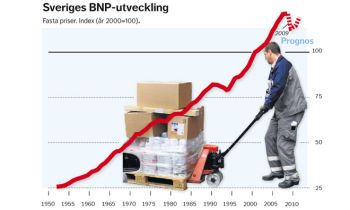
Samma förhållande gäller också andra länder eftersom den globala tillväxten varit enorm de senaste decennierna.
Den andra sidan av arbetslöshetsstatistiken är sysselsättningen. Där är vi ännu inte i närheten av krisåren på 1990-talet. Under åren 1990–1993 minskade sysselsättningen med hisnande 600 000 personer – från en nivå bra mycket lägre än den vi vant oss vid på senare år. Efter 1997 har sysselsättningen ökat kontinuerligt fram till toppåret 2008. Just nu är andelen sysselsatta vuxna nere på nivån i slutet av 2006.
Kommentar av Rolf Englund
Jaha, och jag som har läst så många gånger att det började gå utför för Sverige runt 1970......
Snacket om Eftersläpningen
Roosevelts New Deal på 30-talet gick ut på att med höjda inkomstskatter och utgiftsminskningar få balans i budgeten, som till slut uppnåddes 1938.
Då bröts uppgången och produktionen sjönk.
Först när balansmålet övergavs kunde ekonomin expandera tillräckligt mycket.
Danne Nordling, 20/2 2009
Arbetslösheten fortsätter att öka men det ekonomiska läget har blivit "ett par snäpp bättre".
Det finns därför ett visst utrymme för satsningar i höstens budget.
Anders Borg, E24 2009-08-06
Huru tänker Anders Borg?
Rolf Englund 2009-08-12
Regeringen har hållit hårt i pengarna under krisen.
Belöningen kan komma som sänkt skatt under valåret 2010.
SvD-ledare 11 augusti 2009
Visst är det förståeligt att kommuner och landsting önskar mer resurser, men det är näppeligen där som arbetslösheten väntas stiga mest. Tvärt om, det är snarare den sektor som klarar sig lindrigast, åtminstone enligt Arbetsförmedlingens beräkningar. Inom industrin räknar man med att strax över 60000 personer förlorar jobbet både innevarande år och nästa, inom den privata tjänstesektorn mellan 30000 och 40000 både detta och nästa år. Inom offentlig sektor handlar det om strax under 10000 personer 2009 och 15000 personer 2010.
Det finns anledning att se över tillskotten till landsting och kommuner, men skälen att satsa på skattesänkningar för det privata näringslivet torde vara större inte minst då arbetslinjen hävdas.
Teorin om automatiska stabilisatorer förutsätter att kommunerna inte skall avskeda eller höja skatten.
Därför måste staten stabilisera kommunerna.
Men detta tycks inte vara motivet för att nu ge extra pengar till kommunerna.
Man kan dela in stabiliseringspolitiken i tre kategorier: automatisk, reaktiv och proaktiv.
Danne Nordling 11/8 2009
On a visit to the London School of Economics last November, the Queen asked why no one saw the financial crisis coming.
For if people with enough authority and influence had foreseen it, some preventive action would have been taken and either the crisis would not have occurred, or it would at least have taken a different form.
Samuel Brittan, FT, August 6 2009
Hur vi en dag ska ta oss från lågränteträsket till en lite mer sund räntesättning förstår jag inte.
Det gör ingen annan heller och det börjar väl bli några av oss som undrar hur exit-strategin bland
”stora tänkare” som Ben Bernanke eller Lars E O Svensson egentligen ser ut.
Pekka Kääntä, 2 juli 2009
The efficient-markets hypothesis
Of all the economic bubbles that have been pricked, few have burst more spectacularly than the reputation of economics itself.
Paul Krugman argued that much of the past 30 years of macroeconomics was
“spectacularly useless at best, and positively harmful at worst.”
The Economist print July 16th 2009
Anders Borgs plan för balans i EU-ekonomin
Mats Hallgren, Svde24 2009-07-07
Our economy’s lights, if not switched off in a rehash of the 1930s Depression, have certainly been dimmed in a 21st century version likely to be labelled the Great Recession.
McHouses, McHummers, and McFlatscreens, all financed with excessive amounts of McCredit created under the mistaken assumption that the asset prices securitising them could never go down.
There is a developing optimism that we can go back to the lifestyle of yesteryear.
Forecasts based on econometric models inevitably miss these secular/structural breaks in historical patterns because it is impossible to quantify human behaviour
Bill Gross, July 2009
It could be that future generations of German politicians find ingenious ways around the balanced budget law.
Or that they find a two-thirds majority to overturn it.
Or that Mr Sarkozy or his successors follow Germany into a future of austerity.
But as long as one of those three events fails to happen, Germany may discover that unilateral fiscal rigour in a monetary union could prove extremely costly.
For the sustainability of the euro, you surely do not want to get into a position where a large member state has a rational economic reason to quit.
So if Germany and France really do what they both promise, you may as well start the egg timer.
Wolfgang Münchau, Financial Times June 28 2009
Den 2/6 2009 skrev Carl-Johan Westholm under rubriken "Politiskt inkorrekt av Reinfeldt och Borg"
ett hyllningsinlägg på sin blog Stateblind.
Rolf Englund blog 22/6 2009
The recovery from the Depression is often described as slow
because America did not return to full employment until after the outbreak of the second world war. But...
Christina Romer, chairwoman of Barack Obama's Council of Economic Advisers and a scholar of the Depression,
The Economist print June 18th 2009
What gave the Great Depression its name was a brutal decline over three years.
This time the world is applying the lessons taken from that event by John Maynard Keynes and Milton Friedman, the two most influential economists of the 20th century.
The policy response suggests that the disaster will not be repeated.
Martin Wolf, Financial Times, June 16 2009
Two economic historians, Barry Eichengreen of the University of California at Berkeley and Kevin O’Rourke of Trinity College, Dublin, have provided pictures worth more than a thousand words (see charts)
The bad news is that this recession fully matches the early part of the Great Depression. The good news is that the worst can still be averted.
‘A Tale of Two Depressions’, June 2009, www.voxeu.org/index.php?q=node/3421
Two opposing dangers arise. One is that the stimulus is withdrawn too soon, as happened in the 1930s and in Japan in the late 1990s. There will then be a relapse into recession, because the private sector is still unable, or unwilling, to spend.
The other danger is that stimulus is withdrawn too late. That would lead to a loss of confidence in monetary stability worsened by concerns over the sustainability of public debt, particularly in the US, the provider of the world’s key currency.
At the limit, soaring dollar prices of commodities and rising long-term interest rates on government bonds might put the US – and world economies – into a malign stagflation.
Contrary to some alarmists, I see no signs of such a panic today. But it might happen.
A significant decline in both consumption and investment will mean a recession in the US.
This conclusion is so obvious that the only question is why the markets are not forecasting it already.
Barry Eichengreen Financial Times 20/12 2004
What I hear more and more, both from bankers and from economists, is that the only way to end our financial crisis is through inflation.
Their argument is that high inflation would reduce the real level of debt, allowing indebted households and banks to deleverage faster and with less pain.
The advocates of such a strategy are not marginal and cranky academics. They include some of the most influential US economists.
Wolfgang Münchau, Financial Times, May 24 2009
Consider what would happen if the UK or US were to attempt Hungarian or Estonian style cuts.
There would be a huge outcry.
So rather than taking the axe to public spending, the British and American governments are borrowing madly,
with no sign of any credible long-term plan to balance the books.
Gideon Rachman, Financial Times, May 25 2009
Did inflation targeting fail?
Central banks have mostly escaped blame for the crisis.
How can it have gone so wrong? Also about The Taylor Rule
Martin Wolf, Financial Times, May 5 2009
MV=PQ
Okay, when you become a central banker, you are taken into a back room and they do a DNA change on you.
You are henceforth and forever genetically incapable of allowing deflation on your watch.
It becomes the first and foremost thought on your mind: deflation, we can't have it.
John Mauldin 24/4 2009
MV=PQ. This is an important equation, right up there with E=MC². M (money or the supply of money) times V (velocity -- which is how fast the money goes through the system -- if you have seven kids it goes faster than if you have one) is equal to P (the price of money in terms of inflation or deflation) times Q (roughly standing for the Quantity of production, or GDP)
So what happens is, if we increase the supply of money and velocity stays the same, and if GDP does not grow, that means we'll have inflation, because this equation always balances. But if you reduce velocity (which is happening today) and if you don't increase the supply of money, you are going to see deflation. We are watching, for reasons we'll get into in a minute, the velocity of money slow. People are getting nervous, they are not borrowing as much, either because they can't or the animal spirits that Keynes talked about are not quite there.
In the world that existed before the financial crisis, central bankers were triumphant.
They had defeated inflation and tamed the business cycle.
And they had developed a powerful intellectual consensus on how to do their job, summarised recently by David Blanchflower, a member of the Bank of England’s monetary policy committee, as “one tool, one target”.
The tool was the short-term interest rate, the target was price stability.
The Economist Apr 23rd 2009
This minimalist formula fitted the laissez-faire temper of the times. A growing array of financial markets could price risk and allocate credit efficiently. Central bankers had merely to calibrate their interest-rate tools and all other markets would automatically adjust. Central banks still cared about financial stability and full employment, but could argue these were best served by stabilising prices—without, if you please, interference from politicians.
The financial crisis has upended all that.
The business cycle was supposedly subdued, yet the world is in the deepest recession since the 1930s. Deflation has become a more dangerous enemy than inflation; with interest rates in many countries at or close to zero, central banks have had to reach for other tools.
Folkpartiets ekonomiske talesman Carl B Hamilton säger nej tack till en kraftigt expansiv politik
i ett läge utan säker internationell uppgång i sikte.
DN/TT 31/3 2009
"Att i dag gå ut hårt med ökade offentliga utgifter för att motverka krisen är som att spänna upp en brygga över ett vattendrag med okänd bredd och utan visshet om var andra stranden befinner sig", skriver han i ett pressmeddelande.
Hamilton jämför med 1970-talet då den borgerliga regeringen körde i diket med en sådan politik och han slår fast att detta inte kommer att hända igen.
Carl Bildt berättar:
I det europeiska samarbetet har under dessa decennier diskuterats vad som kunde göras för att undvika en för den ekonomiska utvecklingen skadlig turbulens på valutamarknaderna.
Det första försöket till stabilitet var den s.k. valutaormen kring den västtyska D-marken som Sverige under några år försökte att vara en del av, men som vi misslyckades att klara eftersom vi tillät kostnader att skena iväg långt mycket snabbare än i den västtyska ekonomin.
1977 tvingades vi (RE: Gösta Bohman, Carl Bildt m fl), som ett resultat av den s.k. överbryggningspolitiken under mandatperioden mellan 1973 och 1976, att ge upp det försöket.
Ur Carl Bildts veckobrev v1/2002
Anders Ferm berättar:
Jag var med när överbryggningspolitiken tog form, jag inbillar mig det i varje fall.
Det var efter valet 1973 och man sade ”vad skall vi nu göra, snart är det val igen”.
Det var jämviktsriksdag och det höll nästan på att gå åt pipan.
En kväll satt jag hemma hos Allan Larsson, och han förklarade för mig att ”varje lågkonjunktur följs av en högkonjunktur”, och jag nickade och sade ”lysande tanke”.
Han fortsatte: ”Då gäller det, att företagen när högkonjunkturen kommer är rustade, de skall ha varulager som de kan sälja av och de skall ha produktionskapaciteten intakt”.
Jag tyckte att det var briljant, att ingen hade tänkt på det förr!
Att efter en lågkonjunktur kommer alltid en högkonjunktur, det är klart att man skall överbrygga den,
och alla grep efter det där.
Samtal med Johan Norberg
Varför blev det finanskris?
Var det girigheten som löpte amok?
Den osunda kulturen före finanskrisen hade aldrig uppstått
om det inte varit för alla politiska misslyckanden.
PJ Anders Linder, SvD 29 mars 2009
Vi befinner oss mitt i den största ekonomiska nedgången på 80 år,
för första gången i världshistorien har vi en global kris.
Följderna kan bli synnerligen stora och kostsamma,
men det verkar inte ha utlöst någon nämnvärd kreativitet bland våra ledare.
Kristina Persson, Global Utmaning 17/3 2009
Trots att EUs ekonomier sammantaget har starkare finanser än den amerikanska finns inga stora och samordnade stimulanspaket på väg. Därmed kommer inte heller den amerikanska stimulansen att få tillräckligt bett.
Sverige hör till de länder som drabbas värst. Inte för att vi har en dåligt skött ekonomi, utan därför att vi är extremt exportberoende. ändå talar vår statsminister om att vi bör försöka uppnå budgetbalans! Som om det vore möjligt och lämpligt i dagens läge.
- Most mainstream macroeconomic theoretical innovations since the 1970s
(the New Classical rational expectations revolution associated with such names as Robert E. Lucas Jr., Edward Prescott, Thomas Sargent, Robert Barro etc, and the New Keynesian theorizing of Michael Woodford and many others)
have turned out to be self-referential, inward-looking distractions at best.
Rolf Englund agreeing with Willem Buiter, blogging at Maverecon, 5/2 2009
Bush orsakade krisen genom feltajming
Destabiliserande tajming av både sänkta skatter och räntor är den triviala förklaringen.
Bush förde expansiv finanspolitik i en högkonjunktur.
Danne Nordling, 13/2 2009
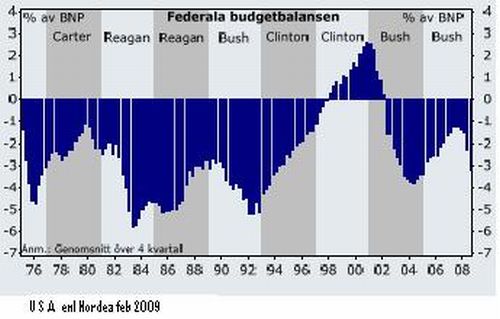
Kommentar av Rolf Englund:
Observera de stora budgetunderskotten under Reagan.
Talet om Reagans skattesänkningar som "Supply-Side" är struntprat.
Reagan fick fart på ekonomin genom hederlig Keynesiansk politik.
in almost every respect it is doing significantly better than expected.
It is impressive.
Carl Bildt blog 6/12 2005
The biggest political story of 2008 is getting little coverage.
It involves the collapse of assumptions that have dominated our economic debate for three decades.
Since the Reagan years, free-market cliches have passed for sophisticated economic analysis.
E. J. Dionne Jr. Washington Post, July 11, 2008
CNN uppfinner det Kenyesianska hjulet på nytt
Saving more and cutting debt might sound like a good plan to deal with the recession.
But if everyone does that, it'll only make matters worse.
Chris Isidore, CNNMoney.com senior writer, February 12, 2009
The statement that systemic breakdowns are surprisingly rare
in the free-wheeling Anglo-Saxon model is false.
Martin Wolf February 9, 2009
This is a glorious moment to be an economist
Now we call for trillion dollar stimulus plans on the basis of little more than citing John Maynard Keynes
Benn Steil, Financial Times, February 5 2009
Finally, there is inflation.
If central banks and governments are aggressive enough, they can generate inflation, which will lower the debt burden.
But they will imperil – if not terminate – the experiment with unbacked fiat (or man-made) money that started in 1971.
Martin Wolf, Financial Times January 27 2009
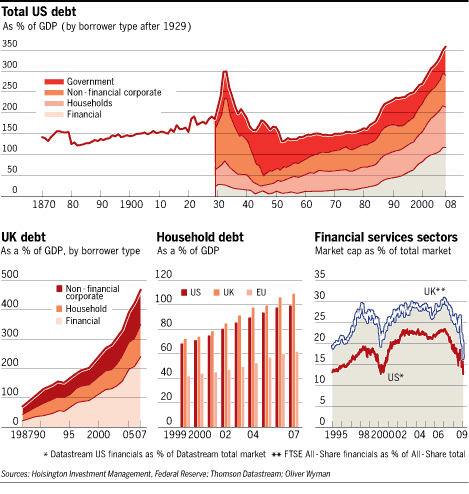
The ratio of US public and private debt to gross domestic product reached 358 per cent in the third quarter of 2008. This was much the highest in US history
Nearly all of this debt is private. That reached an all-time high of 294 per cent of GDP in 2007, a rise of 105 percentage points over the previous decade.
The same thing happened to the UK, on a yet more impressive scale.
This has been a gigantic debt and credit expansion.
Once such asset bubbles burst, it becomes hard to find borrowers and lenders who are either willing or creditworthy. The over-indebted start paying down their debts, instead, as now. Desired savings also soar. Realised savings may not rise, however: incomes may collapse, instead. This is what John Maynard Keynes called “the paradox of thrift”.
The result will be a slump caused by balance sheet collapse rather than attempts to control high inflation.
Some recommend a “liquidation”. A chain of bankruptcy would indeed eliminate a debt overhang, as happened in the 1930s. But, with much of the economy enmeshed in bankruptcy and the financial sector imploding, a depression would result. To choose that option must be insane.
An opposite approach is to sustain existing levels of debt, by slashing its cost to borrowers and trying to grow out of it over many years. This is what current monetary policies seek to achieve. It is a good idea, however unpleasant to creditors. But this would not generate much additional borrowing or fresh spending; it would not stop the indebted from trying to lower their debt; and it would not restore the financial sector to health.
Finally, there is inflation. If central banks and governments are aggressive enough, they can generate inflation, which will lower the debt burden. But they will imperil – if not terminate – the experiment with unbacked fiat (or man-made) money that started in 1971.
I förrgår fick Barack Obama stöd för ett stort stimulanspaket i representanthuset.
Priset för att Slösa under 2009 är att Spara under resten tiden i Vita huset.
PJ Anders Linder, SvD 30 januari 2009
Sverige har drabbats av finansiell oro och lågkonjunktur därför att kinesiska handelsöverskott och låga amerikanska räntor har underblåst en orimlig allt nu-kultur och absurda lånevanor i USA. Vad skulle LO-makt över näringslivet eller miljarder till vindkraften kunna göra åt det?
I själva verket läggs i dessa dagar grunden till många år av stram finanspolitik. Sverige upplever just nu värdet av starka statsfinanser och förhoppningsvis finns 1990-talet i tillräckligt färskt minne för att staten ska hålla i pengarna något så när även om det blir maktskifte 2010.
Och i vår omvärld kommer regeringar att tvingas hålla stenhårt i pengarna om man ska klara av den skuldsättning som nu byggs upp genom olika räddnings- och stimulanspaket. I förrgår fick Barack Obama stöd för ett stort stimulanspaket i representanthuset. Men priset för att vara president Slösa under 2009 är att vara president Spara under resten av sin tid i Vita huset.
Washington should be curbing its spending growth, not expanding it.
Larry Kudlow, 26 Jan 2009
As I wrote today, all of the proposed government spending is just a transfer of resources.
There’s no net growth impact.
Beträffande vägen ut ur krisen var den allmänna uppfattningen, såväl bland liberaler som konservativa,
att finanspolitiska stimulanser är nödvändiga, ju snabbare desto bättre.
Detta är en skarp omsvängning från gårdagens pessimism om finanspolitikens potential till dagens hopp om finanspolitiken som räddaren i nöden
Lars Jonung, Kolumn DNs ledarsida 29/1 2009
The battlelines are drawn.
On one side we have the Labour Government and the Liberal Democrats, the Bank of England, the US Federal Reserve Board and the vast majority of Keynesian economists in every country - plus Barack Obama.
On the other side, the Tory Opposition, the German Socialists, the European Central Bank, the Church of England and the vast majority of Marxist economists in every country - plus the British public.
The question, of course, is what to do about the recession.
Specifically whether the way out is “to spend, spend, spend or to save, save, save” - as David Cameron has so clearly put it.
I believe, in line with the vast majority of non-socialist economists, that Mr Cameron's campaign for savings is completely wrong
Anatole Kaletsky, The Times January 8, 2008
How to stop the recession
Too much recent commentary has treated the current recession as if it were preordained and unstoppable. Recessions are not Acts of God.
What must policy-makers now do? The answer is that they must raise the growth rate of bank deposits in the hands of genuine non-bank agents, such as companies and households
Tim Congdon and Gordon Pepper, Daily Telegraph 07 Jan 2009
We know that the current driving force behind this downturn is “deleveraging”.
Overindebted households and undercapitalised banks are adjusting their balance sheets, building up savings in the first case and restricting lending in the latter.
There is no chance of a sustained economic recovery until that process is almost complete.
Wolfgang Münchau, Financial Times, December 28 2008
We should not try to avoid 1929. We have already failed.
The best we can do now is to avoid 1930, 1931 and 1932
What about the €200bn European Union stimulus package that was agreed in a watered-down form by EU leaders on Friday?
Unfortunately, it is a public relations exercise first and foremost, designed to dupe people into believing that the EU is finally doing something.
Wolfgang Münchau, Financial Times, December 14 2008
How to prevent the Great Depression of 2009
The global financial system is undergoing a meltdown that has not been seen since the 1930s and
nobody seems to know what to do about it.
How did we get to this point and how can we move forward?
Roger E.A Farmer, Financial Times December 30, 2008
Med en inriktning på finanspolitik måste regeringen vidta ofinansierade skattesänkningar och utgiftshöjningar. Detta strider naturligtvis känslomässigt mot alla amatörekonomers sätt att göra analogier mellan ett hushålls och statens ekonomi. Utan ekonomisk utbildning tror man att staten måste agera på samma sätt som hushållen.
Det är detta fenomen som också bidrar till att man kan ställa upp en teori om "ricardiansk ekvivalens".
Om hushållen faktiskt tror att statens budgetunderskott bidrar till att pensioner, a-kassa, sjukförsäkring, barnbidrag och liknande måste skaras ned eller avskaffas blir det ekonomiskt rationellt för den enskilde att drastiskt öka sitt sparande. Då blir finanspolitiska åtgärder verkningslösa eller rentav kontraproduktiva.
Anders Borg har hänvisat till denna effekt som förklaring till att han inte velat ta till kraftiga motåtgärder.
Danne Nordling 6/12 2008
Regeringen bör ge en generell garanti för bankernas verksamhet
Dessutom behövs insatser på 50-60 miljarder kronor, utöver regeringens budget
Pengarna måste användas så att man når största möjliga sysselsättningseffekt
Därför bör man skjuta till mer pengar hos kommuner och landsting
Assar Lindbeck i DN 3/12 2008
Att göra något i närheten av det Svenskt Näringsliv talar om är ju helt ansvarslöst.
Det skulle leda till att människor inte kände något förtroende för de offentliga finanserna.
Det privata sparandet skulle öka och i slutändan skulle den expansiva effekten utebli
Anders Borg i Fokus 28/11 2008, reporter Anders Jonson
Svenskt Näringsliv gör helt om, dock utan att göra en pudel
Nu behövs en aktiv statlig finanspolitik där regeringen släpper loss reformer och offentliga jobb för cirka 50 miljarder det närmaste året.
Svenskt Näringslivs verkställande direktör Urban Bäckström och chefsekonom Stefan Fölster, DN Debatt 16/11 2008
Skall Urban Bäckström och Svenskt Näringsliv tvingas göra en pudel?
Rolf Englund blog 2008-10-26
Svenskt Näringsliv: Vi anser att aktiv stabiliseringspolitik inte skall bedrivas.
Remissvar på SOU 2002:16, Stabiliseringspolitik i valutaunionen
"I'm a market-oriented guy, but not when I'm faced with the prospect of a global meltdown,"
President George W. Bush, 14 Nov 2008
Rearranging the Deckchairs on the Titanic?
Silvia Wadhwa, CNBC. 6 Oct 2008
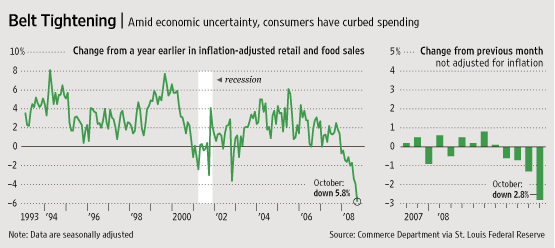
U.S. retail sales dropped by 2.8% in October -- the largest monthly drop since records began in 1992.
Sales have fallen for four straight months, a longer streak than during the 2001 recession, with declines worsening each month.
As consumers pull back, the threat rises of a deep and prolonged recession.
Wall Street Journal 15/11 2008
New figures coming out of the US economy confirms that in almost every respect it is doing significantly better than expected. It is impressive. Carl Bildt blog 6/12 2005
It is disturbing that the only time US had a near zero deficit was in 1992 and the dollar was low against the swedish krona.
Rolf Englund, maj 2001
The main object of Alistair Darling, the British chancellor, is to inject more spending power into the British economy by a mixture of tax cuts and spending increases
The most frequent objection is to ask: “Where will the money come from?”
The short answer is: the Bank of England printing works in Debden.
Samuel Brittan, Financial Times, November 20 2008
Det är stabiliseringspolitikens kris vi ser idag.
Det är förhoppningen att regeringarna har sådana kraftfulla verktyg, att om ekonomin börjar sladda skall det gå att sätta in motåtgärder så att vi slipper krascha i diket, som nu har gäckats.
Denna föreställning är fel - alla vackra teorier till trots.
Danne Nordling 18/11 2008
Den allt djupare lågkonjunkturen bör mötas med stimulanser från så många håll som möjligt.
Växande underskott i ländernas statsfinanser måste accepteras tills världsekonomin återhämtar sig.
Däremot måste varje land självt få avgöra i vilken omfattning.
DN, huvudledare 15/11 2008
Det bästa västvärlden kan göra för u-länderna är att så snabbt som möjligt få slut på recessionen
för detta krävs massiv keynesiansk efterfrågestimulans, menar David Weil.
Det är svårt att ge något annat recept i dag.
Men när krisen är över bör Keynes åter få vila och underskotten saneras.
Ragnar Roos, signerat, DNs ledarsida 15/11 2008
The Bank of England’s extraordinary 1.5 percentage point interest rate cut to 3 per cent is
scary, justified and irrelevant.
Fiscal policy is our most potent instrument
Wolfgang Münchau, Financial Times, November 9 2008
What matters to many companies is the London interbank offered rate (Libor), or the Euribor in the eurozone. Large companies often fund their short-term liquidity needs on the commercial paper market. The US Federal Reserve has cut the Fed funds rate from 5.25 per cent in September 2007 to 1 per cent recently. But 90-day commercial paper rates were a little over 5 per cent when the crisis started in August 2007 and still close to 5 per cent last month. Only recently have they fallen to 3.3 per cent, and only after the Fed started to intervene in this market directly.
Perhaps an even bigger problem than the persistence of high interest rates is the fall in credit volumes.
Banks have been cutting down on all types of loans, for mortgages, consumer credit and businesses.
Interest rate cuts have no short-term effect on volumes.
As Stephen Cecchetti, chief economist of the Bank for International Settlements, once reminded us,
good fiscal stimuli are timely, targeted, and temporary.
Another important element is their size. They have to be sufficiently large for impact, but not large enough to risk deterioration in a country’s solvency.
Fiscal policy, more than monetary policy, will determine how and when this crisis will be resolved.
More by Wolfgang Munchau at IntCom
Det var inte bara Wall Streets finansföretag som byggde ekonomiska korthus med hjälp av högbelåning under de år då likviditeten flödade och räntorna var låga.
även de amerikanska hushållen konsumerade som om det inte fanns någon morgondag genom att låna på villan och med ständigt kontokortskrediter trots att reallönerna knappast ökade alls.
Det var då, det.
Lars-Georg Bergkvist, SvD 9/11 2008
Kina presenterade på söndagen ett enormt stimulanspaket för att dämpa effekterna av finanskrisen
Det kinesiska stimulanspaket är värt omkring 4 650 miljarder kronor fram till 2010.
SvD E24 2008-11-09
Svenskt Näringsliv: Vi anser att aktiv stabiliseringspolitik inte skall bedrivas.
Skall Urban Bäckström och Svenskt Näringsliv tvingas göra en pudel?
Rolf Englund blog 2008-10-26
How can the next administration reconcile its longer-term goals for the economy with the imperatives of the economic crisis?
Getting this right will not be easy, but is the key to success or failure in Mr Obama’s presidency.
Clive Crook, Financial Times, November 9 2008
Mr Obama will most likely keep his promise to cut most households’ taxes (relative to what current law provides, plus some extra relief for the working poor). This is helpful for the economy in the short term and he will regard it as a political necessity in any case. Yet the fact remains that this will undermine the long-term fiscal position. Care must be taken not to let the rest of any stimulus compound the problem.
With this in mind, the next fiscal plan should lean heavily on temporary spending. More generous unemployment assistance scores highest. This mostly feeds through to consumption, and automatically does so at the right time. It helps the people who most need help. Later, when unemployment falls, the demands on the public purse fall with it.
Assuming this recession may be prolonged, infrastructure spending also scores well. It directly supports low-wage employment in the hard-hit construction industry. So long as the projects are desirable on their merits, they are valuable as public investments. And once you have built a bridge (preferably to somewhere), you do not have to keep building it. Turning off the tap is relatively easy.
Svenskt Näringsliv: Vi anser att aktiv stabiliseringspolitik inte skall bedrivas.
Skall Urban Bäckström och Svenskt Näringsliv tvingas göra en pudel?
Rolf Englund blog 2008-10-26
The big difference in diagnosis is between those who still think in terms of a conventional business cycle with output fluctuating in familiar snakelike fashion around a stable trend given by “supply side” factors, and those who believe that something more apocalyptic has happened.
Samuel Brittan, Financial Times, November 6 2008
Higlhly recommended
USA:s ekonomi befinner sig i en brydsam situation.
Frågan är nu vad som skulle ha kunnat göras annorlunda vid 1930-talskrisen och som Obama därför borde satsa på idag.
Danne Nordling 6/11 2008
The U.S. economy is spiraling downward into recession and gargantuan budget deficits.
The Humpty Dumpty of the housing and consumer bubbles cannot be put back together, no matter how many Wall Street bailouts, liquidity injections or tax rebates are put in place.
A country that sustains zero or negative household saving rates for years and borrows heavily from abroad is bound to pay a heavy price, and that time has come for the United States.
Jeffrey Sachs, November 5, 2008
More pressing than discretionary fiscal action is getting the banks to lend.
This is why they have been helped, in the first place.
Unfortunately, their marginal cost of funds, plus required margins, is above rates they are expected to charge.
This is why sharp cuts in official intervention rates are vital.
Martin Wolf, Financial Times 30/10 2008
The best recipe for avoiding a global recession
Before our political leaders get too fancy remaking capitalism
they should co-ordinate macroeconomic policies to stop a steep global downturn
Jeffrey Sachs, Financial Times, October 27 2008
Stabiliseringspolitiken sköts i huvudsak av Riksbanken via prisstabilitetsmålet.
Finanspolitiken bidrar till makroekonomisk stabilitet genom de automatiska stabilisatorerna och
genom att skapa trovärdighet för att de offentliga finanserna är långsiktigt hållbara.
Prop. 2007/08:100, sidan 69
Jobbpolitik, räntepolitik och finanspolitik verkar vara de tre metoder som finns för att påverka den reala ekonomin vid en begynnande lågkonjunktur.
Räntesänkningar kan dock leda till stora obalanser på sikt. Och finanspolitiken kan leda till kontroversiella budgetunderskott.
Så vad göra?
Danne Nordling 3/11 2008
är jobbpolitik en adekvat åtgärd i en lågkonjunktur?
Att frågan ens kan ställas visar hur oklar den stabiliseringspolitiska teoribildningen blivit under de senaste åren.
Det borde vara ganska klart att en politik som ökar arbetsutbudet inte kan ha någon praktisk verkan i ett läge när problemet är för liten efterfrågan på arbetskraft.
Till skillnad från i de flesta andra länder förekommer i Sverige knappast några olika ekonomisk-politiska skolor utan det finns en stark - och skadlig - tendens att orientera sig mot samma åsikter.
På sjuttiotalet var alla keynesianer. Efter några års debatt svängde i stort sett hela ekonomkåren - och tongivande politiker och journalister - till att förorda en icke-ackomodationspolitik utan undantag ens i exceptionella krissituationer.
Lars Calmfors DN Debatt 26/11 1992
Och då sade jag till Göran Persson...
Till skillnad från keynesianerna satsar monetaristerna på en stabil politik - i stället för att gasa och bromsa vill man i onda och goda tider öka penningmängden i en lagom takt.
Enligt monetaristerna kan penningmängden öka både för fort och for långsamt.
Rolf Englund vid Nationalekonomiska föreningen den 18 januari 1995
The current crisis reminds us that, in a free economy, the price of the greatly improved long-term performance that only free economies can provide is an ineradicable economic cycle.
As John Maynard Keynes pointed out in the 1930s, the cause of the cycle is alternating moods of optimism and pessimism, and
its motor is credit, which enables optimism to determine economic activity.
Nigel Lawson. Time Magazine, October. 01, 2008
This basic error, born of folly, ignorance and greed, is the biggest cause of the mess we are now in. It was compounded by other factors. A system of remunerating bankers with fat bonuses based on the volume of business done, irrespective of the quality and future profitability of that business, did not help. A variation of Gresham's Law was also at play, with imprudent lending driving out prudent lending. This tends to occur as responsible institutions see their market share fall while those of irresponsible institutions rise, and decide to emulate the reckless practices they previously eschewed
Central bankers cannot escape censure, either. In his memoirs Alan Greenspan, former chairman of the U.S. Federal Reserve, writes: "I was aware that the loosening of mortgage credit terms for subprime borrowers increased financial risk, and that subsidized home-ownership initiatives distort market outcomes. But I believed then, as now, that the benefits of broadened home ownership are worth the risk."
For those of us who believe in free markets, these interventions are unpleasant.
Wall Street Journal editorial OCTOBER 15, 2008
Nyliberalerna tysta så det dånar
Det intellektuella civilkuraget hos den stora kader nyliberala ekonomer, som under årtionden hyllat USA:s ansvarslösa marknadsekonomi, imponerar inte.
Bo Rothstein, SvD Brännpunkt, 27 september 2008
Under den tid som den nu snarast helgonförklarade Kjell-Olof Feldt var finansminister grundlades den djupa kris för den svenska ekonomin som ännu inte är övervunnen. Tillsammans med sin rådgivare Klas Eklund och dåvarande riksbankschefen Bengt Dennis, blåste han, liksom sin brittiske kollega Nigel Lawson, på den inhemska ekonomin och tryggade därmed återvalet för sina regeringschefer Carlsson och Thatcher, varefter de avgick från sina finansministerposter och skrev uppmärksammade memoarer.
Rolf Englund, För Sunt Förnuft 1994-12-12
Om staten drar ned BNP med säg en procent, för att "spara pengar", så
kan staten inte i en lågkonjunktur öka BNP med en procent genom att
pytsa ut pengar i ekonomin.
Nils-Eric Sandberg 1/2 2007
Den främsta drivkraften bakom vår höga tillväxt är nedskrivningen av kronans värde.
Denna depreciering blev följden när valutaspekulanterna tvingade Riksbanken att överge den fasta kronkursen i november 1992.
Krisen skapade gigantiska budgetunderskott på 90-talet, en automatisk och önskvärd följd av de dåliga tiderna.
Lars Jonung, signerat, DN 7/9 2006
De automatiska stabilisatorerna har sina poänger.
En konjunkturkänslig budget kan göra att produktion och sysselsättning i ekonomin svänger mindre
Lars Heikensten och Klas Eklund, DN Debatt 4/7 2007
Lars Jonung har tillsammans med Klas Fregert skrivit en lärobok i Makroekonomi (Studentlitteratur)
som nyligen utkommit i en ny upplaga. Den är välmatad och pedagogisk och den fyller ett behov efter alla år när ekonomer glömt bort att utbud och efterfrågan – inte bara utbud – alltid utgjort basen för den nationalekonomiska vetenskapen.
Rolf Englund om SNS-boken Bank- och fastighetskrisen 1990-1993